

Going against the grain in managing assets
By sticking to a solid philosophy, Dimensional Fund Advisors today has garnered strong historical returns and a fiercely loyal following

Genevieve Cua
Singapore
US-BASED Dimensional Fund Advisors (DFA) has made its name swimming against the tide of conventional thinking in the asset management industry since its founding in 1981.
Today, key aspects of its core philosophy have become mainstream such as its insistence on low costs and its scepticism over active management's ability to outperform. More recently, factor-based investing, which it has always adhered to, has also gained traction.
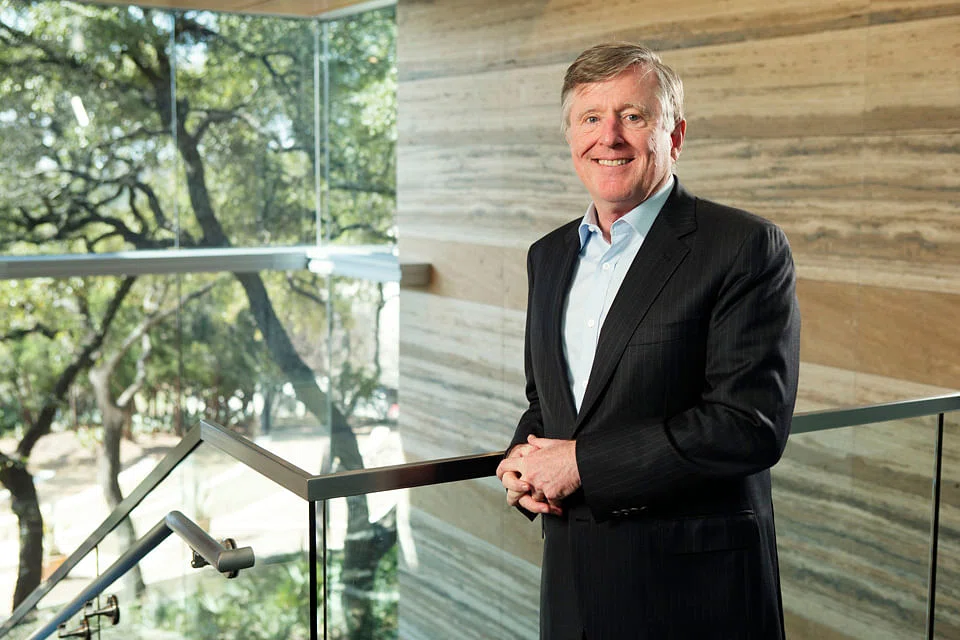
With 35 years in the business, DFA co-founder David Booth sees no reason to change the firm's approach to markets. After all, the firm has generated strong historical returns and inspired a fiercely loyal following - all this without marketing directly to individual savers.
One of DFA's core tenets is that macro factors such as interest rates, commodity prices and money flows are not forecastable.
Says Mr Booth: "The level of interest rates is largely outside our control... If I try to play the game of outguessing markets, I generate a lot of cost and stress. People are better off looking at the distribution of outcomes from any investment. The distribution of outcome will look in the future as it has in the past - around some mean and there will be variability.
"Then you decide the basic allocation you want - how much in stocks versus riskless assets and what types of stocks. And from then on you shouldn't have to make very many changes. In some ways, our investment philosophy parallels what most of us have as a personal philosophy. We don't make drastic changes to our personal philosophy as adults.''
He says the way the firm manages money today has remained largely the same, even though technology has made processes speedier and more efficient.
"When we started, interest rates were double digit; now we see negative rates. We've seen all kinds of markets. But having a robust philosophy means you shouldn't have to manage money particularly differently today than you did when rates were 15 per cent.''
He adds: "Markets go up and down. To induce people to take risk, they have to have an expectation of higher returns than if they invest in a riskless asset. The problem with individuals is being able to stay with the investment long term when markets go down.
"When you are in the middle of an earthquake you don't know if you are seeing a pre-quake to a big one, or that's all there is. People have a tendency to panic and get out at the wrong time. It's not so much about investing, but about investment counselling. I guess what's what we do pretty well.''
The firm raised US$90 million in its first year in 1981. Today, it manages US$445 billion in assets - all garnered strictly through "authorised'' advisers, who meet certain criteria and must attend a two-day "boot camp'' at Texas or California which they pay for.
In Singapore, DFA can be accessed through two financial advisory firms. One is GYC Financial Advisory which has a platform agreement with DFA and invests proprietary money in DFA strategies. The other is Providend which has registered eight DFA funds for distribution, and includes the funds in clients' portfolios.
Working through advisers may explain DFA's apparent ability to command sticky assets, even though individual investors are notoriously temperamental. In fact, it continued to attract inflows in the worst of times, even through pockets of underperformance. Between 2008 and 2012, DFA saw net inflows of US$34 billion, compared to an industry outflow of US$535 billion from equity funds. Since inception to end-September, the fund has beat the Russell 2000 Value index by 1.64 percentage points on an annualised basis.
DFA takes a largely passive approach to markets in the belief that markets are efficient and it is difficult for active management to beat the market. In its early days, this thinking was scoffed at. Index funds were already in the market then - John Bogle of Vanguard launched the first index fund based on the S&P500 in 1975.
But DFA set out to further refine the index fund. Its approach is formed through research by academics Eugene Fama and Kenneth French, who designed a three-factor model to explain the risks and returns of stocks. Basically, the model takes the basic capital asset pricing model and adds size and value to the risk factor. Based on this, small cap and value stocks are found to generate higher returns over the long term, but investors must be able to ride out the risk. Professor Fama, a Nobel laureate who developed the efficient market hypothesis, is a DFA director and serves on the investment policy committee. Professor French is also a director and co-chairs the investment policy committee.
By tilting the indexes towards value, small caps and profitability, DFA arguably pioneered the "smart beta'' or factor-based approach that is all the rage today. Smart beta funds are a departure from market capitalisation indexes, screening holdings for factors such as size, value or momentum. "We're a click away from index funds. We're basically passive in that we don't think we can find value that isn't already reflected in securities prices. But we think by making some adjustments on trading, we can add some value.''
Mr Booth says: "The idea of doing empirical research to try to answer questions is a relatively new field. It's only about 50 years old. If you can't test out your belief to support them with empirical research, then you are left with just beliefs. So empirical research is very important.
"On the equity side we know all the stocks. It's a question of how much weight to give the stocks in your portfolio. That's where empirical research comes in. We tend to invest more in small cap stocks than the market, more in lower priced stocks and those that satisfy certain profitability measures. We know based on all evidence about managers and markets that you want a well diversified low cost portfolio. Above and beyond that, we think you can take a few simple cuts to make a difference. We pretty much do that year in and out.''
Yet, the degree to which his belief in a low-cost passive approach has been embraced by the industry must be something of a surprise. Today the trend towards low cost vehicles seems unstoppable - assets in exchange-traded funds and products currently exceed US$3.4 trillion - helped by investor demand and regulation. DFA funds' expense ratios may be as low as 12 basis points.
"Thirty five years ago it was really a challenge to talk about these ideas. Journalists said - of course, you can beat the market; everyone knows that. You guys are crazy.
"Now when we speak to journalists, they say - what do you mean you can beat the market? There has been a huge change. You can debate our philosophy but what's crystal clear is that fees are coming down in the industry. For society as a whole, low-cost asset management has been hugely beneficial.
"If manager A makes more in the market, manager B makes less. That adds up to the market minus the cost of investment. It's simple arithmetic. Now your chances of getting a fair deal are much better than they were 35 years ago because you have so many low-cost alternatives. I'm an optimist. I like all of this.
"We're obviously beneficiaries; that's one reason I like it. But it also makes you feel good that in the long term, more and more will get a fairer deal than in the past.''






