

Hang on to your older tranche of Singapore Savings Bonds
The only scenario where a holder of the old March 2017 SSB can consider making the switch to the newer February 2018 SSB is if the holder has a very short one-year investment time horizon
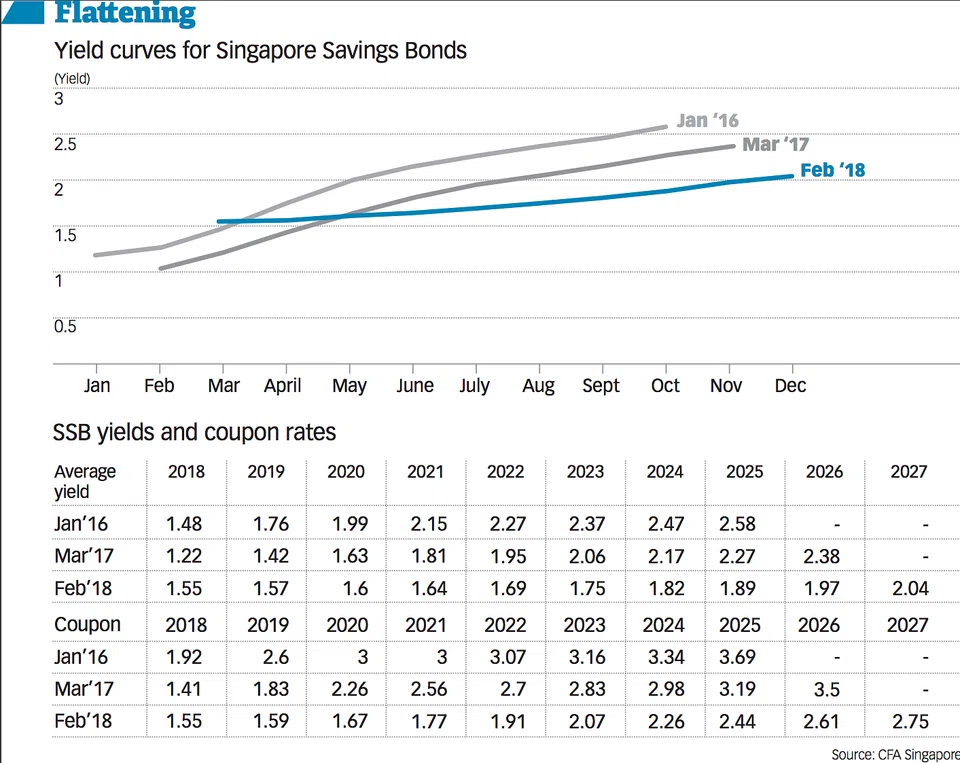
THE details of the next month's Singapore Savings Bonds (SSBs) were recently announced. In the announcement, the yield - based on the end-December Singapore Government Bonds (SGS) 10-year-yield-curve, and the coupon rate - the interest paid in the Nth year that the bond has been held, are shown in the table below.
What may have piqued investors' interest is that the coupon offered in the first year has risen to 1.55 per cent, the highest first year coupon since SSBs were introduced in October 2015.
As a quick recap, SSBs are a savings instrument available to retail investors. The returns mirror the yield on the SGS prevailing at the time of subscription, and depends on the period that the investor holds the bond. It pays an interest rate (called the coupon) corresponding to the year that the bond has been held.
The average of the coupons if the bond is held for N periods is the yield of the Nth-year bond at the time of subscription.
Reflecting the steady rise in short-term yields that we saw over 2017, the upcoming February 2018 tranche offers to pay higher interest rates in the earlier periods compared to previous tranches of SSBs. However, because of the flattening of the SGS yield curve, investors in the new SSB stand to receive lower interest in later years relative to older SSBs.
The graph below illustrates this point by comparing the yield curve of the new February 2018 SSB against the yield curves of the January 2016 and March 2017 SSBs. The January 2016 and March 2017 SSBs were selected because these instruments appear in the Save & Invest Portfolio Project that CFA Singapore has been running for the past two years. In this project, we manage three simulated portfolios for the regular Singapore retail investors using readily accessible instruments.
The graph clearly shows how interest rates have evolved in Singapore over the past three years. The yield curve experienced a parallel shift downwards from 2016 to 2017, which is a comparable fall in interest rates across all tenures, reflecting the lower interest rate environment over this period.
The latest yield curve however has flattened noticeably (shorter-term yield rising, but longer-term yield falling), mirroring a trend of flattening yield curves globally. This reflects the rise in short-term interest rates primarily driven by the three interest rates in the United States last year and the subsequent knock-on effect on short-term interest rates in Singapore, coupled with the fall in longer-term yields.
In fact, the average 10-year yield of the SSB has fallen from 2.58 per cent to 2.38 per cent to 2.04 per cent over these periods.
Investors who hold older tranches of SSBs and who have a shorter time horizon, may well be thinking whether it makes sense for them to switch from their existing SSBs to the new SSB for the additional coupon pickup.
The table below compares the coupon or interest paid against the calendar year that they are paid. Note this is just a general comparison based on the year of issue, and we have ignored the slight differences because of the different months of issuance.
The table clearly shows that the coupon of the new February 2018 SSB beats the March 2017 tranche only for the current year 2018.
So the only scenario where a holder of the old March 2017 SSB can consider making the switch to the newer February 2018 SSB is if the holder has a very short one-year investment time horizon.
And even then, the coupon pick-up is not really significant (just 14 basis points or 0.14 per cent, before factoring in the redemption and buying fees of S$2 each) and the holder must understand that he will be forgoing much higher coupons in later years should his investment time horizon changes.
Note that as redemption payments take about a week to settle, holders looking to make this switch also need to have fresh funds available to bridge the week-long difference between subscription and redemption (unless the redemption is make in the previous month).
Another observation from this analysis is that because of the step-up formula, holders of the older vintages of SSBs like the January 2016 tranche, are now starting to enjoy pretty decent coupon payments, more than compensating for the very low coupons in the initial periods. A common comment heard when SSBs were first launched, was the paltry coupons being paid in the early years.
With the fall in 10-year yields to 2.04 per cent, should investors put fresh funds into the new tranche? The average Singapore investor probably still holds a good amount of their portfolios in cash and fixed deposits.
Considering that most deposit rates are below 1.5 per cent and the new SSB tranche offers to pay 1.55 per cent in the first year, the SSB would seem a better alternative to deposits at the moment. The flexibility and relatively low cost of switching means that a holder can make the switch if a subsequent SSB tranche offers more attractive rates.
The application closes at 9 pm on Jan 26. But remember that there is a S$50,000 limit to the amount you can subscribe to, and there is a S$100,000 limit across all SSBs.






