

How to invest amid a global trade storm
Those looking to cut their exposure to US equities in the near term may want to consider China, Europe’s defence sector, or money market funds and short-duration bonds
DURING his re-election campaign, Donald Trump proposed universal tariffs of 10 to 20 per cent and a 60 per cent tariff on China. Many dismissed these as empty threats, doubting he would actually implement them.
However, not only has he followed through with a 10 per cent universal tariff on Liberation Day – since panned by some as Obliteration Day – he has also imposed reciprocal tariffs on around 60 countries, with rates reaching as high as 50 per cent. In fact, China now faces a cumulative tariff rate of 54 per cent, after factoring in earlier tariffs of 20 per cent.
“America First” policy set to curtail consumption and economic growth
It is understandable why Trump wants to reduce the US trade deficit and reindustrialise the country. Achieving this could potentially create more jobs for Americans, bolster supply-chain resiliency, and foster greater innovation. However, the pace at which he is trying to execute his agenda through aggressive tariffs will inevitably hurt US consumers and businesses.
Building domestic manufacturing capacity is a long-term endeavour. Even if US multinational companies decide to reshore some of their manufacturing plants today, it could take many years before those factories become fully operational. In the meantime, businesses will face rising import costs that will squeeze their profit margins, while US consumers will have little choice but to pay higher prices for goods.
Higher prices will likely lead to reduced demand, and with consumer spending accounting for nearly 70 per cent of US GDP, we could very well see a recession if tariffs remain at the current high levels for an extended period. Retaliatory tariffs will also make US exports less attractive, and the resulting drop in demand could lead to layoffs.
The constant fluctuation in Trump’s trade policies also mean companies are likely to delay any form of investments until there is greater clarity, further adding downward pressure on GDP growth.
Be strategic when buying the dip
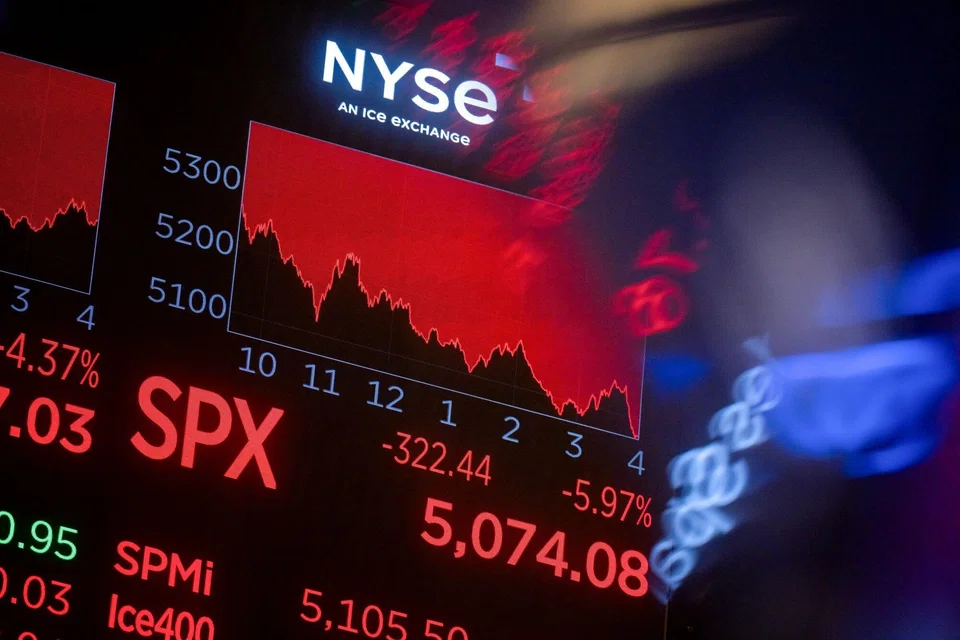
Unsurprisingly, markets crashed in the days that followed the Apr 2 tariff announcement, amid fears of a global economic slowdown.
Many retail investors took the opportunity to buy the dip, as reported by Bloomberg, believing that the market would inevitably rise in the long term. While this is generally the “smart thing to do”, we believe that selectivity matters when buying the dip.
Investors should avoid buying a stock simply because it has fallen significantly from its all-time high. Instead, they should assess whether these companies are able to withstand the impact of prolonged, high tariffs.
Key factors to consider include whether the companies have competitive advantages, such as strong brand loyalty and high switching costs, which enable them to raise prices without substantially impacting demand. Additionally, having diversified revenue streams and a strong balance sheet are crucial for navigating the challenges of a trade war.
Investors may also want to avoid sectors that are particularly vulnerable to the impact of Trump’s tariffs, such as industrials, materials and consumer discretionary.
Consumer discretionary stocks could face significant earnings pressure as Trump extends tariffs to Asian markets such as Vietnam and India, where companies had previously moved their production to bypass tariffs on China. Lululemon, for instance, manufactures about 40 per cent of its products in Vietnam, where Nike also produces about half its shoes.
Instead, we favour industries with long-term structural tailwinds, such as semiconductor companies and the broader technology sector, which are well-positioned to capitalise on the megatrends of AI and digitalisation. These trends are expected to drive strong earnings growth in the years ahead, building on solid fourth-quarter results, during which tech companies reported sustained AI demand.
Within tech, software companies like Alphabet, Meta and Microsoft may be more resilient than hardware companies like Apple, which are more vulnerable to tariffs on goods.
Managing risk through diversification
Although the S&P 500 index has been one of the worst performers in the year to date, we remain confident in the long-term strength of the US. The US continues to hold several key advantages over its global peers, including the world’s largest and most liquid capital markets, the dominance of the US dollar, and a strong concentration of high-quality, industry-leading companies.
Still, investors may understandably want to reduce their exposure to US equities in the near term. Alternative markets to consider include China, where the government is taking decisive steps to revive its economy and support the private sector after past regulatory crackdowns, and Europe’s defence industry, which stands to benefit as Trump’s retreat from the trans-Atlantic alliance pushes European nations to ramp up defence spending.
Outside equity markets, investors can look to money market funds and short-duration bonds as safe-haven assets that still offer attractive yields. Those willing to take on some credit risk may also consider corporate bonds from non-US issuers operating locally and independently of global supply chains, as their revenues and margins are less likely to be affected by disruptions in global trade.
The writer is a research analyst with the research and portfolio management team of FSMOne Singapore, the B2C division of iFast Financial.
TRENDING NOW

Companies still in search of AI use cases with worthwhile ROI, says Broadcom’s CEO

Malaysian king buys stake in Singapore-listed mining firm expanding into rare earths

Once staunchly pro-China, Malaysian Chinese businesses are now distancing themselves from Beijing

Singapore’s wealth management success should extend to everyday families

