

Insights and strategies to help investors hold their nerve
An awareness of history and a disciplined investing approach through dollar-cost averaging could tune out emotions and impulses that can be damaging in the long run

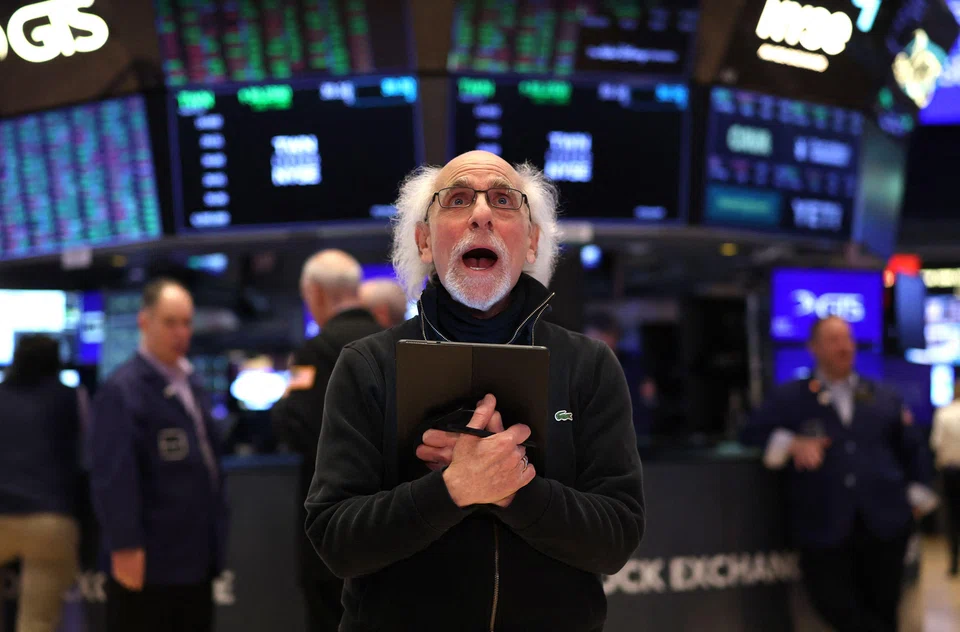
[SINGAPORE] Whipsawing markets have been testing investors’ patience and confidence. Are you holding your nerve?
Many strategists have advised a risk-off stance, and have told investors to refrain from buying the dip. Yet a strategy of dollar-cost averaging is the mainstay of those saving for a long-term goal such as retirement.
Investing a fixed sum at regular intervals automatically buys more shares when prices dip, and fewer shares when markets rise. Is this strategy off the mark, especially in a crisis? It may not always feel so, but financial history is on the side of risk-taking.
To recap, tariffs on nearly all countries – unveiled by US President Donald Trump and had been slated to take effect on Apr 5 – caused a record two-day wipe-out of US stock-market capitalisation of more than US$6 trillion.
Trump pulled markets off the edge when he paused tariff implementation for three months, except for China. But global markets have remained on tenterhooks.
The S&P 500 ended last week up by more than 5 per cent. But there has been unprecedented volatility in the US$28 trillion Treasury bond market amid concerns over higher recession and inflation risks, among others. Yields on 10-year and 30-year US Treasury bonds are hovering at 4.5 per cent and 4.9 per cent, respectively, as investors demand higher compensation for longer dated paper. Consumer sentiment in April plunged to a level lower than during the worst of the 2008 financial crisis.
Erratic approach
President Trump’s erratic approach to tariffs may have drained global confidence, raising the spectre of a US recession or stagflation, and casting serious doubt on the country’s policy and the status of its assets – specifically Treasuries and the greenback – as safe havens.
The big challenge is that even experts are hard-pressed to assess the probability of outcomes. Last weekend, Trump exempted electronic items from reciprocal tariffs, in a reprieve for some consumer electronics giants such as Apple.
Frederic Rochat, managing partner at Lombard Odier, said: “The central question is, are these tariffs of a temporary nature, the opening salvo of negotiations, or much more permanent, which will probably drive a complete rewriting of the rules of global trade?
“If we are in the temporary scenario with deals negotiated, this is likely to lead to further free trade areas, within new boundaries... This is a scenario where the US is effectively again part of a trading system, in which case we think we can probably avoid too much damage and too much recession – provided this happens quickly.”
Howard Marks of Oaktree Capital wrote in his latest letter: “Under these circumstances, it must be accepted that forecasts are even less likely to prove correct than usual... If we insist on achieving certainty or even confidence as a precondition for action, we’ll be frozen into inaction.
“But we also have to bear in mind that deciding not to act isn’t the opposite of acting; it’s an act in itself... The old saws that are the refuge of terrified investors – ‘we’re not going to try to catch a falling knife’ and ‘we should wait for the dust to settle and the uncertainty to be resolved’ – cannot in themselves be allowed to determine our behaviour.”
I believe that rather than be frozen by fear, or worse still, panic and sell, investors need to take stock of their goals. Have those goals changed? It’s likely that the fall in asset values has magnified the need to invest.
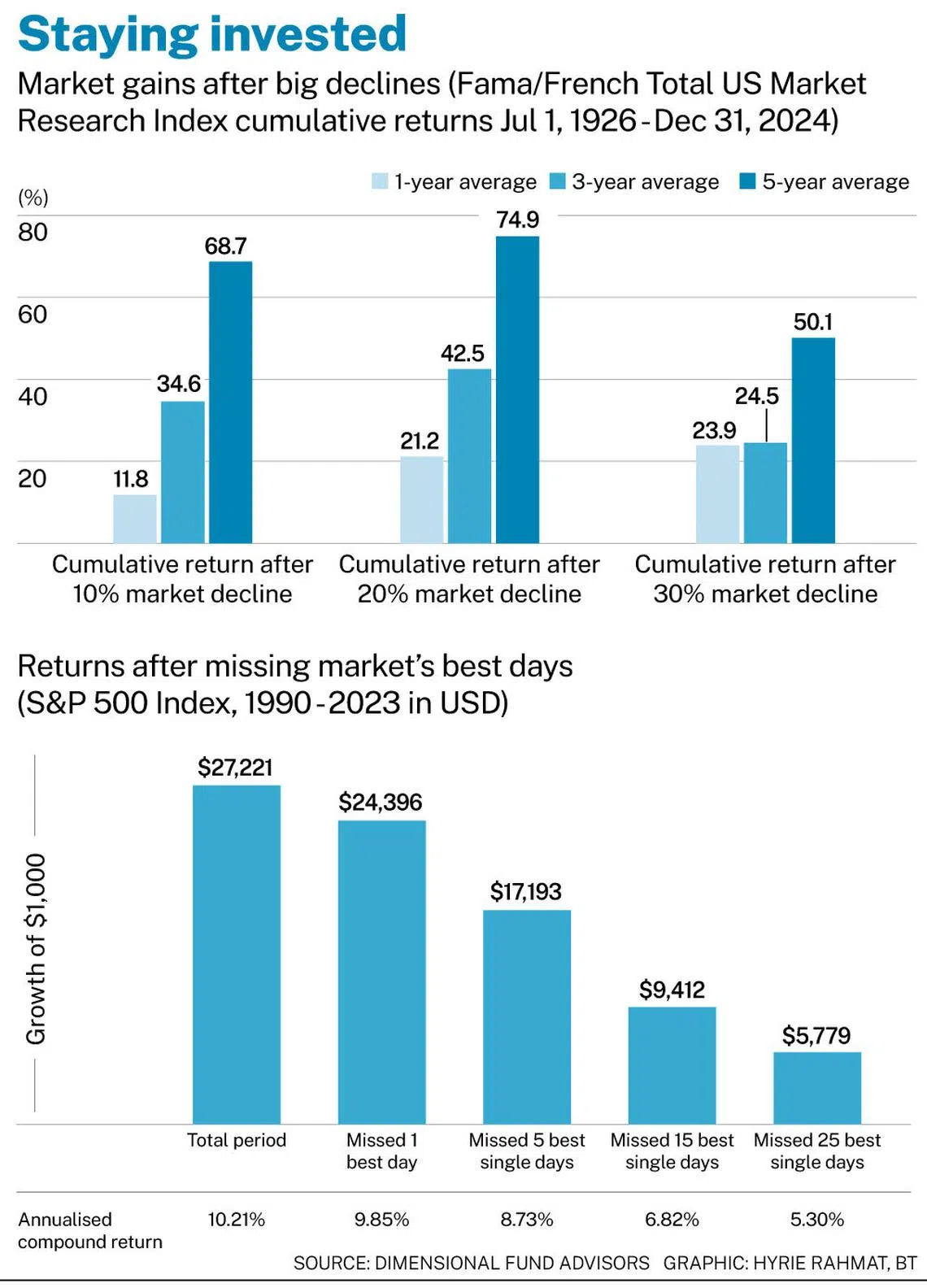
Should you wait for a “safer” time? There are a few things that the long history of financial markets can tell us. History, plus a disciplined investing approach through dollar-cost averaging, helps to tune out emotions and impulses that can be damaging in the long run.
Taking lessons from history
At moments of the greatest pessimism, it almost always feels like this time is different.
In 2008, for instance, when it seemed the imploding US mortgage market could do lasting damage to global growth and asset values, I recall that even journalists at outlook briefings were sceptical that recovery could be round the corner. Yet, after 2009, markets entered the longest bull market, rising 330 per cent over 10 years.
Duncan Lamont, Schroders’ head of strategic research, wrote in a note: “The simple reality is that the stock market has tremendous power to help grow wealth in the long run, but short-term volatility and risk of falls are the price of the entry ticket.”
Markets are forward-looking, wrote Isabelle Williams, Dimensional Fund Advisors (DFA) deputy head of investment solutions, adding that volatility is a sign that markets are working.
“Even if you are worried about ongoing economic challenges, you shouldn’t necessarily expect a negative investment experience going forward, because markets have already factored in known information. The pain you may feel now reflects markets setting prices such that expected returns are always positive.”
DFA funds are systematically managed based on factors historically proven to drive outperformance; these are size, value and profitability.
Diversification pays
The market upheaval is a pointed reminder that spreading your funds across asset classes and industries is a sound strategy.
Year to date, the S&P 500 generated minus 8.8 per cent in return. But the Bloomberg Global Aggregate Index, comprising global investment-grade debt, is up by more than 3.7 per cent. Gold has returned 23 per cent year to date, and strategists expect more upside underpinned by risk aversion and central-bank buying.
There are also more calls for investors to allocate into active strategies, where managers have leeway to depart from broad market capitalisation-weighted indexes, which carry high concentration risks due to the outsized price appreciation of large-cap tech stocks.
As macro uncertainty rises, this also underscores the need for active management and a strong on-the-ground presence, enabling clients to navigate the complexities effectively, rather than relying on broad-brush assumptions.
Providend’s chief executive officer Christopher Tan said: “If you are fully in a country index such as the S&P 500, and are concerned about Magnificent 7 concentration risk, you can look at the equal-weight S&P 500, which would have paid off in 2025, outperforming the market cap-weighted S&P 500 by 2.5 per cent year to date.
“If you are in a global market cap-weighted index… you can look to diversify by factors, adding a factor such as value stocks. US value stocks have outperformed growth by 10 per cent year to date.”
Explore low-volatility funds, options strategies
AllianceBernstein has a range of low-volatility funds focused on mitigating downside risk and capturing the upside in rising markets. The low-volatility strategy selects “high-conviction” stocks based on three factors: quality, stability and price (QSP).
“We believe that companies that have strong QSP features tend to be more resilient in volatile markets, and this has been proven based on our long-term track record,” said a spokesperson.
Separately, some funds incorporate an options strategy to enhance income and mitigate risk. JPMorgan Asset Management recently registered three of its most popular London-listed active exchange-traded funds in the equity premium income series.
The strategy seeks to generate income of 7 to 9 per cent by writing out-of-the-money call options which pay a premium or income, but limits upside participation. It is expected to outperform in a sideways or volatile market.
Among private clients, there is also a strong appetite for structured products with downside protection, said Franck Fayard, Marex head of financial products (Asia-Pacific).
Marex designs customisable structured products using derivatives. Capital-protected notes, called minimum redemption notes (MRNs), consist of a zero-coupon bond and an option. It is best, however, to invest in MRNs before volatility spikes, he added.
“This is because the cost of the option is linked to the implied volatility of the underlying assets, which tends to rise during market downturns. As a result, investors pay significantly more for MRNs created during a market storm than if they had structured them beforehand… Over the past few weeks, we’ve seen a notable pickup in demand for MRNs linked to markets such as US equities, Hong Kong equities and even precious metals,” he noted.






