Investing through adversity
Seven principles to guide investors in times of market declines

Jeik Sohn
ECONOMIES around the world are facing market volatility as prices surge and interest rates increase amidst daily uncertainties. Oil prices are at an all-time high and in Singapore, we see core inflation rising to 3.3 per cent in April 2022, the fastest year-on-year pace in more than 10 years. Constrained supply conditions and heightened geopolitical risks are set to persist in the near term. As we head into the second half of the year, what can investors do?
Stay invested for the long term
Right now, clients are asking us if they should start repositioning their portfolios, change their asset allocation or look for a bottom in prices. Our advice, as always, is to focus on smart investing – keep a long-term investment horizon and focus on relevant research, solid data, and proven strategies. Emotional investing can be hazardous. Here are seven principles to make a sound decision during these uncertain times:
1. Market declines are part of investing
Over long periods of time, stocks have tended to move steadily higher, but history tells us that stock market declines are an inevitable part of investing. The good news is that corrections (defined as declines of 10 per cent or more), bear markets (an extended 20 per cent or more decline) and other challenging patches haven’t lasted forever.
Market downturns happen frequently but don’t last forever

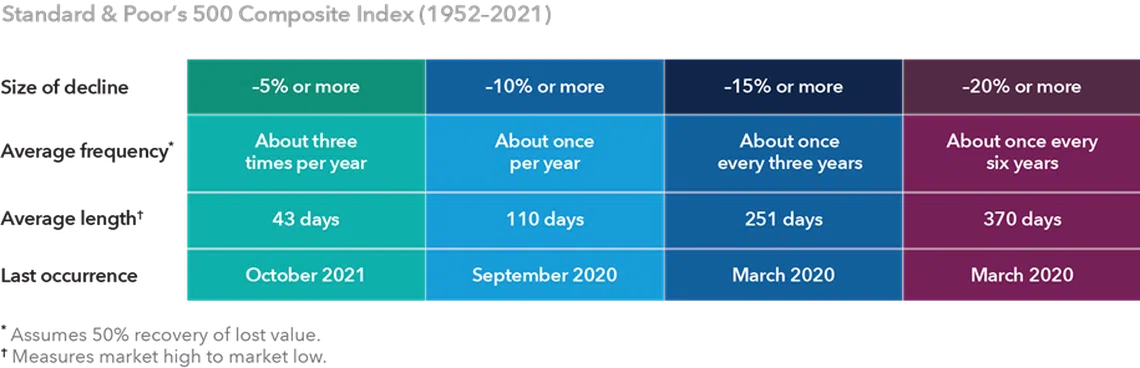
When markets falter, some may be inclined to reduce their exposure to equities. However, history has shown that periods of turmoil and steep market declines have subsequently been proven to be the best times to invest.
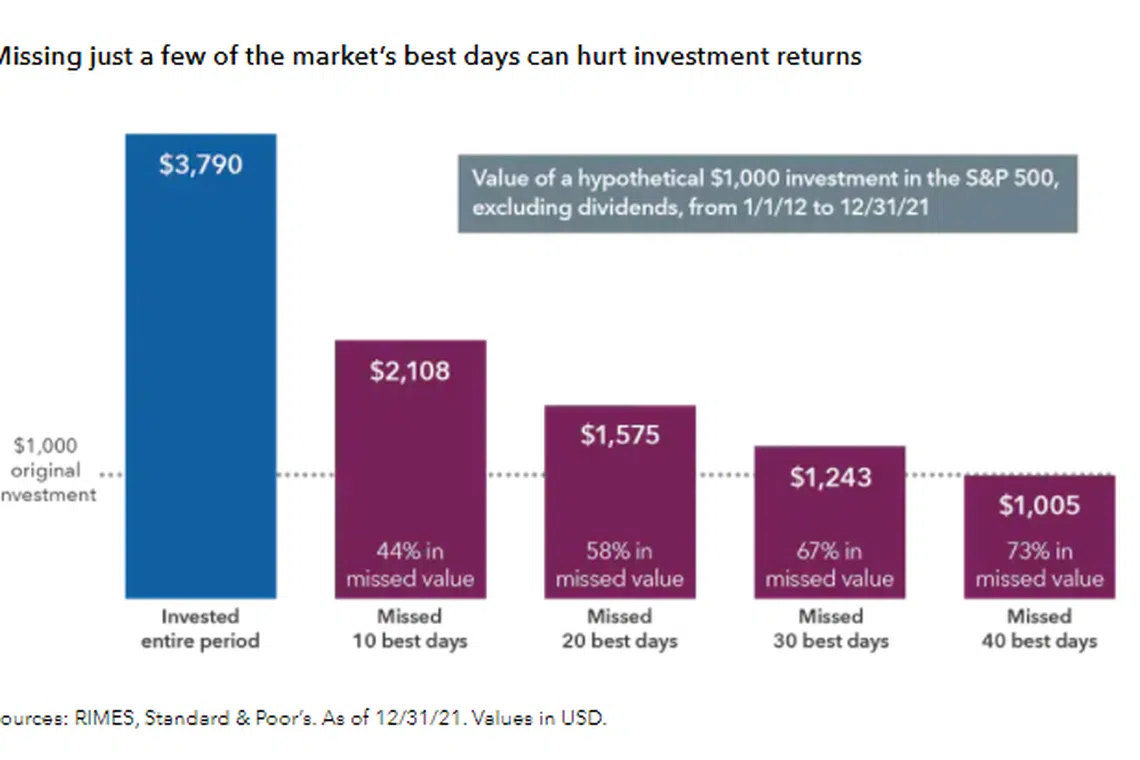
2. Time in the market matters, not market timing
No one can accurately predict short-term market moves, and investors who sit on the sidelines risk losing out on periods of gains after market declines.

Every S&P 500 decline of 15 per cent or more, from 1929 through 2020, has been followed by a recovery. The average return in the first year after each of these declines was 55 per cent.
3. Emotional investing can be hazardous
Emotional reactions to market events are perfectly normal. Investors should expect to feel nervous when markets decline, but it’s the actions taken during such periods that can mean the difference between investment success and shortfall.
One way to encourage rational investment decision-making is to understand the fundamentals of behavioural economics. Recognising behaviours like anchoring, confirmation bias and availability bias – in other words, the tendency to rely too heavily on the first piece of information we are given or the most readily available data, and to interpret and favour information that confirms one’s prior beliefs – may help investors identify potential mistakes before committing them.
4. Make a plan and stick to it
Creating and adhering to a thoughtfully constructed investment plan is another way to avoid making short-sighted investment decisions— particularly when markets move lower. The plan should consider several factors, including risk tolerance and short- and long-term goals.
When we go through volatile times like this, it is easy to respond by focusing on the short term. But the right thing to do in this environment is to push your time horizon and think for the long term.
5. Diversification matters
A diversified portfolio doesn’t guarantee profits or provide assurances that investments won’t decrease in value, but it does help lower risk. By spreading investments across a variety of asset classes, investors can buffer the effects of volatility on their portfolios. For investors who want to avoid some of the stress of downturns, diversification can help lower volatility.
6. Fixed income can help bring balance
Stocks are important building blocks of a diversified portfolio, but bonds can provide an essential counterbalance. That’s because bonds typically have low correlation to the stock market, moving in opposite directions to the stock market.
High-quality bonds have shown resilience when stock markets are unsettled
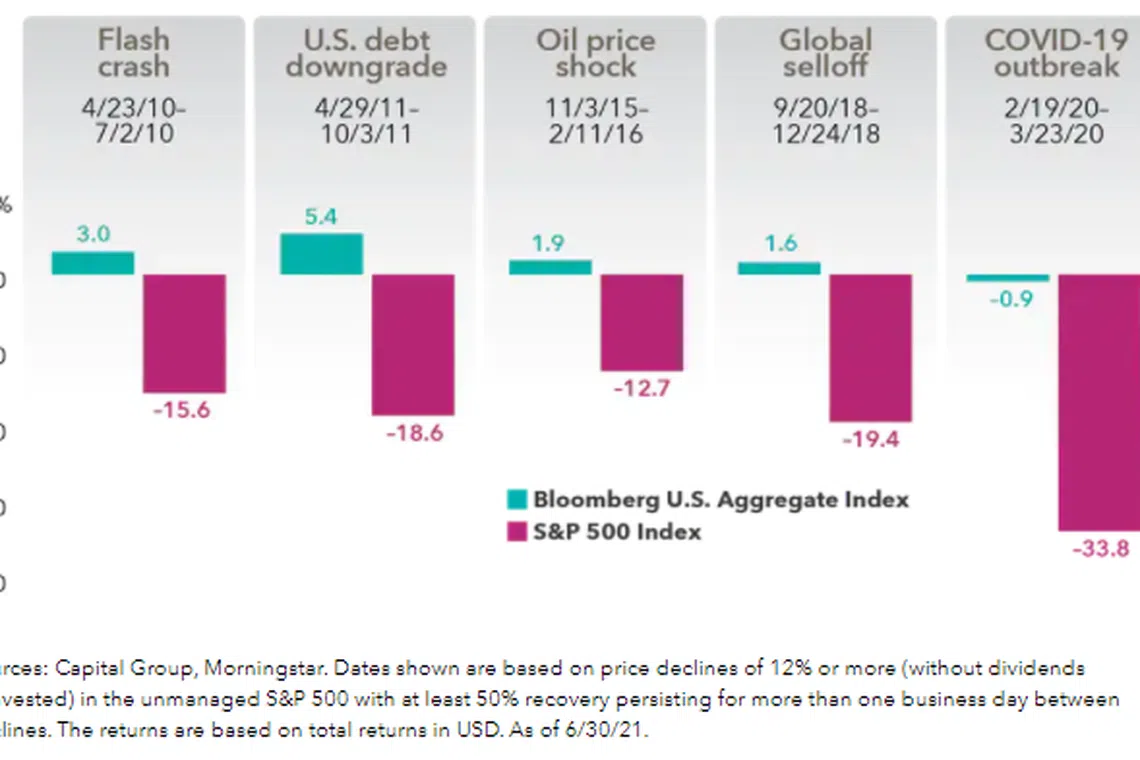
Bonds with a low equity correlation can potentially help soften the impact of stock market losses on your overall portfolio. Funds providing this diversification can help create durable portfolios. Investors should seek bond funds with strong track records of positive returns through a variety of markets.
Though bonds may not be able to match the growth potential of stocks, they have often shown resilience in past equity declines. For example, U.S. core bonds were positive in four of the last five corrections of 12% or more.
7. The market tends to reward long-term investors
Is it reasonable to expect 30 per cent returns every year? Of course not. And if stocks have moved lower in recent weeks, you shouldn’t expect that to be the start of a long-term trend either. Behavioural economics tells us recent events carry an outsized influence on our perceptions and decisions.
It’s always important to maintain a long-term perspective, especially when markets are declining. Although stocks rise and fall in the short term, they’ve tended to reward investors over longer periods of time. Even including downturns, the S&P 500’s average annual return over all 10-year periods from 1937 to 2021 was 10.57 per cent.
It’s natural for emotions to bubble up during periods of volatility. Investors who can tune out the news and focus on their long-term goals are better positioned to plot out a wise investment strategy.
The writer is head of client group, Singapore & Southeast Asia, at Capital Group
Decoding Asia newsletter: your guide to navigating Asia in a new global order. Sign up here to get Decoding Asia newsletter. Delivered to your inbox. Free.
Share with us your feedback on BT's products and services