Look to Asia for AI-themed investments, says JP Morgan Apac equities head
The region’s equities are buttressed by a substantial valuation gap against US peers and a macro environment of lower interest rates
[SEOUL] Investors fret about the overvaluation risks in artificial intelligence (AI)-themed investments, but Asian equities are a fertile hunting ground – buttressed by a substantial valuation gap against US peers and a macro environment of lower interest rates.
This was the view of heads of regional and global equities at the JP Morgan Asset Management Asia Media Summit in Seoul last week.
Expectations of US equities remained “constructive”, as a global CIO panel expressed. But investors need to “keep expectations realistic”, said Paul Quinsee, the firm’s global head of equities.
“We lean positive on AI, and that’s how we’ve basically been for the last two years. The market was feeling excited about AI just a few months back at the end of April and it’s much less excited now. But you have to be a little contrarian and keep expectations realistic.
This year is different
“In the last 15 years, US equities have returned 15 per cent, about twice the returns elsewhere. This year is different; there is suddenly a lot going on in the rest of the world. International investors have something like US$17 trillion in US equity; they’re wondering what they should be looking at.”
Year to date, the rest of the world has outperformed the S&P 500’s 14.5 per cent return. The MSCI AC Asia Pacific ex-Japan Index has returned 29 per cent; the MSCI Emerging Markets Index 31.8 per cent; and the MSCI World index 19 per cent.
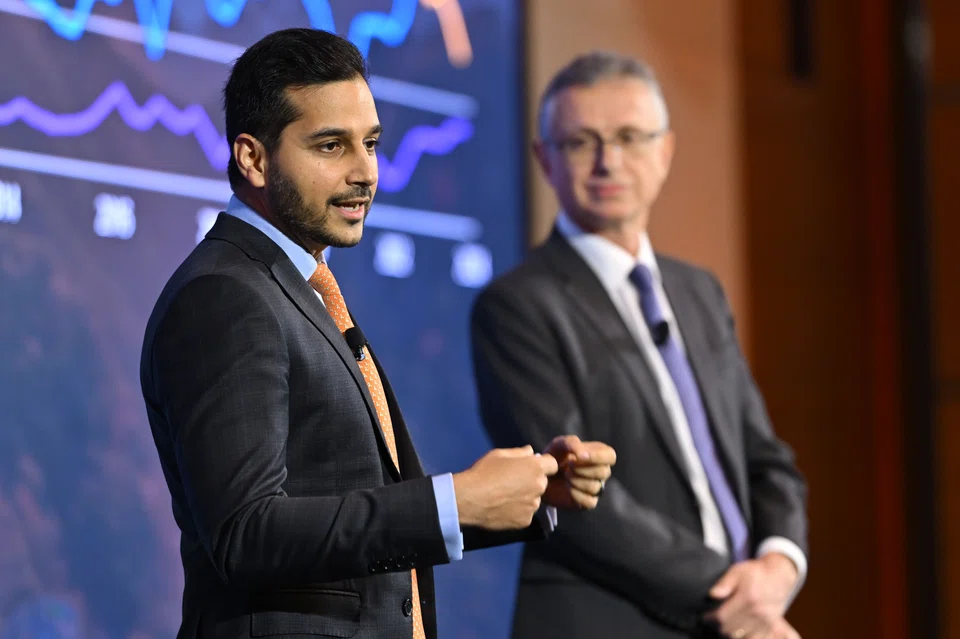
In a joint presentation on Asia equities, Anuj Arora, head of emerging markets and Asia Pacific equities, and Alexander Treves, head of investment specialists (Apac, emerging markets, and Apac equities), present some cogent arguments for Asia.
In the tech hardware segment, for example, the valuation gap stands at nearly 50 per cent. The average price earnings multiple for the top 10 Apac tech stocks is 17 times as at August, compared to 32 times for the top 10 in the Nasdaq.
Arora said: “Obviously the AI revolution is going on, but 65 per cent of all semiconductors are manufactured in (Asia). You cannot have the AI revolution without the Korean, Japanese and Chinese (companies).”
Of the three largest players in High Bandwidth Memory (HBM), two are in South Korea – SK Hynix and Samsung Electronics.
“The US manufacturer trades at more than twice the multiple of the Korean manufacturers… You can’t make a GPU (graphics processing unit) without semiconductors and the supply chain, where the barriers to entry are very high. But still there is a valuation discount.
“If you are big on the AI story, if you think it’s the next industrial revolution, North Asia gives you easy access at 50 per cent discount, and investors are finally coming to grips with that.”
Year to date the Korea Stock Exchange Index (Kospi) has returned nearly 60 per cent, and the MSCI Korea Index over 77 per cent.
More openness to Asia
Treves said: “The US is very good at capitalism but many clients in the region are already very exposed to US equities… We’ve now got more openness to Asia. There are a lot more conversations about Asian equities than we might have gotten a couple of years ago.”
Two other factors are supportive of Asia and emerging markets – a weakening of the US dollar which is positive for emerging assets, and the rise of corporate governance as Asian companies take steps to enhance shareholder value.
Arora said: “Interest rates in emerging Asia are very high. If the dollar cycle is over, hopefully we’re on for a longer term ride on markets going up.” There is typically an inverse correlation between emerging assets and the dollar.
Corporates in China, he said, have also begun to buy back their shares, a first in Chinese index history. “In the past 25 years, Chinese corporates diluted the end-shareholder by 2 to 3 per cent every year. But last year they bought back shares. If this trend persists, it will be very positive for the market from a multiples rating perspective.”
In terms of the amount of money returned to shareholders, there remains a wide gap between the US and Japan, Korea and China.
“But (Asian markets) are moving in that direction, and Korea is the next story. I think corporate governance will be a very strong theme in this part of the world,” he said.
Earnings growth
On the US, the investment backdrop remains relatively benign as growth seems resilient. In terms of the drivers of returns – earnings growth, dividends, valuation and currency translation – “we think it will be a reasonable year but earnings have to do the heavy lifting, because valuations are already pretty high”, said Quinsee.
“Our analysts feel pretty good about earnings growth next year. For the US it’s around 13 per cent, and not just coming from the same companies,” he said.
Iain Stealey, international CIO for global fixed income, currency and commodities group, said the US Federal Reserve is likely to reduce rates twice over the rest of the year. “Inflation isn’t as hard as previously thought, but we have the One Big Beautiful Bill Act coming next year. Fiscal spending is returning in the US and between now and the end of 2026, around five rate cuts are priced. I think this year is reasonably set in stone. But can the Fed continue to deliver next year?”
He said 2025 has been a good environment for fixed income, because of the trend among central banks to reduce rates.
“The second is that for the first time in some years, we have what we love in fixed income – an upward sloping yield curve. In the last few years, the cash rate has gotten more than the 10-year yield. But now the upward sloping yield curve may entice people out of cash. I believe the diversification benefit from bonds is back.”
Corporate spreads, he said, are tight. “We’ve got a corporate market in very good health, and the flow picture is heavily skewed towards credit. The favourite saying at the moment is that spreads are tight but the yields are right. People like the high level of income that they can get for what they believe is a fundamentally sound asset class.”