

Manulife issues record US$300 million life policy for a single client
The sale reflects a nascent but growing use of insurance for legacy and succession planning among high-net-worth families

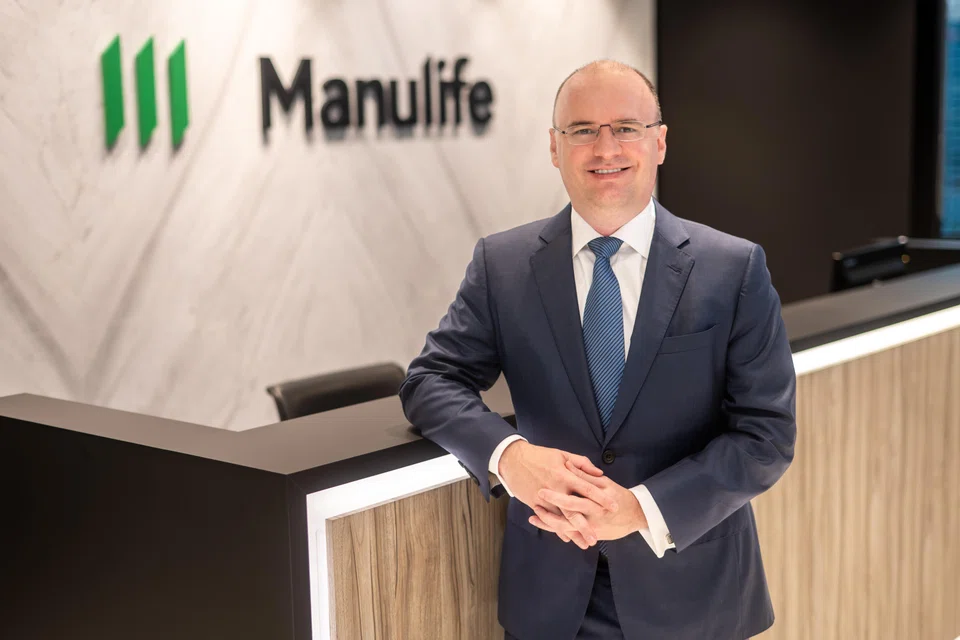
[SINGAPORE] Manulife Singapore has issued a US$300 million life insurance policy for a single client, in what may be the highest-value policy to date in Singapore and the region.
The sale reflects a nascent but growing use of insurance for legacy and succession planning among high-net-worth (HNW) families. The development is significant for the industry, where competition is keen for a slice of the lucrative HNW business.
This is occurring amid a massive intergenerational wealth transfer of an estimated US$5.8 trillion in the Asia-Pacific region, potentially opening up sizeable opportunities in financial services, including banking, wealth and tax advisory, and legal and trust services.
The flurry of activity is reflected in the increase in family offices headquartered in Singapore. At the end of 2024, the number of single-family offices (SFOs) here exceeded 2,000, rising 43 per cent from 1,400 a year earlier.
Singapore’s own population of HNW and ultra-HNW individuals is rising, too. Knight Frank expects the number of ultra-HNW individuals, defined as those with a net worth of at least US$30 million, to grow to 5,300 by 2027, from around 4,498 in 2022.
“There is a broader trend towards larger policies as more HNW families approach insurance as part of their wealth strategy,” said Benoit Meslet, chief executive officer of Manulife Singapore.
“Over the next two decades, as trillions of dollars of wealth are transferred from the first-generation wealth builders to their families, clients look for stable platforms to support that transition,” he added.
Meslet noted that life insurance penetration is “still quite low” among HNW families. “While the market may be nascent, product awareness is rising, because more families are beginning to recognise the unique benefits of insurance.”
In the last 12 months, Manulife issued 25 individual policies valued at over US$50 million each. The sale of such policies, with a sum assured of more than US$50 million, rose by 40 per cent from 2024 to 2025.
“We expect double-digit growth on an annual basis in this market,” said Meslet. “Many HNW families are asset-rich and cash-poor because the wealth is often tied up in illiquid assets. Insurance provides liquidity so they don’t have to sell assets under pressure, and they can make the best decisions.”
The policies that Manulife has sold, including the US$300 million plan, are indexed universal life (IUL) plans, currently the most popular type of HNW worth policy in the market.
In IULs, client premiums are split into two accounts. One is a fixed account which earns a fixed rate of return. The second is an index account, where clients may choose from a range of index exposures. The index account typically enjoys a floor of zero, which protects clients from losses, but depending on the index, the upside may also be capped.
Insurance lends itself to estate and succession planning, as clients can create an immediate legacy and proceeds are not tied up in the probate process. This means there is immediate liquidity upon death.
Families also use it as an estate equalisation tool for their heirs, complementing the distribution of illiquid assets such as business interests and real estate. It may also be used by companies as keyman insurance to ensure business continuity.
Insurers in the HNW segment need to have large underwriting capacity and a team of underwriters who can assess the risk. “You need to have very strong reinsurance partnerships as well, which is something we’ve been building over the past 15 years,” said Meslet.
Manulife claims to be a pioneer in the HNW space. It launched the first universal life product in 2010 and introduced variable universal life insurance in 2017. In 2019, it launched the first IUL.
For large policies, it may typically take two months from application to policy issuance. “The customer needs to receive advice from a variety of angles,” said Meslet. “They need to understand the tax implications, how to structure their wealth, how the benefits will be paid out. We have significantly shortened the timeline by implementing artificial intelligence in many of our processes.”
There is little industry data on the size of the HNW market for insurance. But a 2024 study by NMG, commissioned by UK-based Utmost Group, found that insurance wealth solutions currently account for just 2 per cent or £543 billion (S$928.1 billion) of the total HNW investible asset market of £28 trillion.
Low penetration is mainly due to limited client awareness or understanding; the client often relies on the specialist financial advisers or brokers to explain solutions and benefits.
“Placement capacity, the number and productivity of suitably qualified and licensed advisers, is therefore a limiting constraint on distribution and penetration in the market,” said the Utmost Group in a report.
By increasing penetration to 3 per cent from the current 2 per cent, the global HNW international life insurance market could add more than £240 billion of additional assets, growing the market by 50 per cent and surpassing £800 billion.
TRENDING NOW

Once staunchly pro-China, Malaysian Chinese businesses are now distancing themselves from Beijing

Looking beyond looming CEO succession, should UOB potentially pursue a transformative merger?

Could stablecoins be the future of money?

Grab CEO’s wife Chloe Tong on life with Anthony Tan and finding her purpose

