

Not time to go risk-on, say strategists
Strategists remain broadly optimistic that a US-China trade deal is likely to materialise, despite Donald Trump's latest threat to hike tariffs on Chinese imports later this week. Here is a round-up of their views.

Genevieve Cua
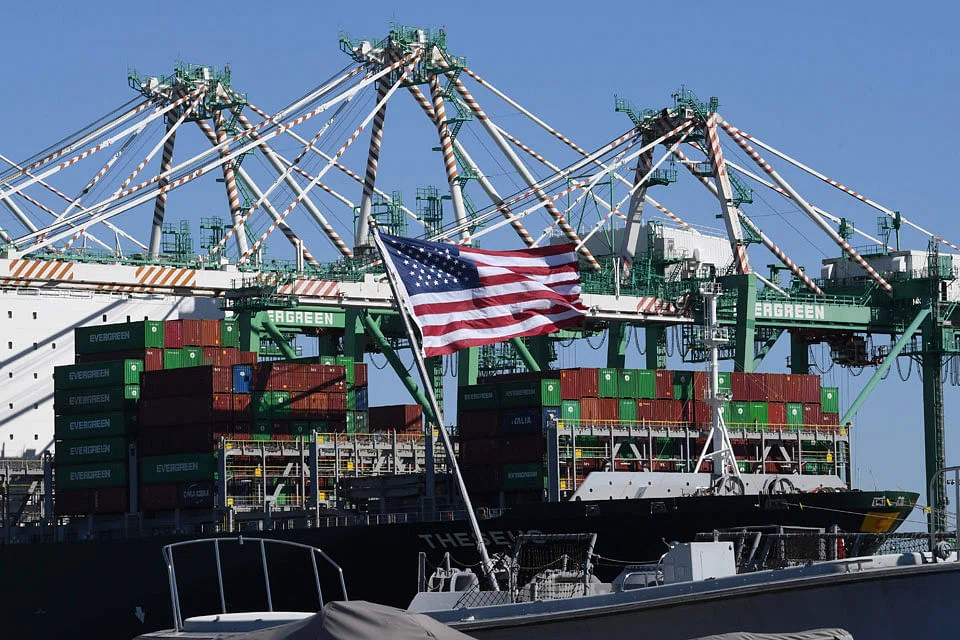


US PRESIDENT Donald Trump's threat to hike tariffs on Chinese imports later this week took markets by surprise, causing an immediate pullback.
The Shanghai Composite Index fell more than 5 per cent on Monday; the Hang Seng Index fell 2.9 per cent and the MSCI Asia ex Japan also tumbled by more than 1.7 per cent.
Strategists, however, remain broadly optimistic, putting forward their base case that a deal is likely to materialise. Most appear to have assigned a probability of about 60 to 70 per cent to this scenario. But most say it is too early to ramp up on risk. In the near term, investors should brace for yet more pullbacks.
To recap, the US imposed an initial 25 per cent of tariffs on US$50 billion of imports from China last year, and another 10 per cent on some US$200 billion worth of products last September. The duties on the US$200 billion of imports were expected to rise to 25 per cent in January but were pushed back pending the outcome of trade talks.
Mr Trump's latest missive was delivered via a tweet on Sunday, threatening to raise tariffs to 25 per cent by May 10, plus another threat to impose 25 per cent tariffs on all Chinese trade with the US - that is, an additional US$325 billion of imports.
Here is a round-up of strategists' views.
APAC chief investment officer John Woods says the timing and severity of Mr Trump's threat suggest gamesmanship ahead of the concluding round of talks between US and China to take place this week. It appears that Mr Trump has raised the stakes in a bid to seal the deal, Mr Woods wrote in a note on May 6.
"At least for the near term, we expect global risk appetite to deteriorate meaningfully.'' Mr Woods assigns a 20 per cent probability to the worst-case scenario where a full-blown trade war ensues, and tariffs are imposed as threatened. This would pose "material risks" to China's nascent economic stabilisation.
Credit Suisse's base case is that of a deal but at a slightly delayed timeframe, to which it has imputed a 70 per cent probability. "We expect continued weakness in risk before a corrective rally retraces most losses once the end game becomes apparent.''
Tan Min Lan, APAC head of UBS Chief Investment Office, puts a 30 per cent probability to the scenario of a breakdown in US-China talks. This, she wrote in a note yesterday, could cause US equities to trade 10-15 per cent below levels last week, and Chinese stocks 15 to 20 per cent lower. "Experience from 2018 should remind investors that a market shock, which follows a period of low volatility, can lead to systematic selling, exacerbating market declines beyond what would fundamentally be justified,'' she wrote.
The base case, however, remains a deal that reduces tariffs. "Should we see signs of a deal emerging, markets would likely quickly revert to prevailing levels seen last week, when progress was largely priced in. This would imply over 5 per cent upside for Chinese stocks, 2 per cent for Europe, and 2 per cent for US.''
She recommends clients look into options strategy - a "collar'', for instance, comprising the purchase of an out-of-the-money put option to limit the downside, while selling an out-of-the-money call option. "The sale of the call reduces the price of downside insurance, in exchange for giving up part of the upside if markets recover.''
She also advises investors to shift to higher-quality equities, which could mitigate the risk of near-term volatility. Within Asia she likes high-quality and defensive segments such as Singapore equities, Asian financials, Asian large caps and stocks with high dividend yields.
Hou Wey Fook, DBS Bank chief investment officer, sees Mr Trump's latest salvo as part of his negotiation strategy. "Every party is aware that there are no winners in a full blown trade war. We believe therefore that rationality will prevail at the end of the day. Our base case is that there will be a trade deal.''
It holds onto its view published for 2Q that unless there is a comprehensive US-China trade deal, including the lifting of existing tariffs, "we do not see global equity indices breaking out to new highs''. "At this juncture, we hold the view that this 'tug of war' market will remain in play."
He advocates a "barbell'' strategy to help mitigate uncertainty. "To 'barbell' a portfolio is to take overweight exposures at both ends of the risk spectrum - on one end, hold companies that are beneficiaries of secular growth trends of digitalisation, ageing, millennial spending; and on the other end, to hold assets that generate consistent income such as BB/BBB-rated bonds and Reits.''
Eli Lee, BOS head of investment strategy, sees a one-in-three chance that trade talks break down. While Mr Trump's threats could be seen as negotiating tactics ahead of China negotiators' visit to the US this week, he could well walk away from a "transparently weak deal that is not politically accretive for him, particularly ahead of his 2020 re-election campaign''.
"Over the last month, we have been repeatedly cautioning our clients against excessive trade optimism being priced into the markets, and we are well positioned for this. We opt to keep our asset allocation strategy unchanged, and will not sell into this correction ... Given that we still see more than even odds of an eventual trade agreement, we will look for opportunities to be buyers in this correction going forward as valuations become more attractive. It is still too early, however, to be adding risk at this point in time.''
The bank has called a neutral on US and Asia ex-Japan, and overweight on Japan and Europe, which are more defensive against trade disappointment.
Strategists at Lombard Odier put a 60 per cent probability to the scenario of a deal in June, which will help trade recovery and boost global economic activity. "Under this positive (and our central) scenario, we think most of the good news has already been priced by the markets and the recent weakness would revert relatively swiftly. Following that and the maturity of the US business cycle, we expect equities to perform reasonably well but certainly not maintain their momentum of Q1 2019.''
The strategists expect emerging market assets to perform "rather decently'' on the back of trade normalisation, some improvement in global data and the Fed remaining on hold.
They put a 25 per cent probability of a deal being postponed towards late 2019 or 2020. This would put domestic demand and markets under pressure in the near future. "This strategy of 'kicking the can down the road' will keep investors at bay and suppress sentiment. In such a scenario, equities would suffer and give back some of their gains so far this year, with Chinese stocks likely underperforming. Commodities would be subject to broad-based pressure under the threat of reduced aggregate demand, while gold prices would rise ...''






