Revolutionising mobility the Singapore way
CAN Singapore as a small island play a significant part in sustainability? Does the country have the necessary infrastructures, systems, and technologies to make the Singapore Green Plan 2030 an attainable goal in the foreseeable future? Which are the companies positioned to play a role in this push for more sustainable energy or technologies that will support these initiatives?
Singapore has already boldly outlined its ambition under the Singapore Green Plan 2030. This ambitious plan outlined concrete targets to support Singapore’s agenda on sustainable development. This includes doubling annual tree planting to one million more trees, reducing the amount of waste to landfill per capita per day by 30 per cent; achieving 75 per cent mass public transport peak-period modal share; greening 80 per cent of Singapore buildings; and for all new car registrations to be of cleaner energy models – and to achieve all these goals by 2030.
While these targets are ambitious, it has been demonstrated that Singapore is an early adopter and has the drive and commitment to continue with its green efforts which also earned the city its recognition as a garden city with the world-class Gardens by the Bay and the Unesco-listed Singapore Botanic Gardens.
Singapore is currently ranked fourth in Oliver Wyman Forum’s Urban Mobility Readiness Index, which assesses how integrated, sustainable, innovative, accessible, collaborative, and resilient mobility systems across 60 global cities are. To take the country to the next level requires the combined efforts of the government, companies, and its citizens.
There are two highly touted sustainable technologies revolutionising mobility in Singapore. These are electric vehicles (EVs) and sustainable aviation fuel (SAF).
In the EV space, a critical factor is the ease of and accessibility to charging stations. To deal with this, landlords are gradually installing more charging points. The target is to install 60,000 EV charging points by 2030.
The current EV charger operator landscape in Singapore is rather fragmented, between small, private players and unlisted subsidiaries of larger, well-known companies, some of which are electricity providers themselves.
EVs are gradually becoming more affordable as raw materials and battery prices drop. Currently the adoption rate is low in Singapore. EV sales accounted for only 12 per cent of total car sales in 2022 and only 1 per cent of the total car population at the end of 2022.
According to McKinsey, pre-pandemic carbon dioxide emissions from the aviation industry contributed to about 2.5 per cent of total emissions globally or one billion tonnes of carbon dioxide being produced in a year. From 2005 to 2019, the aviation industry improved fuel efficiency by around 39 per cent, but the benefits were outweighed by the absolute increase in emissions as air travel became more accessible to the masses.
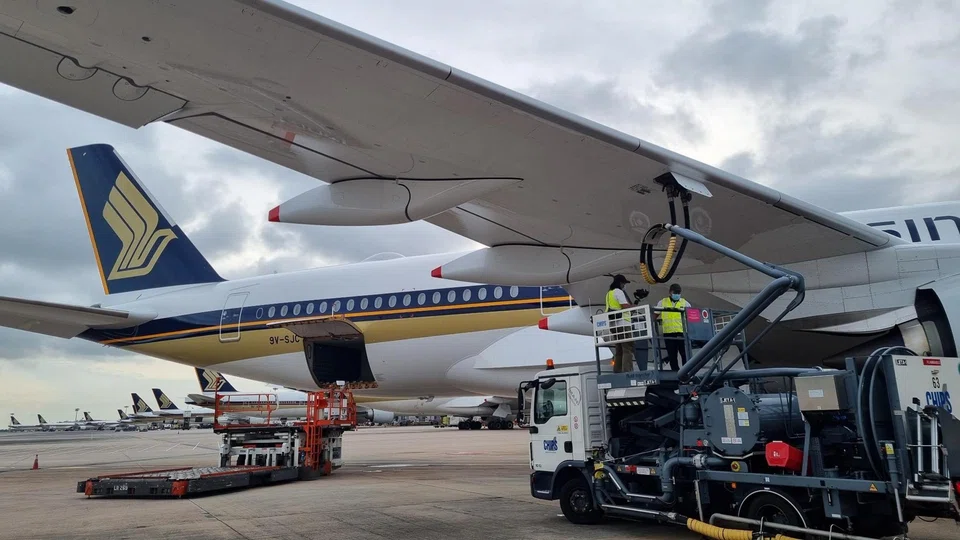
In 2021, International Air Transport Association (IATA) member airlines passed a resolution committing to achieve net-zero carbon emissions from their operations by 2050. However, the path to reaching that goal will not be an easy one, given the long lifecycles of planes, slow implementation of policy, and long lead time for innovative technologies such as electric and hydrogen aircraft.
SAF has been identified as a key solution and is expected to contribute to 65 per cent of the required reduction in emissions. Despite its benefits, SAF currently accounts for less than 1 per cent of all fuel used in aviation globally.
Given that SAF is still considered an emerging technology, it will take time for production to scale up to a level that is commercially viable given that production pathways are still being explored, feedstock supplies are limited, and costs still do not make economic sense.
As a global logistics hub with one of the world’s busiest transhipment seaports and one of Asia’s largest cargo airports, Singapore has a significant role to play to combat climate change. It is encouraging that the government and some leading companies are coming together to spearhead the effort to transform the local transport system into a greener and more sustainable one.
Some of the Singapore-listed companies that are either enabling more widespread adoption or actively responding to these technologies to future-proof their businesses include Keppel Infrastructure Trust, Keppel Corp, ComfortDelgro, Singapore Post, Frasers Centrepoint Trust, Singapore Airlines and China Aviation Oil Singapore.
Carmen Lee is head of OCBC Investment Research