

Singlife with Aviva strategic review aims to expand offerings and client base
Group CEO Pearlyn Phau is keen to appeal to a range of clientele, including HNWIs; the entity aims to continue to be active in the par products market, she adds
Singapore
SINGLIFE with Aviva isn't exactly a new entity in Singapore's traditionally staid insurance industry.
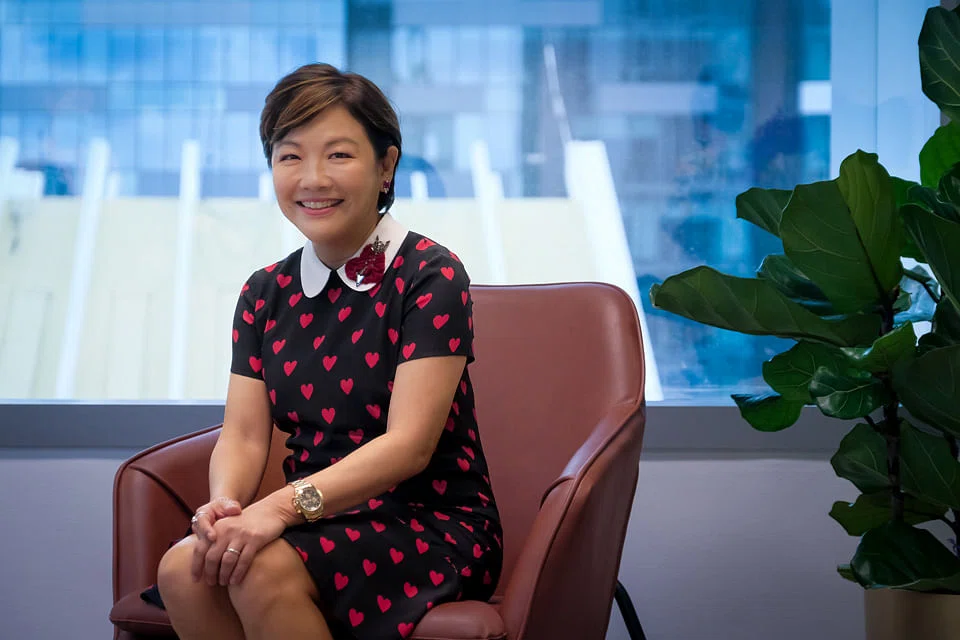
But a strategic review of the business by group chief executive Pearlyn Phau, who was roped in last August, may well refresh and enhance its offerings to appeal to a range of clientele, including high net worth individuals (HNWI), licensed financial advisory (FA) firms and retail customers.
Singlife with Aviva is the merger of insurance upstart Singlife and Aviva, first announced in 2020 in a deal valued at S$3.2 billion, the largest insurance deal at that time.
Ms Phau previously held a number of senior leadership roles in DBS Group.
Singlife with Aviva was reported to have about 1.5 million customers and gross written premiums of S$3.8 billion in 2020. It holds a composite licence which allows it to manufacture general and life insurance products targeted at a broad spectrum of clients.
Phau says: "As a joint entity, we can manufacture general insurance products; we're a Shield provider and one of the largest players in the employee benefits space. We're actually a financial services company. The thing we need to do is to bring all of that into one proposition for our customers."
Addressing gaps
According to Phau, the group has its work cut out to address both protection and savings gaps, which have been accentuated by the ongoing Covid health crisis.
"The last 2 years has raised awareness of not just the need to plan, but also to address the gaps in protection, especially for critical illness. People also forget that the cost of living is a lot higher now and people live a lot longer. If you retire at 62, your years in retirement are longer. It's something we really need to address very rapidly."
The high net worth (HNW) market is one she is keen to develop further. Since Feb 25, the group has ceased to market its HNW product line, pending its business review. Phau says the firm is "a very small player" in the HNW space. "But we definitely have the interest to participate. I'm also open to partnerships and distribution agreements. We want to offer choice as well where it makes sense, and not limit the customer to the products we manufacture."
She says that while legacy planning is a perennial need among HNWIs, there is also opportunity in retirement products with guarantees. "This is a little less common in this market, but this could be an opportunity and a gap. Because the wealthy could be buying for their dependants and also for a passive income."
Phau believes the licensed FA segment is a growth area. The group's platform business under Navigator services FAs through a B2B model. A separate platform Dollardex caters directly to investors.
Navigator Investment Services late last year appointed Akhil Doegar as chief executive. He was formerly with DBS Bank as managing director and head of digital payments group.
Phau says: "We're engaging quite heavily with FAs to understand how we can improve the services. They tell us that customers are more savvy and we need to offer more solutions..."
The strategic review of Navigator may eventually not just expand product offerings but also enhance the tools for portfolio management for clients.
"We want to equip FAs with the means to communicate with customers. If there is a market event, for example, the FA can reach out to customers at scale."
Navigator, she says, will look into "defining and upholding industry standards for customer servicing".
"Resiliency, response time, timeliness, accuracy - these are very important things. The other thing that's part of the CEO mandate is to make sure we empower and raise the savviness not just of the end customer but also of the financial advisers who deliver that service."
She says while Navigator's current offering comprises mostly funds, the group aims to build a "multi-asset class platform across investment, insurance and retirement plans".
The platform which currently has over 1,000 funds aims to take on more ESG-themed funds, for instance, as well as money market and exchange traded funds.
The group has established a CIO office to facilitate not just a coordinated investment view, but also to undertake the review and due diligence on third-party asset managers who may be appointed to manage funds on the group's behalf, including the management of participating (par) insurance funds. Kim Rosenkilde is group chief investment officer.
Pushing for simplification
Meanwhile, the group is working to simplify the language around health products, to enhance customers' understanding of the policies they own.
Phau says: "We are making a big push for simplification because the industry is so complex. At the end of the day needs are needs. We're working hard to simplify not just the language, brand and naming conventions, but also the way the product is described and the product discovery journey.
"We want to simplify the process, but I don't know if this is easier said than done. If we're able to make the process simpler, then it doesn't become so intimidating, and maybe people will want to talk a lot more about it."
The group, she adds, aims to continue to be active in the par products market. Par products are those where returns are smoothed and typically partially guaranteed. The prospect of higher interest rates, she says, is "a relief".
This is because premiums and bond coupons can be reinvested at higher yields, which enables insurers to fulfil promised returns. "It has been such a low-rate environment for so long. But the industry as a whole has adapted quite well... Even in the last couple of years despite a difficult environment, most insurance companies have kept to the illustrated return which is a good thing."






