

South Korea's small caps outperform larger peers
Govt policies are boosting stimulus and promoting entrepreneurship
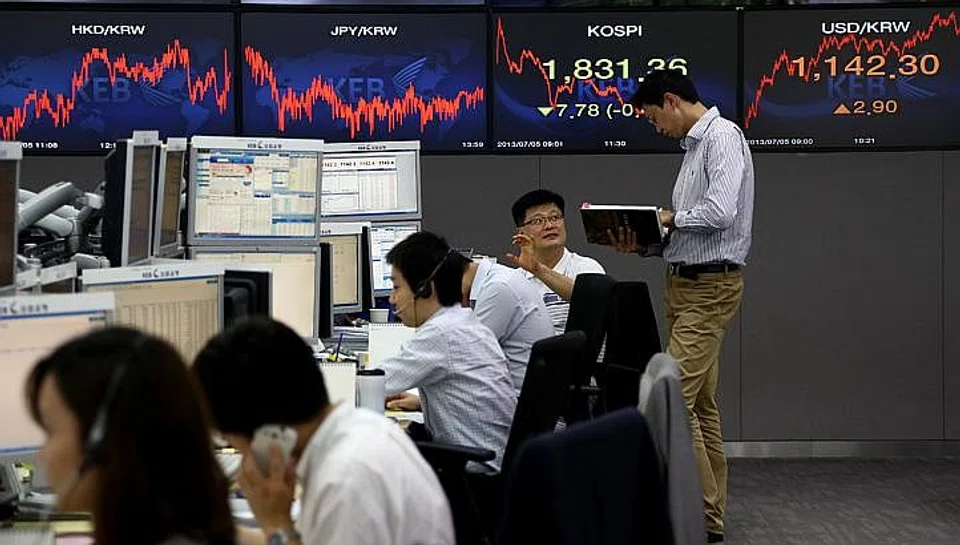
SOUTH Korea's smaller companies are beating larger peers by the most since 2005 as President Park Geun Hye boosts stimulus and promotes entrepreneurship. The small-cap Kosdaq Index has advanced 15 per cent this year, outperforming the benchmark Kospi by 14 percentage points and beating the MSCI Emerging Markets Small Cap Index by 6.5 points till Monday. Mark Mobius, whose US$1 billion Templeton Asian Smaller Companies Fund topped 98 per cent of peers during the past five years, has been boosting holdings in South Korea and now has more than 30 per cent of his fund invested in the country.
While a stronger won and disappointing earnings have dragged down exporters such as Samsung Electronics Co, South Korea's small-cap companies are gaining from fiscal stimulus and Ms Park's push to level the playing field with conglomerates.
Growth in Asia's fourth largest economy will probably accelerate to 3.7 per cent this year from 3 per cent as government spending rises and lower interest rates support domestic demand, according to forecasts from the finance ministry.
"With the encouragement of the government to put small and medium-cap names first, that's going to be very important going forward," said Mr Mobius, who oversees about US$40 billion as the executive chairman at Templeton Emerging Markets Group. "We'll be able to find more variety in the Korean market."
The Kosdaq, whose companies have a median market value of US$62.4 million, fell 0.3 per cent to 575.56 at the close in Seoul. The Kospi, with a median value of US$183 million, retreated 0.5 per cent. The won rose 0.1 per cent against the US dollar. It strengthened 0.4 per cent on Monday after Standard & Poor's raised the nation's credit rating outlook last week to "positive" from "stable".
Sansung Life & Science Co, a Gyeonggi-based maker of packing materials, has surged 579 per cent this year for the biggest increase on the Kosdaq. Com2us Corp, a developer of mobile games, advanced 471 per cent.
The gains have left small-cap companies trading at wider-than-average premiums versus larger peers. The Kosdaq is valued at 1.5 times net assets, a 46 per cent premium over the Kospi. That compares with a mean gap of 25 per cent during the past decade, according to quarterly data compiled by Bloomberg.
Sansung L&S has a price-to-book ratio of 9.2, up from 1.3 nine months ago. The multiple for Com2us has increased by more than five times during the period to about 11.
"Small-cap stocks do have valuation risks," Lee Jin Woo, a fund manager at KTB Asset Management Co, which oversees about US$7.9 billion, said from Seoul on Sept 18.
Money managers are still adding to their holdings, lured by faster earnings growth, said You Seung Min, chief strategist at Samsung Securities Co. Small-cap funds with at least one billion won (S$1.2 million) under management have posted a three-month return of 8 per cent, versus 2.9 per cent for large-cap funds, according to Seoul-based researcher KG Zeroin Co.
Sansung L&S posted 6.7 billion won of operating profit in the three months ended June 30, an almost 12-fold increase from a year earlier. Com2us's operating profit jumped almost eightfold.
"Earnings are the biggest reason we're seeing a rally among the smaller companies," Mr You said. "While investors see the valuation burden, they still have no choice but to create a portfolio with an overweight in small and mid-sized companies."
Meanwhile, Samsung Electronics posted the smallest quarterly profit in two years as marketing costs at the world's biggest smartphone producer increased and the won strengthened. Second-quarter earnings at Kospi companies trailed analyst estimates for at least the seventh straight quarter, according to data compiled by Bloomberg.
"More eyes are turning to small and mid-sized stocks since the earnings at large caps keep disappointing investors," Jung Yong Hyun, a Seoul-based fund manager at KB Asset Management, which oversees about US$34 billion, said on Monday.
Ms Park's plan to promote South Korea's "creative economy" is also supporting small-cap stocks, Bruce Lee, the Seoul-based chief executive officer at Zebra Investment Management, said on Sept 19.
The country's first female president said in January that the government will establish a so-called "centre for creative economy and innovation" this year that provides assistance to small and medium-sized companies.
She said that the goal is to help people with fresh ideas get financial aid without collateral, amid legislative steps to rein in the influence of chaebols, the country's conglomerates. Two centres have been set up in Daejeon and Daegu this year.
Sales at the nation's five biggest conglomerates were equivalent to about two-thirds of gross domestic product last year, according to South Korea's Fair Trade Commission.
South Korea's government is also taking steps to bolster the domestic economy. Finance Minister Choi Kyung Hwan has announced an 11.7 trillion won stimulus package, eased mortgage lending controls and outlined plans to give tax breaks to companies that boost dividends and investments. The central bank has cut its policy rate to the lowest in more than three years and faces growing pressure to reduce borrowing costs further. - Bloomberg
TRENDING NOW

‘The next 40 years’: SingLand CEO Jonathan Eu on remaking Marina Square
SGX gold-linked counters lose their shine as the precious metal hits one-year low

Peter Kwee’s Ridley Park bungalow on the market with S$100 million asking price

Alibaba sued for allegedly hiding ties to suspected spy Alice Huang from Megaspeed

