

Strides in governance could help Asian markets challenge US exceptionalism
But the US’ strength lies in its edge in corporate governance – investors enjoy legal clarity, shareholder empowerment and deep, liquid capital markets

AT THIS time in 2025, optimism reigned over the concept of US exceptionalism, the notion that the US is unique and hence is expected to generate outsized returns.
But as the year wore on, that narrative lost steam.
Where does US exceptionalism stand today? The concept is far from dead, based on the many opinions and strategy reports that come my way.
However, 2025 brought attractive opportunities outside the US which were far more rewarding than the S&P 500.
Last year, the S&P 500 returned around 17.9 per cent, compared to 30 per cent for Asia ex-Japan and 34.4 per cent for emerging markets.
But what about the future? Andy Budden, investment director of Capital Group, argues that the secret sauce of American exceptionalism is rooted in two things: The US is the global hub for innovation, and offers “rock-solid” corporate governance.
He said: “I’d argue that that’s not changing. But if you can hear a little hesitation, it’s because part of the formula for US success has been solid institutions like the Federal Reserve and the Department of Justice, just to name two at random.”
The Fed was recently served with subpoenas by the Department of Justice, relating to the multi-year project to renovate its office buildings.
Fed chair Jerome Powell said in a statement that the investigation is unrelated to the renovation, but rather “is a consequence of the Federal Reserve setting interest rates based on our best assessment of what will serve the public, rather than following the preferences of the president”.
He said he would stand firm to serve out the Fed’s mandate of ensuring price stability and maximum employment.
Budden said: “American exceptionalism is not dead, but of course, it’s very important to always be vigilant. We don’t see cracks appearing in the system yet.”
Long-run historical data between 1900 and 2024 shows that US equities outperformed the world (ex-US) by some 2.3 percentage points.
Here are some insights relating to the two pillars of US exceptionalism, as cited by Budden.
AI valuations: Bubble or not
Most strategists are convinced the artificial intelligence (AI) theme is transformative and here to stay. Even lofty valuations can be justified, as they see it. DBS’ chief investment office’s outlook report for the first quarter of 2026 says the AI boom has “the hallmarks of froth, with soaring valuations, concentration risk and speculative fervour”.
But it also adds: “Unlike the dotcom bubble, today’s macro backdrop and policy support are far stronger. Big Tech’s spending plans, while massive, remain proportionate to GDP (gross domestic product).”
It warns against complacency, however. One concern is circular funding, under which companies fund one another’s growth. This, it said, is not unlike the vendor financing practices of the 1990s and “deserves close scrutiny for systemic vulnerabilities”.
Budden said valuations of AI infrastructure companies appear high, but they look more reasonable once future revenue and profit growth are factored in.
“There are estimates that total spending on AI infrastructure will have reached US$7 trillion by the middle of next decade. If you assume that AI can take meaningful market share of the US$40 trillion global knowledge worker economy, then there is a case for this scale of investment.
“But it depends on companies finding productive ways to deploy AI to improve their performance and productivity within the next three to five years.
“At this stage, the jury is out, but we’re optimistic. We’re meeting with a lot of companies – banks, industrials, retailers, pharmaceuticals, software; they have hard evidence that AI is making an impact on their bottom line.”
In its 2026 outlook report, Blowing Bubbles, Standard Chartered expects the valuation debate to persist through the year, “resulting in bouts of volatility when high expectations are not decisively exceeded”.
Its positive outlook for equities this year is anchored by a few factors, including the persistence of the AI theme, Fed rate cuts in 2026 and a weak US dollar, which is historically positive for risk assets.
Pictet’s Alexandre Tavazzi cautions that AI could turn “from a gift into a curse”. “If the AI-driven momentum were to falter, the wealth effect that has buoyed consumer spending and capital expenditure could unwind, and US economic resilience with it. The K-shaped economy would close from the top. This could lead to a recession.”
Corporate governance: Asia catching up
The Capital Group’s report, The Great Global Restructuring, reiterates that the US has an enviable edge in offering investors a combination of legal clarity, shareholder empowerment and deep, liquid capital markets.
Its particular strength is corporate governance; the long history of alignment between corporate and shareholder interests has paid off in shareholder returns and a lower risk premium.
However, some Asian markets have begun to pursue governance reforms and now present compelling opportunities. The report said US dominance “is no longer unchallenged”, and competition is narrowing the gap.
Japan, for instance, began to change its governance standards a decade ago, moving towards a more shareholder-aligned model. Its reforms are bearing fruit. Japanese companies have significantly increased dividends and buybacks, and reforms have since driven a rerating of Japanese equities.
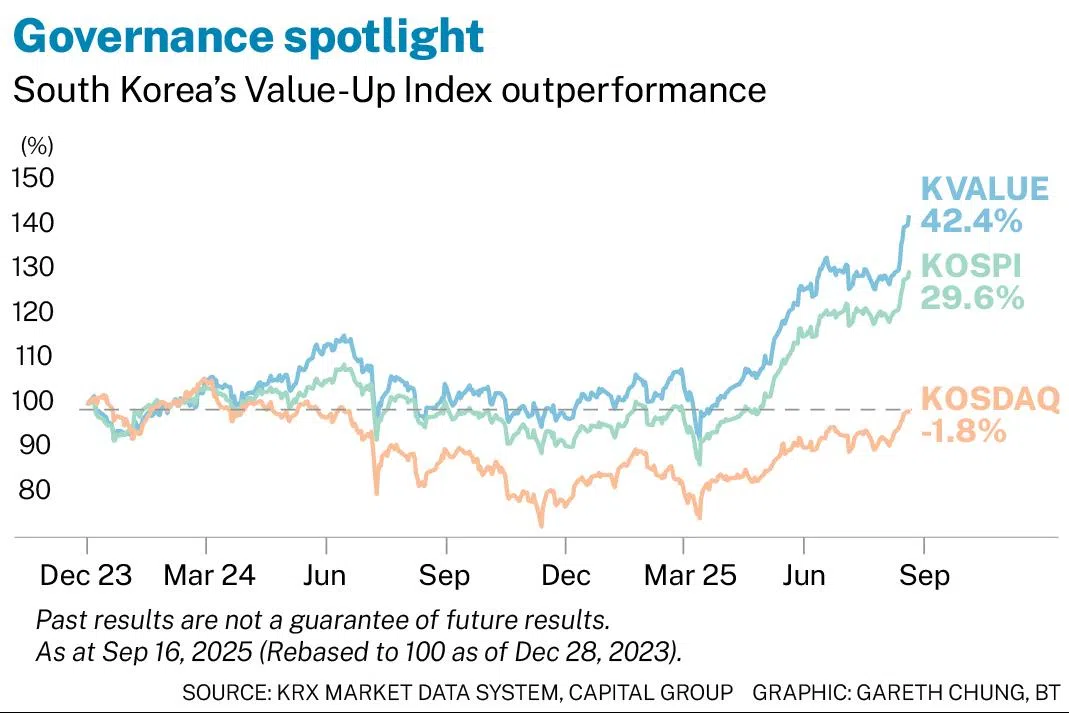
Following in Japan’s footsteps is South Korea, where equities have long been traded at a discount to global peers, due partly to governance challenges arising from complex cross-shareholding structures and limited board independence. In a major effort to enhance shareholder returns, South Korea launched the Corporate Value-Up Programme in 2024.
Its positive impact is apparent. At end-2025, the South Korea Value-Up Index recorded an 89.4 per cent year-on-year gain, reaching a new all-time high of 1,797.52 points, outperforming the Kospi’s 75.6 per cent gain. The key indicators of the South Korean stock market, including price-to-book and price-to-earnings ratios, also improved.
China has also taken steps. In 2024, the China Security Regulatory Commission issued its first comprehensive directive on “market value management”, defined as “strategic management actions” to boost shareholder value. The reforms extend to state-owned enterprises as well.
Elsewhere, Taiwan, Thailand and Taiwan have also taken steps to enhance governance. Capital Group said in its report: “As governance standards rise across Asia and these markets close the gap with the US, global capital is iincreasingly willing to flow to markets that reward transparency, accountability and investor alignment…
“In a world of rising governance parity, the US must continue to earn the trust premium that has historically set it apart.”
TRENDING NOW

ComfortDelGro appoints two new independent directors

Once staunchly pro-China, Malaysian Chinese businesses are now distancing themselves from Beijing

NoonTalk needs continued financial support from CEO Dasmond Koh, auditors warn

DP Architects sets the benchmark for sustainability disclosure and design

