
Taking a sensible approach to ongoing risks
Patrice Conxicoeur of HSBC Asset Management says investors should worry first and foremost about return of capital
 Add BT as a preferred source
Genevieve Cua
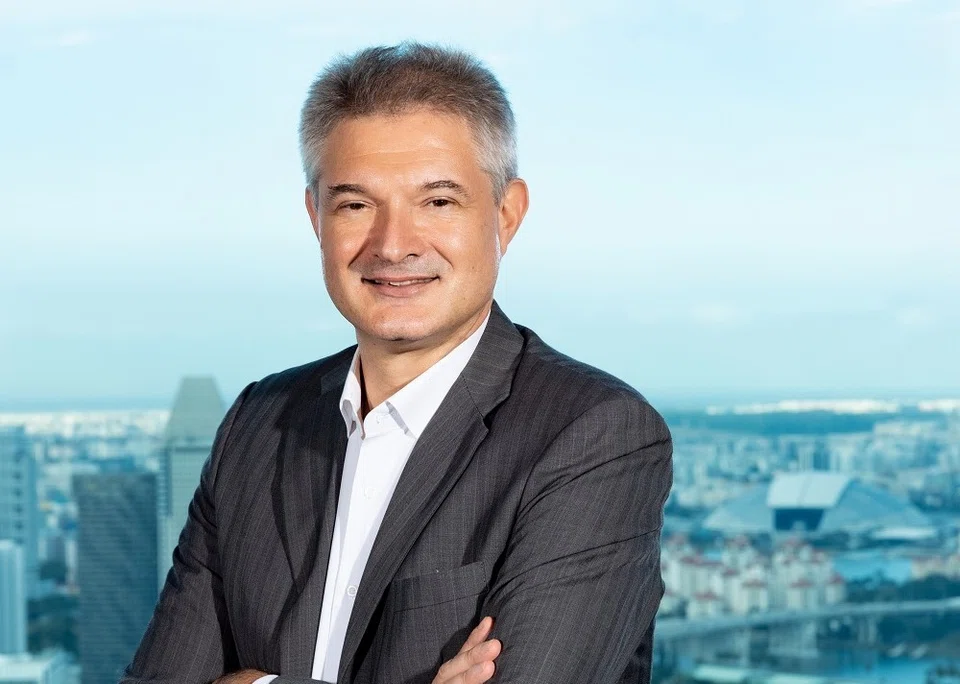
TODAY'S volatile environment, where markets struggle to find an even keel amid a plethora of risks, is one where investors should "worry first and foremost about return of capital before we worry about return on capital", says Patrice Conxicoeur, Singapore chief executive and Southeast Asia head of HSBC Asset Management.
Conxicoeur was speaking specifically about fixed income markets, where credit spreads have widened. But it is arguably a prudent stance for investments in the current climate, where for the first time in more than a decade, inflation and interest rates are climbing, dealing a double whammy for bonds. Equity markets are also grappling with a reckoning on valuations.
While the upward trend in rates and inflation could to some degree have been anticipated since last year, the Russia-Ukraine war was a wild card.
"We're dealing with more uncertainty now than has been the case for a long time. When we have uncertainty, we have volatility. This creates opportunities, but often those opportunities arise out of pain. As portfolio managers, we're generally more comfortable talking about the medium- to long-term, because the unwritten rule of asset management is that when you make predictions about the next hour or day, you're just flipping a coin. The longer the period of forecast, the higher the probability of being right because the short period is a random walk. But over a longer period, fundamentals tend to reassert themselves. A year like this forces us to be more tactical or short-term than we'd like to be."
Conxicoeur's base case is a scenario where inflation remains elevated for most of the year, and monetary policy is on "autopilot", which suggests that rates rise globally. In this scenario, to which he assigns a probability of 70 per cent, economic growth remains "solid".
A brighter scenario, albeit with a lower probability of 15 per cent, is a Goldilocks scenario where inflation tamps down and supply chain snarls ease. The flip side of this, however, is bleak. Supply chain issues are unresolved; commodity and food prices remain elevated and feed into inflation and growth, and corporate profits suffer. In all 3 scenarios, central bankers hike rates.
Navigate Asia in
a new global order
Get the insights delivered to your inbox.
"All those scenarios lead us to prefer equities against fixed income. Even in the best scenario from a growth perspective, there is nothing to hold back central bankers from hiking rates. And in the worst case, we end up in a recession, but not before we have a prolonged bout of inflation. I don't think central banks will sit on their hands, even the ones who have a growth mandate. So, this is more of an equity environment. Even longer duration (fixed income) is unlikely to be rewarded."
Across the board in all scenarios and asset classes, the importance of environmental, social and governance (ESG) considerations in investments remains resonant. He believes an ESG discipline can become a source of outperformance. This places a premium on on-the-ground research and active management.
"I think we're in a world where both private investors and institutional or professional investors care more than ever, and also are mandated to care by their shareholders or regulators. ESG doesn't go away.
"We're in a difficult environment, which is most likely the case for the foreseeable future. But on top of this, you need to worry about what exactly makes the company tick from an ESG perspective, so you need to do your homework. If you don't do your homework, you end up in a tick-box environment, and sooner or later someone will call you out for greenwashing. I think market tolerance for (greenwashing) is rapidly waning."
There are pockets of opportunity, however, in fixed income. Wider credit spreads have raised yields, even as they signal higher risk even among prime corporate issuers. A segment that Conxicoeur likes is securitised debt which gained notoriety when subprime loans imploded and sparked the 2008 great financial crisis. "The reality is that asset-backed and mortgage-backed paper is of much higher quality now than pre-2008 crisis, and it still has a complexity premium. Which is a polite way of saying there are still many out there who would not touch it with a stick … And these are usually variable rate papers, where the yield resets on a quarterly basis. In a rising rate environment, what's not to like?"
He also sees opportunities in emerging market debt, which has suffered a beating this year. In March, hard currency emerging sovereign debt spread soared to more than 500 basis points, which it has done only twice in the past. "Emerging markets have taken a battering since the beginning of the year, and on the heels of a year which wasn't exactly pretty either. This creates fantastic pockets of opportunity in spreads that are much higher than anything we've seen since the last crisis … But selectivity is very much the rule of the game, and research. As we've learned from the Russia-Ukraine war, no one is immune from being surprised from time to time."
An ESG-integrated investment process has to be underpinned by quantitative and fundamental research. "We're still in a period where (ESG) data is not as complete as we like it to be. The source of outperformance is really the good old informational advantage on what makes some companies more robust than others, and how much confidence we can have in them."
The firm does not believe in a mainly exclusionary approach or a blacklist of companies to avoid. "By definition, if we say - these are the bad guys, and we sell their stock. How do we sell it? By finding a willing buyer, who presumably cares less than we do. So maybe the net effect isn't one we would like… The vast majority of companies are neither heroes nor villains, but somewhere in between. Our job is to help them on this journey just as we help our clients and investors. This is what engagement is all about."
For investors, Conxicoeur has some sensible, evergreen advice. One, don't be a hero and take undue risk. Two, be diversified. "At the risk of sounding boring, diversification is more important than ever. There's nothing wrong with having part of your portfolio in very punchy, metaverse theme or climate change, very concentrated and very aggressive. But it should be in the context of a widely diversified portfolio, not 25 per cent of your hard-earned cash."
Three, be disciplined, have a plan and stick to it. "This is the good argument about monthly investment plans, which tend to disconnect the investment decision from yesterday or last week's market move, which in the long run never matters."
“"We're still in a period where (ESG) data is not as complete as we like it to be. The source of outperformance is really the good old informational advantage on what makes some companies more robust than others, and how much confidence we can have in them."”
Patrice Conxicoeur
Copyright SPH Media. All rights reserved.

