Time to cast a critical eye on ESG investing
Research suggests there is little evidence to support the claim that by investing sustainably, investors can do well and do good at the same time. Investors should consider their objectives

Genevieve Cua

THE bear market is raising tough questions on funds with the ESG (environmental, social, governance) or sustainable label, and the scrutiny has come none too soon.
The scrutiny has less to do with greenwashing – which remains pervasive – but more to do with a fundamental divide between investors’ interests and the feel-good goal of doing good for societies and the environment. Can investors have their cake and eat it?
Quite apart from the bear market, longer-term data and research suggest that there is little evidence to support the claims that investors can do well and do good at the same time, and that there is no trade-off in returns. What 2022 returns show, albeit over a short period, is that there is a trade-off in returns.
And, while the five-year returns data still reflects an outperformance by ESG funds over their non-ESG counterparts, it isn’t clear that the outperformance can be attributed to any sustainable bent. Rather, it’s more likely due to a bull market backdrop of low rates and a bias towards growth investing – and technology in particular.
In the year up to end-August, MSCI’s ESG indexes for global equity underperformed the MSCSI ACWI index. Sustainable funds this year suffered twin blows: exclusion of energy stocks caused them to miss out on the year’s best performers, and an over-exposure to tech stocks which suffered the brunt of a rising interest rate and inflationary environment.
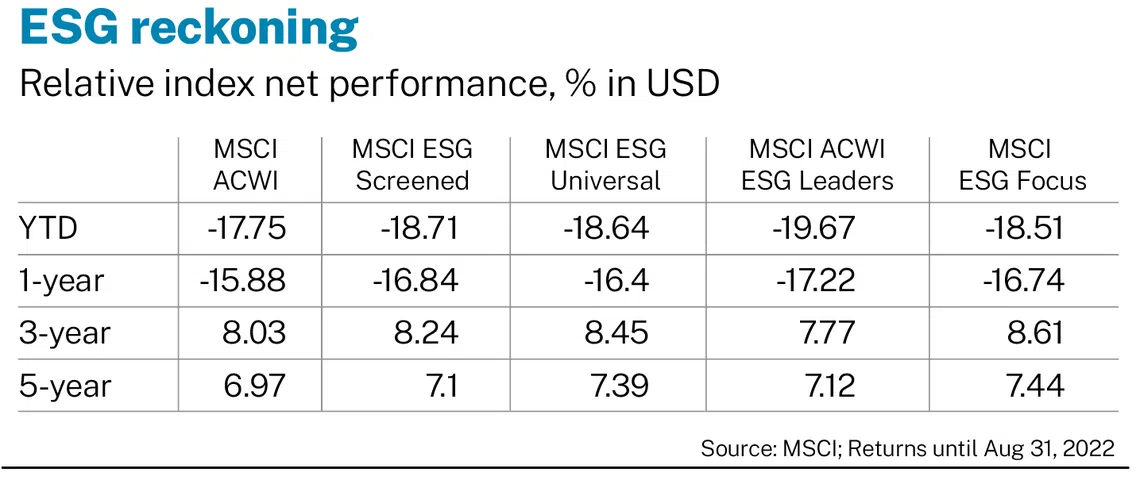
MSCI’s data for five years shows some outperformance. But not if you examine Bloomberg data which shows an underperformance by global ESG funds – a return of an average 6.3 per cent annualised since 2017 compared with 8.9 per cent for broader funds up to mid-June. According to Bloomberg, an investor who put US$10,000 into an average global ESG fund in 2017 would have US$13,573 this year, roughly US$1,720 less than if they’d put it into a non-ESG portfolio.
Rich Nuzum, Mercer’s executive director (investments) and global chief investment strategist, who was recently in Singapore, welcomes the scrutiny. “I think questions should be asked, and the scepticism is potentially useful, because ESG is not one-size-fits-all.
“There are many issues an investor could focus on in ESG. But even before we get to whether your focus is on climate, biodiversity, water security, circular economy, or diversity… even before we get to any specific issue, why are you doing ESG? Because you want to outperform, or you want to have an impact, or achieve both at the same time? Those are three different things. And they will lead you to three different strategies.
“It’s not one-size-fits-all. And there are very sophisticated investors, including some in Singapore, that fall into the category of what I would call brown-to-green as relates to climate. They are trying to solve the problem of climate by working with all actors, including traditional energy companies to come up with solutions.
“I personally think that’s the right and best approach. Other investors screen out any traditional energy company because of their role in producing carbon. And activists then attack investment managers or asset owners and say – How can you own this traditional energy company? But if the companies went out of business, the economy would tank, and we wouldn’t be able to afford to invest to mitigate carbon.’’
In short, an ESG or sustainable label is powerful for marketing, but investors will need to consider what they want to achieve from an ESG investment, if they are to even begin to navigate the sustainable funds universe, which itself is mired in complexity because of inconsistencies in taxonomy, disclosures and labelling.
Here are some insights to consider.
Gap between what ESG ratings signify and investor perception
An ESG rating sends a signal that a company or fund is better in its ESG practices than others and hence benefits the world, correct? Wrong.
For example, MSCI’s ESG ratings, widely used by funds and distributors here, do not measure a company’s impact on the earth and society. Instead, as a Bloomberg analysis points out, the ratings assess the potential impact of the world on the company and its shareholders. MSCI itself says this: “Our ESG ratings provide a window into one facet of risk to financial performance. They are not a general measure of corporate ‘goodness’, a barometer on any single issue or a synonym for sustainable investing.’’
Similarly, Sustainalytics’ risk ratings seek to reflect a company’s unmanaged ESG risks that could wield a “substantial impact on the company’s economic value”.
Do ESG funds deliver value?
A paper by Cornell and Damodaran, Valuing ESG: Doing Good or Sounding Good?, finds the evidence is inconclusive on whether higher ESG ratings are associated with higher risk-adjusted returns. There is also little evidence that socially responsible funds that invest in companies with high scores for corporate social responsibility deliver excess returns.
Say the authors: “In many circles ESG is being marketed as not only good for society, but good for companies and for investors. In our view, however, the hype regarding ESG has vastly outrun the reality of both what it is and what it can deliver. The potential to make money on ESG for consultants, bankers and investment managers has made them cheerleaders for the concept, with claims of the pay-offs based on research that is ambiguous and inconclusive, if not outright inconsistent with some of the claims.’’
Massive reclassification of funds a potential drag
Following the implementation of the EU Sustainable Finance Disclosure Regulation in 2021, Morningstar has been reclassifying funds based on a review of documents against the new set of regulations. Article 6 funds look at potential ESG risks; Article 8 funds, seen as “light green’’, “promote’’ ESG categories. Article 9 funds have measurable ESG “objectives’’, and are seen as “dark green’’.
Morningstar, which in January removed the ESG label from 1,200 funds with over US$1 trillion in assets, recently said that nearly a quarter of funds classified as Article 8 do not live up to ESG investing principles. In the second quarter, Article 8 funds saw significant outflows of 30 billion euros (S$42 billion) compared to 5.9 billion euros in inflows to Article 9 funds.
As the dust has yet to settle on fund labels, lending weight to accusations of greenwashing, ESG-labelled funds may well be regarded with increased scepticism by investors, quite apart from the heightened risk-off sentiment this year.
ESG as a process vs a product
As more funds and managers jump on the ESG bandwagon, it’s important to distinguish between a fund that employs ESG criteria and data in its investment process, and an ESG-labelled fund that may be thematic in nature. As Jon Hale of Morningstar writes in a column, the use of ESG-related inputs in the investment process has become widespread, as this is expected to better help investors understand the risks a company faces. Increasingly, these inputs also guide fund managers’ engagement with companies.
In contrast, ESG as a product is likely to have explicit exclusions of certain sectors, among others. Funds that want to be differentiated themselves may emphasise specific themes or even claim certain positive impacts. Whether they live up to these claims is something investors will need to further scrutinise.