

Weighing portfolios’ greenback exposure: US exceptionalism has ‘room to run’
The US dollar’s status as a safe-haven asset is being eroded on tariff and economic uncertainties; the downgrade of the US’ credit rating; and looming questions on the US’ debt sustainability

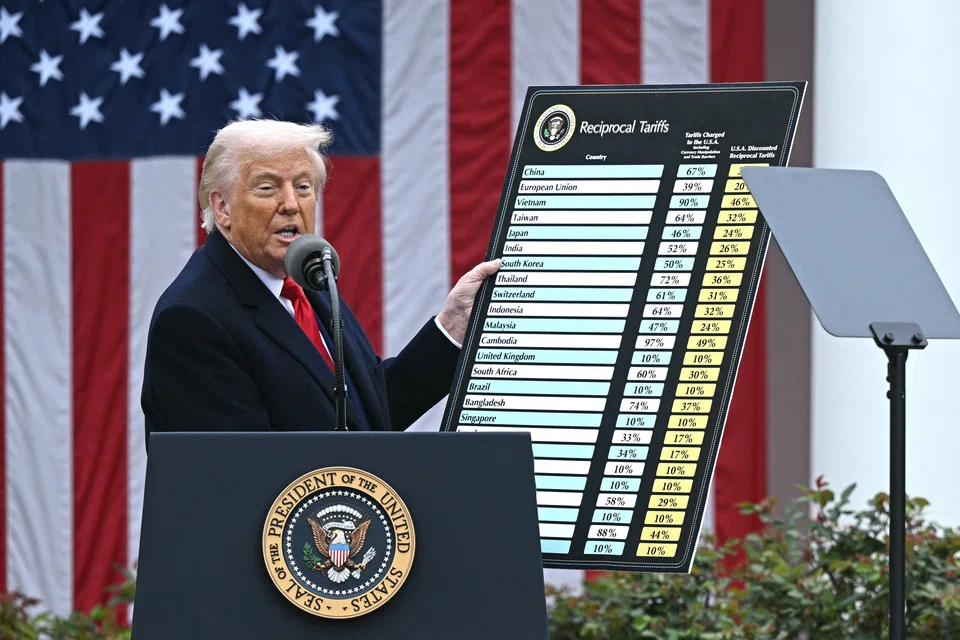
[SINGAPORE] Investing in US dollar (USD) assets has been a no-brainer for decades. USD strength was seen as a given – many of its strengths remain today: it is the world’s primary reserve currency; it undergirds global trade; and it is also the main currency for issuance of non-US sovereign and corporate debt.
But with the fading of the US exceptionalism narrative, private clients are grappling with the big question of whether they should sell or lighten US assets and their USD exposure.
The strengthening of Asian currencies such as the Singdollar against the USD has had a material impact on returns from US assets. The price return of the S&P 500 year to date, for example, is around 2.78 per cent in USD. For SGD-based investors, this translates into a loss of 3.6 per cent.
Other investors whose home currencies have strengthened face a similar predicament. In euro terms, an investment in the S&P 500 has lost 8 per cent; for yen investors, the loss is nearly 6 per cent.
Year to date, the Dollar Index (DXY) has declined by more than 9 per cent. Strategists believe the DXY could bounce from current levels, but the six-to-12-month view is that of continued weakness.
The USD’s status as a safe-haven asset is being eroded on several fronts – tariff and economic uncertainties, Moody’s downgrade of the US’ credit rating, and looming questions on the US’ debt sustainability. US President Donald Trump’s “Big Beautiful Bill”, which has yet to pass in the Senate, is expected to increase the US’ deficit by US$2.6 trillion between 2025 and 2034.
Norman Villamin, UBP group chief strategist, said in a presentation last week: “We think we’ve now pivoted to a structurally weak dollar regime. This is an important shift in terms of how we invest going forward.
“Until now, we’re used to thinking about everything in dollars, and that’s okay as long as the dollar was strong. But now we must think about investments in the context of the currency that we eventually receive.”
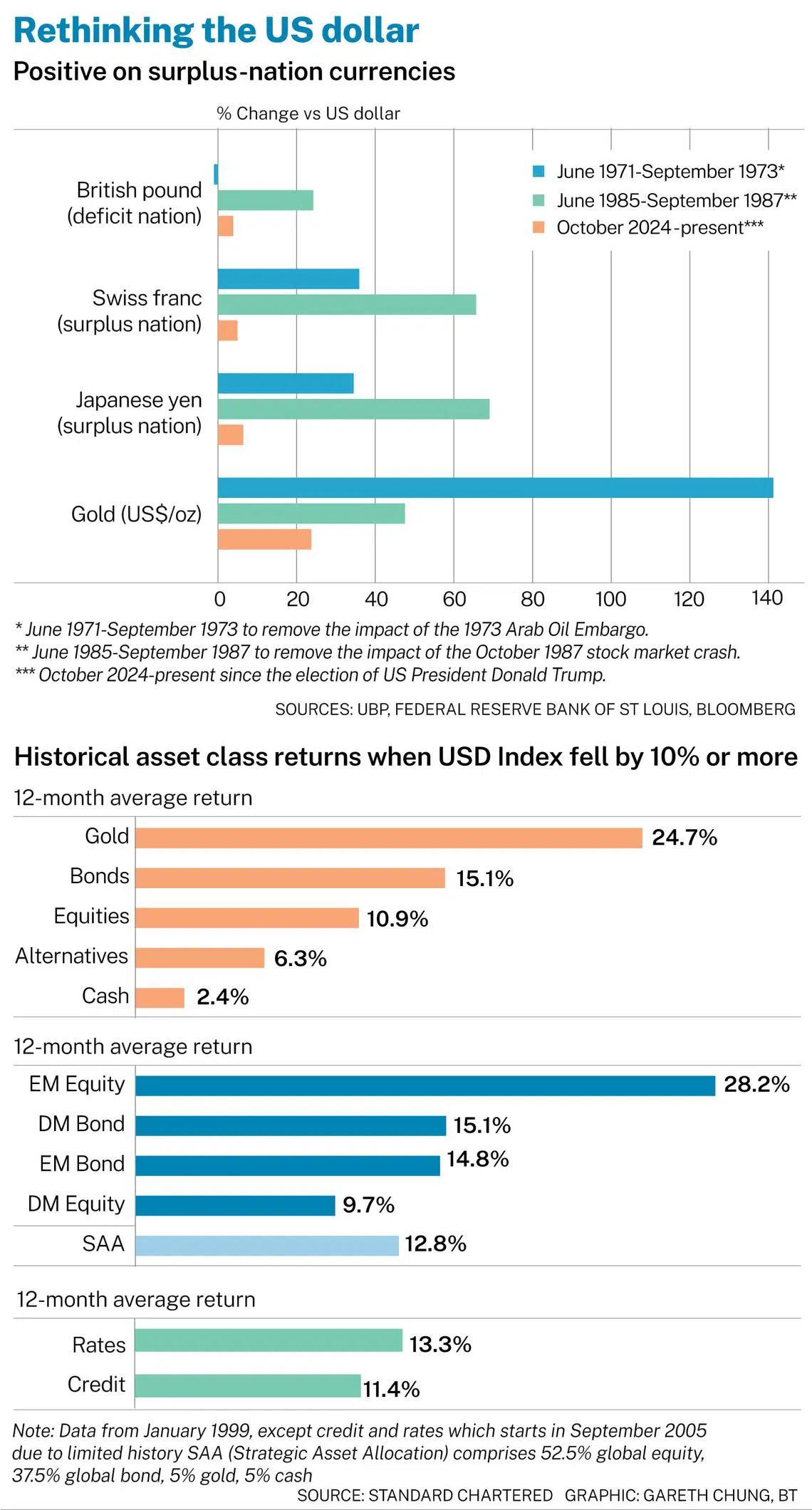
Currencies of countries with a capital account surplus are set to benefit from USD weakness, he added.
UBS downgraded the USD from “neutral” to “unattractive” this month, said Hartmut Issel, Apac head of equities and credit at UBS Global Wealth Management.
“We anticipate renewed dollar weakness as the US economy slows and as focus shifts to a potential expansion of the already large US fiscal deficit,” he said. “We believe the recent stabilisation in the dollar presents a good opportunity to assess dollar needs and use dollar strength to diversify.”
Stay diversified; gold benefits
Strategically, the most prudent path for investors is to stick to a globally diversified portfolio, as there are assets and currencies that benefit from USD weakness. One is gold, whose price typically rises when the USD is weak. Emerging market assets including Asia ex-Japan equities and bonds also benefit.
Gold’s standing as a safe-haven asset is further enhanced amid rising geopolitical conflicts. UBP’s Villamin has the most optimistic forecast for gold price at US$4,000 an ounce this year. The price currently stands at around US$3,432. It has risen more than 30 per cent year to date.
He said: “Clients ask, can I wait for a pullback to buy? Yes, you can. We still think there’s opportunity in gold. But our clients who tried to buy the dips in gold have not been so successful over the past 18 months.”
DBS chief investment officer Hou Wey Fook expects gold to be well-bid; DBS has a year-end target price of US$3,765. “Some key tailwinds include continued central bank reserve diversification and robust investor demand in this new era of heightened risk and uncertainty,” he said.
Still, strategists caution against going overboard on the “sell America” trade – simply because there is yet no alternative to the USD and US corporate earnings remain resilient.
Villamin reckoned the US economy would be stronger than consensus expectations. “We continue to be of the view that the Federal Reserve may cut interest rates, but they are going to cut a lot less than everybody expects,” he said.
“We look at what final demand (based on activity indicators) is doing. For the consumer, not only credit cards, but also auto loans and residential real estate are actually strong and picking up. So all the tariff news and terrible sentiment are bad, but the actual activity is pretty good.”
Oxford Economics dismissed expectations of a “seismic shift” in USD dominance anytime soon – both as a reserve currency and anchor of the global financial system. The sell-off of the USD, equity and fixed income assets is so far driven by three developments unique to the tariff shock, it wrote in a report.
One, the hit to demand from tariffs is larger in the US than the rest of the world. Two, international investors are rebalancing their over-exposure to US assets. The third is acute US policy uncertainty.
Sell America? Not so fast
Strategists remain generally positive on equities, including US stocks. Standard Chartered upgraded global equities in a June advisory, thanks to a “sharp improvement in near-term outlook”. It has a “small overweight” on US equities, even as it urges clients to remain diversified.
Rajat Bhattacharya, senior investment strategist at the bank’s wealth solutions chief investment office, believes the “sell America” trade is overdone, at least in the near term.
“US policy has turned more pragmatic following the negative feedback from markets on the initial tariff proposals. The Trump administration’s focus has shifted to passing a mildly stimulative budget, including tax incentives for companies and households,” he said.
Bank of Singapore (BOS) has a “moderately overweight” call on equities, in favour of European and Asia ex-Japan equities “on the back of undemanding valuations and better outlooks on support from fiscal and monetary policies”, said global chief investment officer Jean Chia.
She expects USD-based returns to continue to face headwinds over the next 12 months against currencies such as the euro. Still, the concept of US exceptionalism has room to run, she maintained.
“US dollar dominance will not fade fast due to few alternatives. We would caution against making drastic shifts in holdings on currency considerations alone, and instead consider a balanced portfolio. Many US-based assets remain core holdings for investors in the near to medium term, given the size of the asset base and for company or asset-specific reasons,” she said.
DBS’ Hou said: “Rather than attempting the near-impossible feat of timing the market or unpredictable events, staying invested in a well-diversified portfolio allocated across multiple asset classes helps cushion the geographical and currency risk.”
Hedging the currency exposure is, of course, an option. BOS’ Chia said hedging is reasonable for investors who demand certainty in expected cash flows, and are willing to give up some parts of their return.
“We note that dollar weakness has emerged as a market consensus view – it’s priced into the market and is relatively costly. So, the benefits of hedging at the moment differs across investors and/or currency pairs,” she added.
A paper by Dimensional Fund Advisors’ head of investment research Wei Dai, which examined 12 markets between 1985 and 2019, found that the benefits of hedging would depend on the volatility of the asset relative to the currency. Equities’ volatility tends to be greater than that of currencies, and hence hedging a stock portfolio’s currency exposure may not reduce overall return volatility.
But currency volatility tends to dominate the returns of a bond portfolio, and hedging could help dampen the portfolio volatility.
TRENDING NOW

DBS remains analysts’ pick ahead of Q3 earnings after Singapore banks’ share slump

Singapore identifies 7 firms responsible for haze fires, notices issued urging action: Grace Fu

Good Class Bungalow market activity picks up pace on ‘realistic’ pricing

High Court rules against Julius Baer’s Singapore trust arm in US$50 million family trust dispute

