

What to make of war, oil price, inflation and volatility
Resist the urge to time markets around headlines; instead, be patient and stay invested in a diversified portfolio
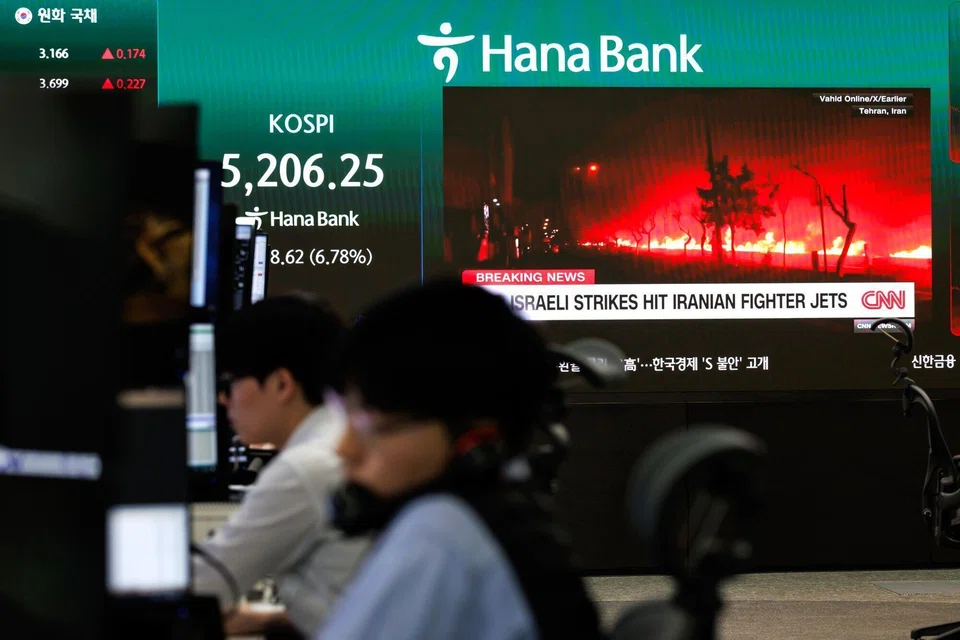
THE first week of March rocked the markets and is testing investor nerves. US and Israeli strikes on Iran shuttered Gulf airspace and triggered circuit breakers from Seoul to Karachi.
The world’s best-performing stock market in South Korea suffered its worst single-day crash since 2008.
Gold spiked, the VIX index – which is a key measure of volatility – jumped to 30, and Treasury yields whipsawed as investors struggled to decide whether to fear inflation or flee to safety.
On Monday (Mar 9), the Brent crude surged above US$100 a barrel.
It is human nature to feel that this time is different and worse than during previous conflicts. But the science of wealth demands that we look beyond the headlines and examine the evidence.
History’s comfortable lesson
Let’s start with the obvious. The relationship between war and financial markets is counterintuitive. The US stock market rose a combined 115 per cent during World Wars I and II. The Dow gained an annualised 16 per cent through the Korean War and nearly 43 per cent in total during the Vietnam War era.
During the Cuban Missile Crisis – 13 days when the world stood on the brink of nuclear annihilation – the Dow lost just 1.2 per cent, then gained more than 10 per cent by the year-end.
Maybe because military and industrial spending rises, investments to rebuild both infrastructure and arsenal were seen to lead to greater economic activity.
The pattern is remarkably consistent. Research from Carson Group, examining 40 major geopolitical events over 85 years, found that the S&P 500 lost an average of just 0.9 per cent in the first month following a shock, then gained 3.4 per cent over the subsequent six months.
According to Hartford Funds, stocks were higher one year after the onset of armed conflict roughly 70 per cent of the time, with average returns in the high single digits.
Why? Because markets ultimately respond to corporate earnings, economic growth, interest rates and innovation – not the vagaries of geopolitical winds.
Real risks elsewhere
That said, dismissing every concern would be naive. The Iran conflict matters primarily because of oil.
Roughly 13 million barrels per day of the stuff are normally carried through the Strait of Hormuz, accounting for about 31 per cent of global seaborne crude flows. Goldman Sachs estimates that the market is pricing in approximately four weeks of disruption, with Brent trading roughly US$13 above the firm’s estimated fair value of US$65.
If the conflict is short-lived, crude can simply be stored on land in oil-producing countries in the Middle East, leaving the cumulative supply unaffected. But if the strait remains disrupted beyond that window, prices could surge higher, leading to forced demand destruction.
For Singapore, in particular, this matters. Asia’s import-dependent economies are acutely sensitive to energy price shocks, and this also explains why the reactions were so sharp in countries such as South Korea. Pricier oil feeds through to consumers as higher transport, utilities and food costs.
The European Central Bank has already flagged a potential 0.5 percentage point bump to eurozone inflation. Should the Brent sustain above US$85 for an extended period, central banks globally, including the US Federal Reserve, may be forced into a “higher-for-longer” posture on interest rates, complicating the rate-cut timeline that markets had been counting on.
AI correction a bigger story than Iran
Ironically, a more consequential market eruption was already under way before the first missiles flew.
The so-called “SaaSpocalypse” of early 2026 has erased nearly US$1 trillion from the S&P 500 software and services index, as the rise of agentic artificial intelligence (AI) triggered a fundamental rerating of per-seat subscription business models. Forward earnings multiples for the software sector collapsed from 39 times to 21 times in just six weeks.
The contagion has not stopped at software. Private-credit firms with significant exposure to technology lending have seen share prices fall by 9 to 16 per cent. An estimated half of data centre investment is funded through private credit, according to Morgan Stanley, creating a web of interconnected exposures that could amplify any reversal.
The US equity market capitalisation was sitting at nearly twice the nation’s gross domestic product, well above dotcom-era levels, and the Magnificent Seven tech giants still represented roughly 35 per cent of the S&P 500.
Yale School of Management statistics showed that AI-related capital expenditure accounted for 1.1 per cent of US GDP growth in the first half of 2025, while AI-related stocks drove 75 per cent of S&P 500 returns since the launch of ChatGPT in November 2022.
This is not a sideshow. A significant correction in AI valuations would have macroeconomic consequences, potentially more durable than a four-week disruption to oil shipping lanes.
Macro overlay still important
Layer these together and the picture for 2026 becomes more textured.
Valuations were already high entering the year. The Case-Shiller price-to-earnings ratio for the US market exceeded 40 for the first time since the dotcom crash. Arguably it has been high for a while, and yet the market kept rising. Of course, it can go higher – it did during the dotcom bubble – but the margin for error is smaller.
The S&P 500 traded at 23 times forward earnings versus 14 times for the FTSE, a historically wide gap that speaks to the premium embedded in US equities and the concentration risk therein versus most other global markets.
A National Bureau of Economic Research study published in February 2026 found that despite 90 per cent of firms reporting no measurable impact from AI on workplace productivity, investment continued to pour in at unprecedented scale.
This could be seen as the classic late-cycle cocktail: elevated valuations, concentrated market leadership, geopolitical uncertainty, and an AI narrative that has driven both real investment and speculative excess.
However, just as we would caution against excessive optimism on the way up that led to concentration risk, we do not want to jump on the bandwagon of bashing all things AI.
Finally, as I wrote in the first Science of Wealth column for 2026, there was almost unanimous positivity among all the talking heads of Wall Street.
None of this means that a major correction is imminent. But it does mean that the margin of safety for investors was already narrow coming into the year, and the Iran conflict arrived at a moment when markets were already recalibrating.
What historical evidence tells us to do
The science of wealth is about using data and evidence to make better decisions – not to predict the future, but to understand the range of outcomes and position ourselves sensibly within it.
The evidence tells us three things.
First, geopolitical events, however frightening, have rarely derailed markets over the medium to long term. The initial shock is real but typically short-lived. Investors who sold during past crises almost invariably regretted it.
Second, the true risk to watch is not war itself but its second-order effects: a sustained oil-supply disruption that reignites inflation and forces central banks to tighten further. This remains a tail risk, not a base case, but it demands monitoring.
Third, the AI and software repricing is structural, not merely cyclical, and may prove more significant for portfolios than the geopolitical headlines dominating the news cycle.
For investors in Singapore and across Asia, the prescription is unglamorous but time-tested: Stay diversified across geographies, asset classes and styles. Resist the urge to time markets around headlines. Ensure that your portfolio is not excessively concentrated in any single theme, however compelling. And remember that the cost of missing the recovery almost always exceeds the cost of enduring the drawdown.
Panic sells at the bottom, but the long arc of markets bends towards growth. The question is not whether you will be invested when it does, but whether you were patient enough to stay the course.
The writer is co-founder and group chief investment officer at Endowus, Asia’s leading digital wealth platform with over S$15 billion in client assets across public, private markets and pension (CPF and SRS)






