Why gold’s price is well-supported and holds more upside
Investors are increasingly open to the idea of adding the precious metal as a risk diversifier to their portfolios
GOLD had a stellar year in 2025, surging by more than 50 per cent and pushing past an all-time high of US$5,000 an ounce in January 2026. This year, the chronically elevated levels of geopolitical uncertainty might be driving a shift in investor attitudes towards risk-hedging.
Investors are increasingly open to the idea of adding gold as a risk diversifier to their portfolio, as they perceive fragility in the current world order.
The DBS Chief Investment Office (CIO) expects more upside to gold in the coming quarters for several reasons. Supportive factors that will prolong the asset’s bull run include US fiscal concerns, geopolitical and macroeconomic uncertainty, and central banks’ diversification of their reserves into gold.
DBS CIO’s price forecast for the first half of 2026 for the yellow metal is US$5,300 per ounce and US$6,250 per ounce in the second half of 2026.
What makes gold attractive
1. It’s a risk diversifier
Gold is viewed as a risk diversifier as it is generally uncorrelated with other assets in an investment portfolio. For example, when stock markets decline (a typical characteristic of volatility), gold prices may rise, providing a portfolio hedge and reducing overall portfolio risk.
This belief has held through in previous recessions. What’s more, gold is highly liquid, which means investors are able to cash in on their holdings with ease. The importance of holding gold in a portfolio has been more obvious in the past five years due to global markets’ heightened volatility.
2. A hedge against inflation
In general, gold prices tend to rise when living costs increase. Moreover, investors buy or hold larger quantities of gold when high inflation is anticipated. This is driven by gold’s inherent value and finite supply. Therefore, it retains its value better than currencies or paper money.
With the ongoing war driving up oil prices and increasing expectations of prolonged stagflation, investor demand for gold is likely to be well-supported.
3. Weakness in the US dollar
Like most commodities, the price of gold has an inverse relationship with the US dollar as it is dollar-denominated. In previous periods of prolonged US dollar depreciation, investors have often resorted to buying gold to preserve their purchasing power.
4. Safe-haven demand
The yellow metal often performs better than other asset classes when risk aversion runs high; its price increases in periods of financial and political uncertainty.
Gold’s role as an effective geopolitical hedge stems from the view that it is useful for countries which face threats of US sanctions.
5. Increasing demand meets decreasing supply
Rising wealth in emerging economies and investment interest have raised demand for gold. As mining volumes have generally fallen over the past decade, gold prices could stay supported.
Furthermore, ongoing gold purchases by central banks reflect a wider geopolitical trend of the need to diversify foreign exchange reserves and increase holdings of neutral, hard assets, according to DBS CIO.
Ways to invest
1. Physical gold
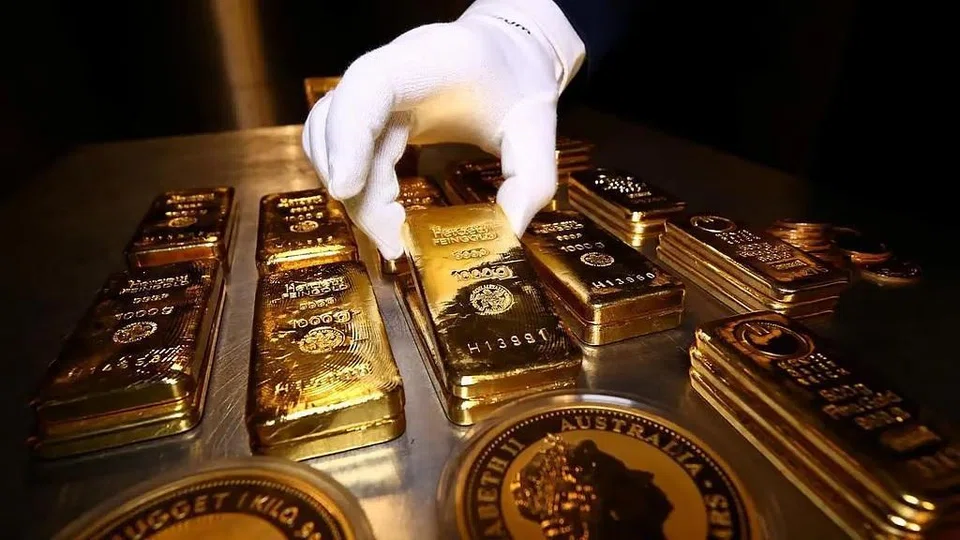
Investors typically purchase physical gold as bars or coins, storing them at home or in a bank’s safe deposit box. Some financial institutions offer gold certificates or savings accounts, eliminating the need for physical delivery.
When investing in physical gold, take note that choosing between gold bullion (minimum 99.5 per cent purity) and gold jewellery depends on your financial goals, personal preferences and practical considerations.
Gold bullion is generally preferred for long-term investment due to its better resale value and liquidity, while gold jewellery offers cultural and aesthetic value as a tangible asset that can be worn.
2. Gold-mining companies
You can also invest in gold-mining companies, which are viewed as proxies to gold performance. Investors can benefit from share price appreciation as well as dividend payouts.
However, share prices of gold miners do not directly track gold prices. Factors such as operational efficiency and profitability significantly influence their share performance.
3. Gold ETFs and unit trusts
SPDR Gold Shares ETF: This exchange-traded fund is a popular choice as it trades on the Singapore Exchange and can be purchased through brokerages in Singapore. Central Provident Fund savings can also be used. The expense ratio for this ETF is 0.4 per cent a year, with a lot size of one unit.
iShares Gold Trust: This ETF has one of the lowest expense ratios at 0.25 per cent and is the second-largest gold ETF. This makes it easy for investors to enter and exit the fund.
Unit trusts with exposure to gold: Another option is a gold-focused unit trust, such as the Ninety One Global Strategy Fund - Global Gold Fund, which offers investors exposure to both established and emerging gold-mining companies.
4. Investing via robo advisers
Some robo advisers offer exposure to gold through a professionally managed portfolio. These solutions typically allocate to gold and/or gold producers through ETFs and/or unit trusts.
Specifically, digiPortfolio’s Global Portfolio provides exposure to gold miners across all risk profiles through the iShares Gold Producers Ucits ETF, which tracks the S&P Commodity Producers Gold Index, a benchmark for gold exploration and production companies.
Do note that while gold can offer portfolio diversification and risk reduction, it does not guarantee protection against all market downturns. It’s essential to consider gold as part of a diversified investment strategy, rather than a sole protection against market volatility.
It is also important that you consider your risk tolerance, investment time horizon and market outlook for the yellow metal, among others.
Lorna Tan is head of financial planning literacy and Lynette Tan is a wealth content specialist, DBS