Why the oil shock can be China’s buying moment
The country often seen as highly exposed to rising oil prices; while this is true in absolute terms, it is an increasingly misleading way to assess risk
WHEN energy markets are rattled, investors tend to sell first and ask questions later. That instinct has weighed heavily on Chinese equities in the wake of the latest Middle East-driven oil shock.
At first glance, the reaction seems intuitive. As the world’s largest oil consumer, China is often seen as highly exposed to rising oil prices. While this is true in absolute terms, it is an increasingly misleading way to assess risk.
A shrinking dependence on oil
The more relevant question is not how much oil China consumes, but how dependent its economy is on oil.
Today, oil and petrol account for roughly 30 per cent of China’s primary energy mix, a share that has been steadily declining.
In contrast, the rest of the electricity generation comes from coal, renewables and nuclear – sources that are largely domestically controlled and structurally insulated from global oil market volatility.
This is the foundation of China’s energy resilience: a system that is less exposed to the very assets currently under geopolitical stress.
Buffers beneath the surface
China’s oil exposure is further cushioned by multiple layers of protection.
China has built a substantial buffer against external energy shocks, starting with its oil reserves. Combined strategic and commercial stockpiles are estimated at around 1.2 billion barrels, among the largest globally, and sufficient to cover more than 100 days of consumption without the need for additional imports. This provides a meaningful cushion in the event of short-term supply disruptions.
Beyond reserves, China also benefits from a strong domestic production base. In 2025, the country produced about 4.3 million barrels per day, meeting around 30 per cent of its total demand.
Since the launch of its “energy security first” policy in 2019, China has steadily increased upstream investment, enhancing output from mature onshore fields such as Daqing and Shengli, while expanding shale and offshore production. This gives China the flexibility to ramp up domestic supply and smoothen potential disruptions when needed.
On the import side, China has taken a highly diversified approach. Russia has become its largest crude supplier, supported by both pipeline flows and seaborne shipments. At the same time, China sources oil from the Americas, Africa and other parts of Asia, meaning that roughly half of its imports already originate outside the Middle East.
Taken together, China’s energy position is not just about scale, but also resilience, built on a combination of reserves, domestic production and diversified supply channels.
Inflation a smaller problem than it looks
For many major economies, an oil shock of this magnitude would quickly translate into a meaningful inflation problem. In China, however, the transmission is significantly more muted.
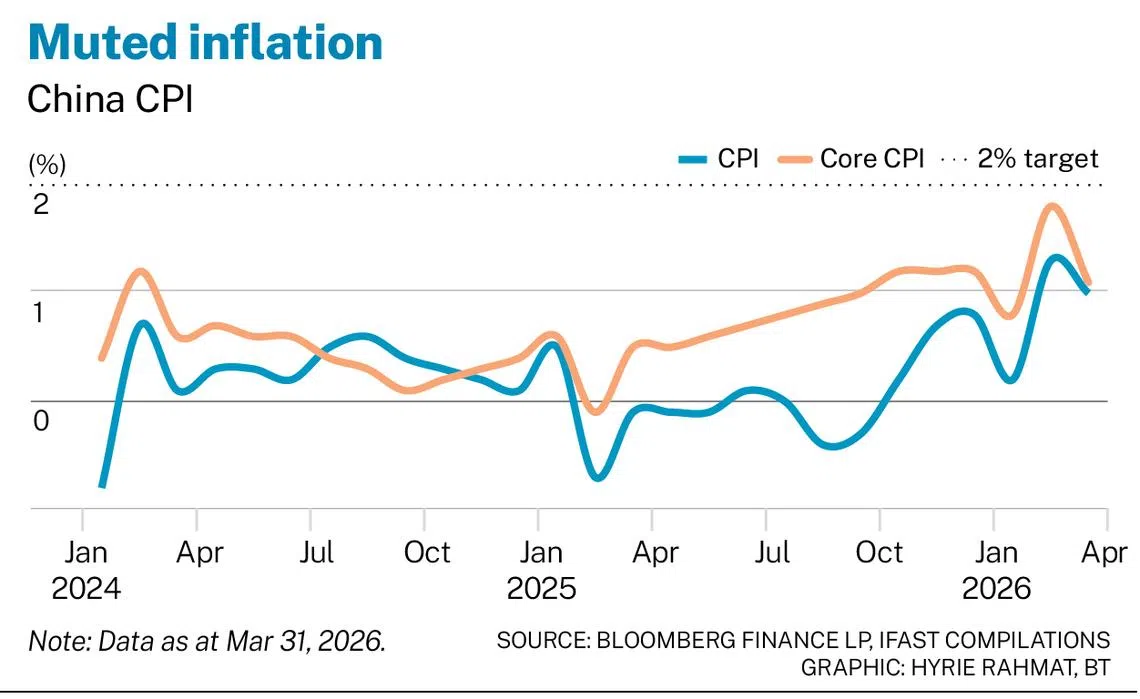
One key reason is China’s relatively low inflation base. Headline consumer price index (CPI) remained around 1 per cent in March, providing a buffer against additional price pressures. At the same time, fuel and oil-related items account for less than 2 per cent of the CPI basket, limiting the direct pass-through into consumer prices.
The rapid adoption of electric vehicles has further reduced household reliance on petrol. This means exposure to oil price fluctuations is structurally lower than at any point in recent history.
Policy support has also played an important role in cushioning the impact. In March 2026, China’s National Development and Reform Commission introduced measures to smooth domestic energy price adjustments, effectively absorbing part of the global price spike and easing the burden on consumers, particularly those still reliant on internal combustion engines.
Taken together, this leaves China in a more manageable position than many Western economies. In the US and Europe, inflation remains above central bank targets, meaning any additional rise in energy prices risks compounding existing pressures.
China, by contrast, retains greater policy flexibility. Policymakers have signalled a clear pro-growth stance following the “Two Sessions”, reducing the likelihood of a simultaneous squeeze from higher energy costs and tighter financial conditions.
Energy in the AI era
What is often overlooked in oil-shock analysis is that energy is not just a cost, it is increasingly a strategic advantage, particularly in the race for artificial intelligence. AI is inherently power-intensive, and the cost of electricity directly determines the cost of computation.
In this respect, China holds a meaningful edge. In parts of western China, where many large-scale data centres are being built, electricity costs can be as low as 0.3 yuan per kilowatt-hour (kWh). By comparison, commercial power prices in major US technology hubs typically range from US$0.08 to US$0.14 per kWh – equivalent to roughly 0.55 yuan to 0.97 yuan per kWh. This translates into a 45 to 70 per cent cost advantage for China in powering AI infrastructure.
In an industry where energy is a core input into every unit of compute, this is not a marginal difference; it is a structural moat. China’s energy system provides reliable, around-the-clock baseload power, essential for data centres that cannot tolerate interruptions, while its rapidly expanding renewable capacity is steadily improving the sustainability of this advantage.
Taken together, China is not only better insulated from energy shocks, but may also be better positioned to compete in the next phase of AI-driven growth, where access to affordable and scalable power is becoming a decisive factor.
Market dislocation a buying opportunity
If China’s exposure to oil shocks is more limited than widely assumed, and if higher energy prices may even reinforce its competitive position in energy-intensive industries, why have equities sold off so sharply?
Part of the answer is behavioural. In periods of global stress, markets are often sold indiscriminately. Part of it is structural. China’s markets continue to face other headwinds, including property-sector weakness and uneven domestic demand.
But broad selling does not always reflect underlying fundamentals. The current weakness in Chinese equities appears disproportionate to the actual economic impact of the oil shock.
In fact, when viewed through a longer-term lens, particularly considering China’s evolving energy mix and its growing advantage in energy-intensive sectors like AI, the recent pullback may represent a disconnect between price and fundamentals.
For investors willing to look beyond short-term sentiment, this is often where the most compelling opportunities emerge.
The writer is a research analyst with the research and portfolio management team of FSMOne.com, the B2C division of iFast Financial, the Singapore subsidiary of iFast Corp