Why is Singapore equity attractive to investors?
Singapore’s Straits Times Index offers high dividend yields and low volatility compared to its APAC peers, with an attractive valuation. The index can also help investors diversify their Technology exposure
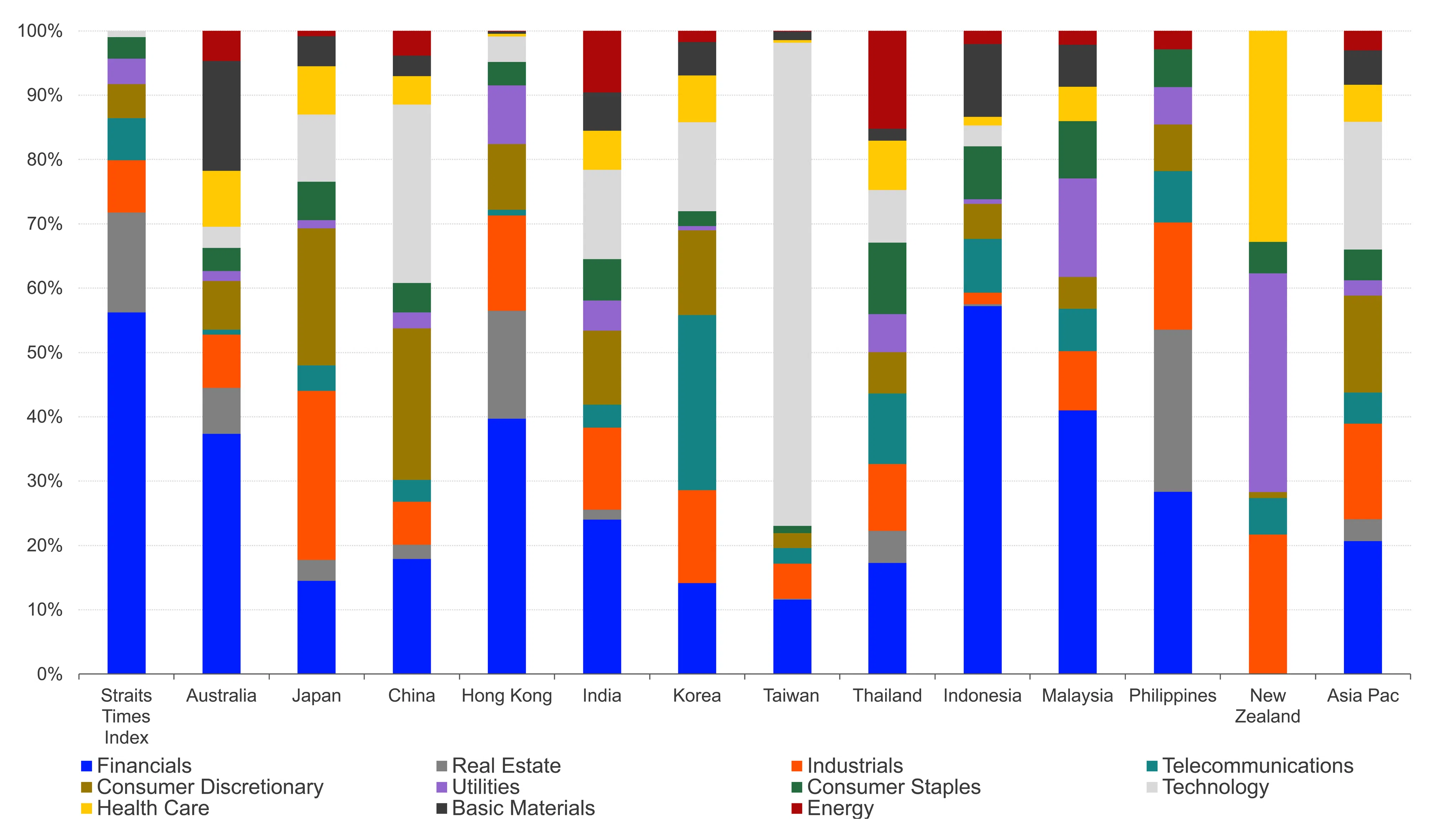
- Given Singapore’s high concentration in Financials and relatively low weight in Technology and Consumer Discretionary industries, the Straits Times Index can be seen as an alternative to diversify from expensive global Technology stocks.
- The Straits Times Index offers high dividend yields and low volatility. These can be attractive to investors seeking income or defensiveness as the world moves towards a rate cut cycle. From a longer-term perspective, demographic shifts to an aging population have raised demand for investment opportunities that offer lower volatility and higher dividends.
- On a valuation basis, the Straits Times Index is inexpensive relative to other APAC markets, while its ROE is relatively high, especially when compared with its ASEAN peers, many of which also have higher weights in Financials stocks.
The Straits Times Index (STI) is an increasingly important piece of the Asia Pacific equity market. In a previous article, Singapore’s growing financial and telecom industries, we tied the growing importance of the services industries, especially Financials, Telecom and Utilities, to the structure of Singapore’s economy and its patterns of GDP growth. In particular, the equity market of Singapore is highly concentrated in Financials, particularly Banks, with the weight of Financials in the STI increasing to more than 50% from 33% over the past 10 years. Financials stocks performed well over the past two years amid the rate hike cycle. In addition, AI beneficiary industries in Singapore including data centers and electricity have led the Telecommunications and Utilities industries to outperform their peers since 2Q24. Although the two industries only account for ~10% of the index weights, it is a rising area that excites investors.
In this article, we focus more directly on characteristics of the STI to highlight the various types of investment opportunities it provides. Singapore equity is concentrated in Financials and has a low weight in Technology, the valuation of which has been expensive across global markets. This allows STI investors to diversify their Technology exposure, which is higher in other APAC markets. Additionally, the Straits Times Index offers high dividend yields and low volatility compared to its APAC peers. For investors looking for income, Singapore’s high dividend yield can be an alternative source of yield as the world gradually moves into a rate cutting cycle. Lower volatility provides a defensiveness that is differentiating from the high volatility Tech industry. Aging demographic shifts also raise the demand for income investing, and for low volatility. From a valuation standpoint, the STI offers these characteristics inexpensively as it is trading at an attractive level compared to its history.
In the sections below, we discuss these characteristics of the Straits Times Index in more detail.
Diversification from expensive global Tech stocks
Because of its different industry composition, the Straits Times Index exhibits a moderate correlation with the broader APAC markets, particularly lower than markets that are more driven by external demand than domestic demand. The correlation of STI with FTSE Asia Pacific Index has decreased since 2021 (Exhibit 1).
Exhibit 1: 36m rolling correlation vs FTSE Asia Pacific Index (In USD terms)
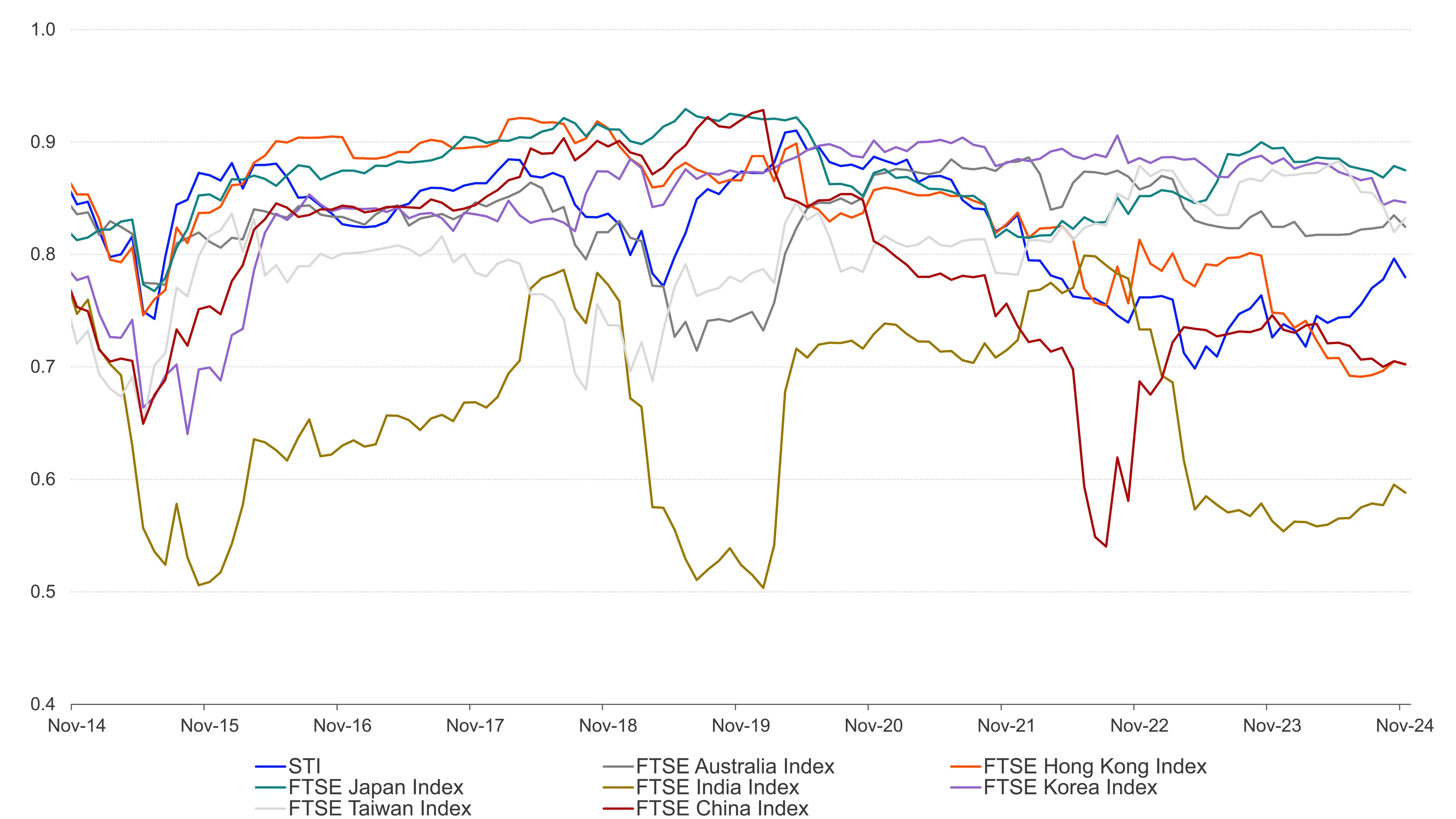
One explanation of the moderate correlation is that the STI has lower weight in Technology, Consumer Discretionary and Basic Materials than other APAC markets (Exhibit 2). Technology has been buoyant due to the global AI up-cycle, while the performance of Consumer Discretionary (particularly Autos) and Basic Materials is more correlated to the economic growth cycle. Therefore, the correlation of STI with the FTSE Asia Pacific Index has fallen since 2021 when Technology (particularly the Technology Hardware and Equipment sector) began to benefit from work-from-home demand, which was then followed by a rise in AI-driven demand in 2023. During this period, the correlations of Taiwan and Japan to the FTSE Asia Pacific Index was relatively high.
Exhibit 2: Straits Times Index industry weights vs other FTSE Asia Pacific indices
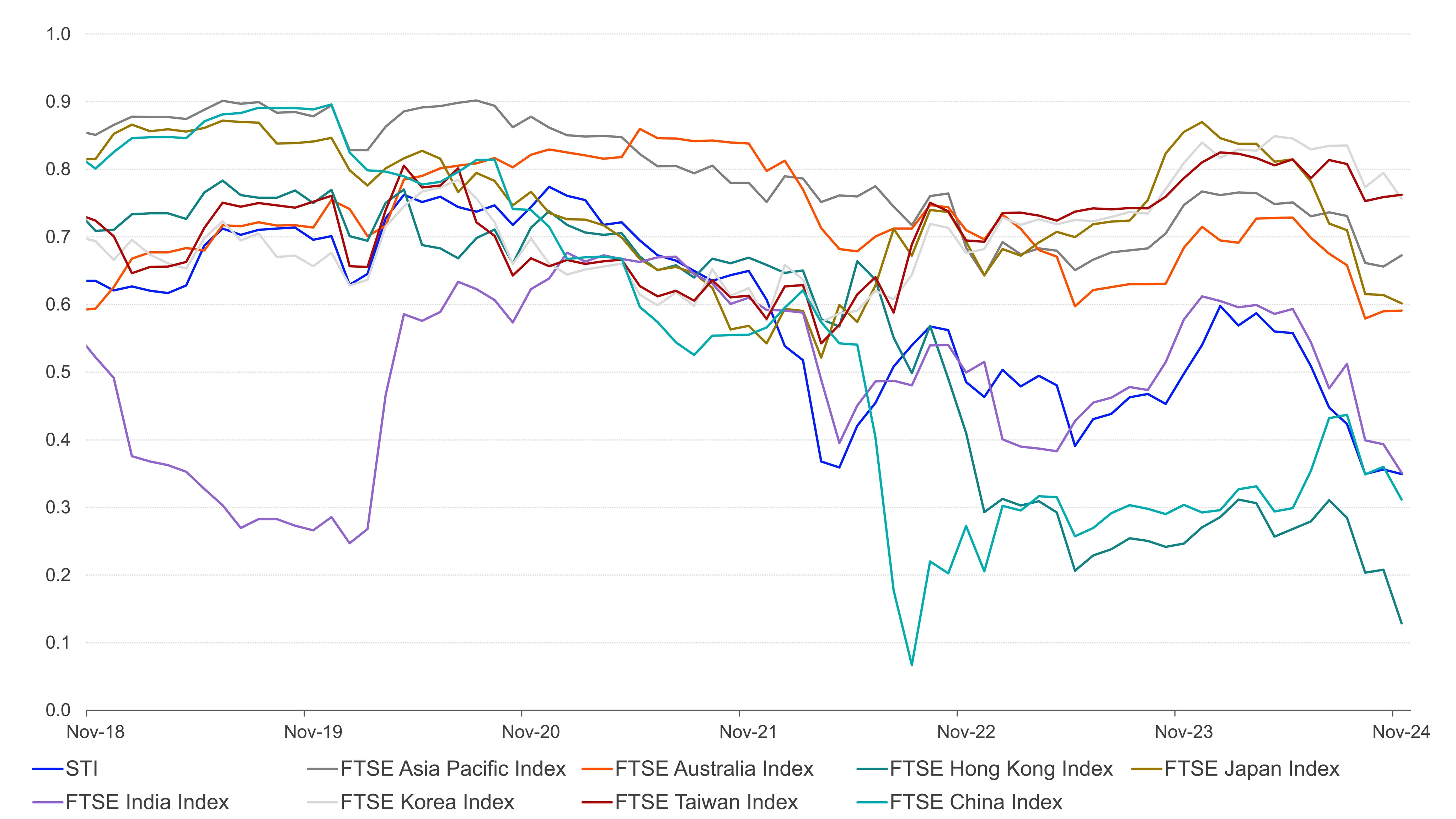
One interesting pattern seen in Exhibit 1 is that the Indian and Chinese markets also exhibited a relatively low correlation with the broader APAC markets as well as global Technology stocks (Exhibit 3), even though these two markets have large Technology industries. There may be multiple reasons for this, including idiosyncratic shocks such as China’s weakness when re-opening after its covid shutdown. However, from an industry standpoint it is important to note that this was because the more expensive Technology stocks globally are predominantly in Tech Hardware and Equipment, which benefited directly from the ongoing AI up-cycle. However, the Technology stocks of India and China are more concentrated on Software and Computer Services.
Exhibit 3: 24m rolling correlation vs FTSE Global Technology SuperTheme Index (In USD terms)
Income: High Dividend Yield
When we compare various characteristics across APAC equity markets, one thing that stands out in the past one to two years is that Singapore’s dividend yields became the highest in APAC, surpassing Australia, which was on average the highest in APAC over the past decade. The dividend yield of the Straits Times Index rose above 5% level in 2023 (Exhibit 4).
Exhibit 4: Dividend yield of STI vs FTSE Asia Pacific Index
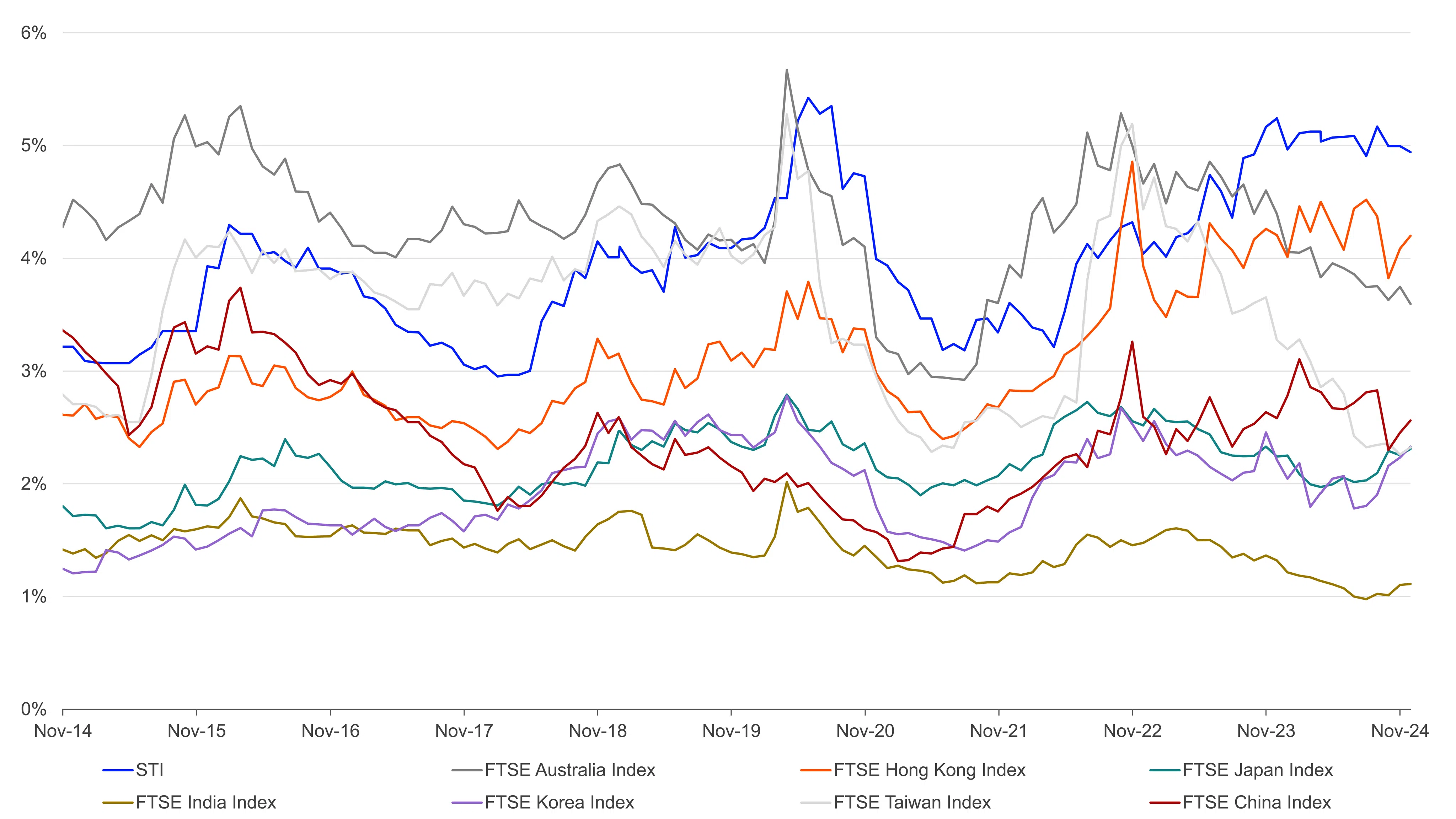
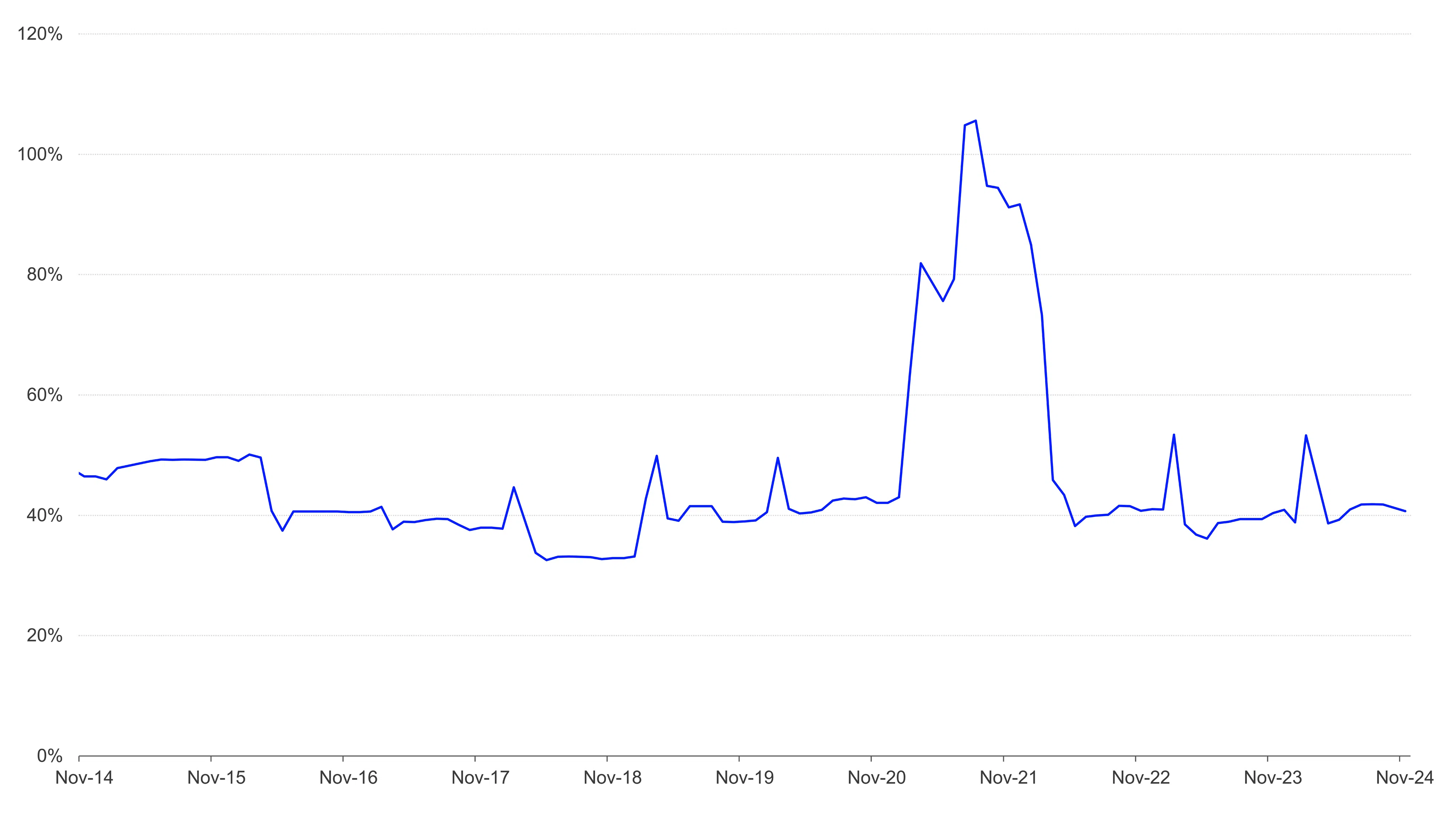
As we discussed in another article about Australia dividend yield (Australian equities – what is a lower dividend yield telling us?), elevated valuations and diminished earnings for Australian firms such as Basic Materials companies were the major reasons for Australia’s falling dividend yield. In the case of Singapore, the index has looked relatively cheap compared to both its past 10-year history range and its regional peers. At the same time, the dividend payout ratio (Exhibit 5) has been stable in the past two years and is around the same as its historical mean (past 10-year average: 46%).
Exhibit 5: STI dividend payout ratio
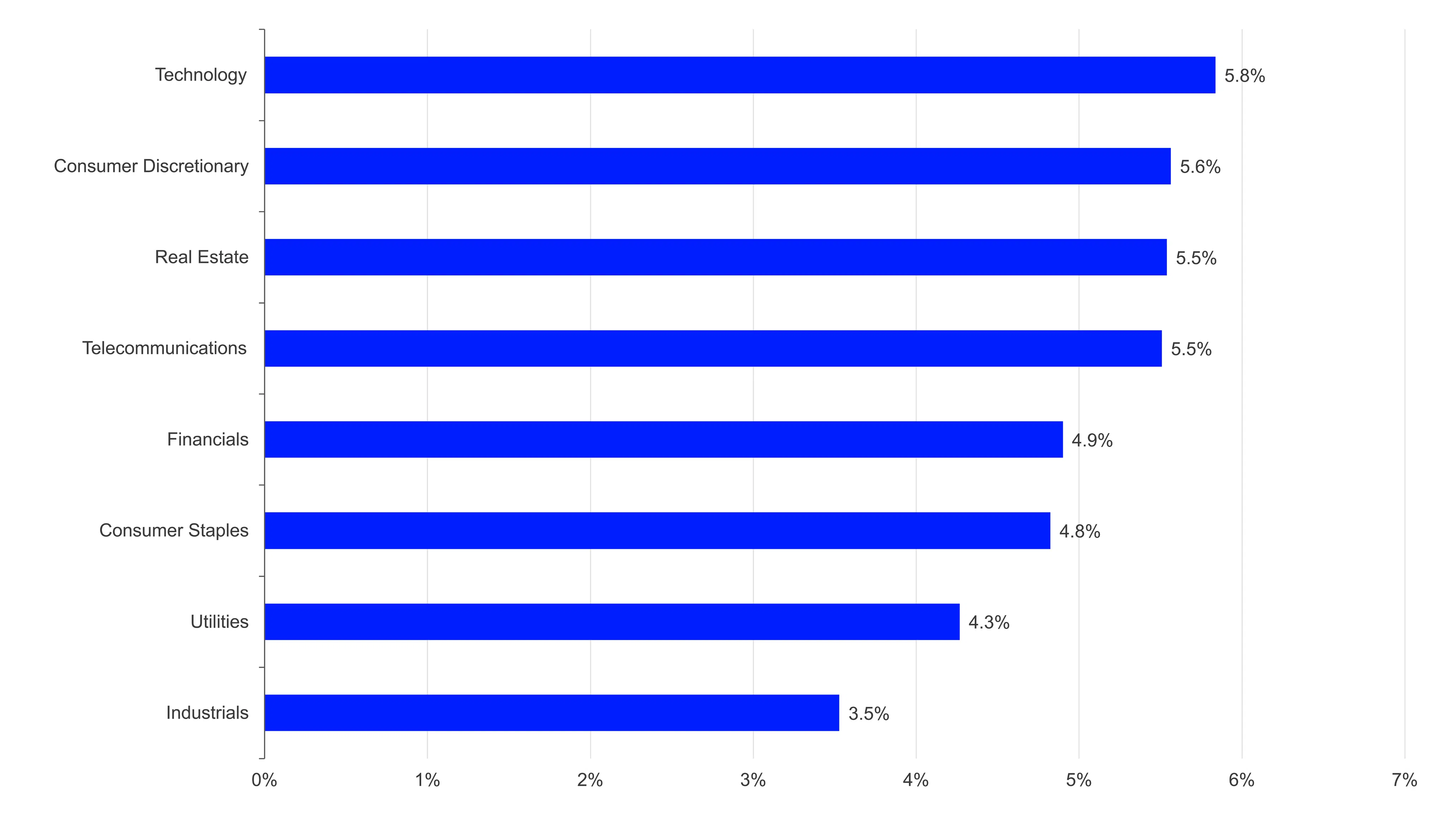
On an industry level, most industries’ dividend yields were larger than 4% – relatively high compared with the APAC average of 2.5%. The two largest market cap industries, Financials and Real Estate, paid dividend yields at 4.9% and 5.5%, respectively, as of November 2024 (Exhibit 6). Technology accounted for only 1.0% of the total index as of November 2024, while Financials and Real Estate accounted for 56.3% and 15.6%, respectively.
Exhibit 6: STI dividend yields by industry
Defensiveness: Low volatility and high dividend yield
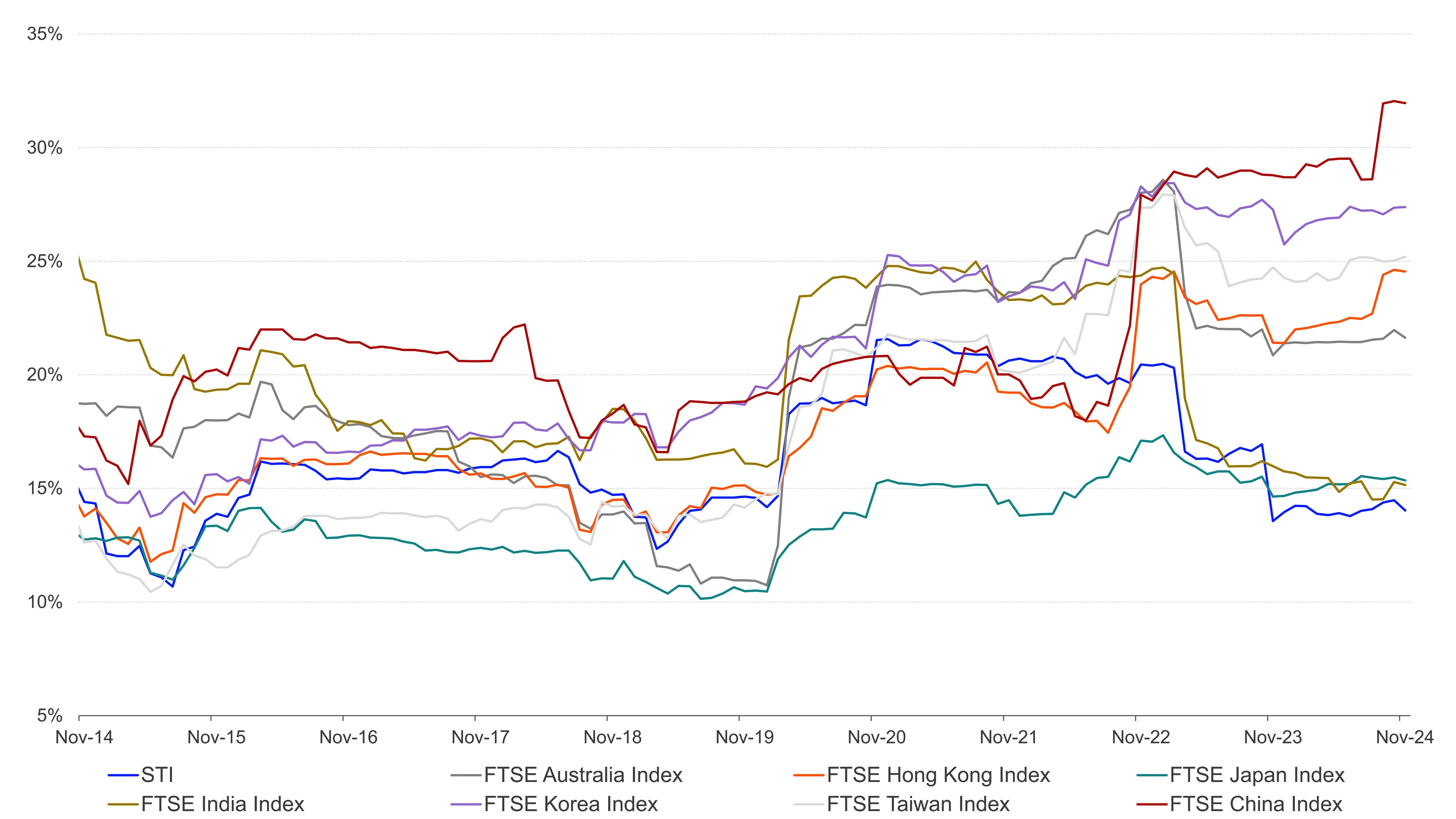
The Straits Times Index also has a low volatility characteristic, mainly due to its high weight in Banks stocks and low weight in more volatile sectors like the Technology sectors. The STI became even less volatile in the past two years, and is now one of the APAC markets with the lowest volatility (Exhibit 7). With a high dividend yield, the low volatility characteristics can be especially attractive in a rate cut cycle when equity market volatility can rise amid various geopolitical risks and uncertainty around the global economic outlook. From a longer-term perspective, demographic shifts to an aging population have raised demand for investment opportunities that offer lower volatility and higher dividends. According to OECD [1], the elderly population in OECD countries grew from around 11.5% to almost 18% over the past 30 years.
Exhibit 7: 36m annualised volatility (monthly observations, in USD terms)
Attractively valued vs APAC peers
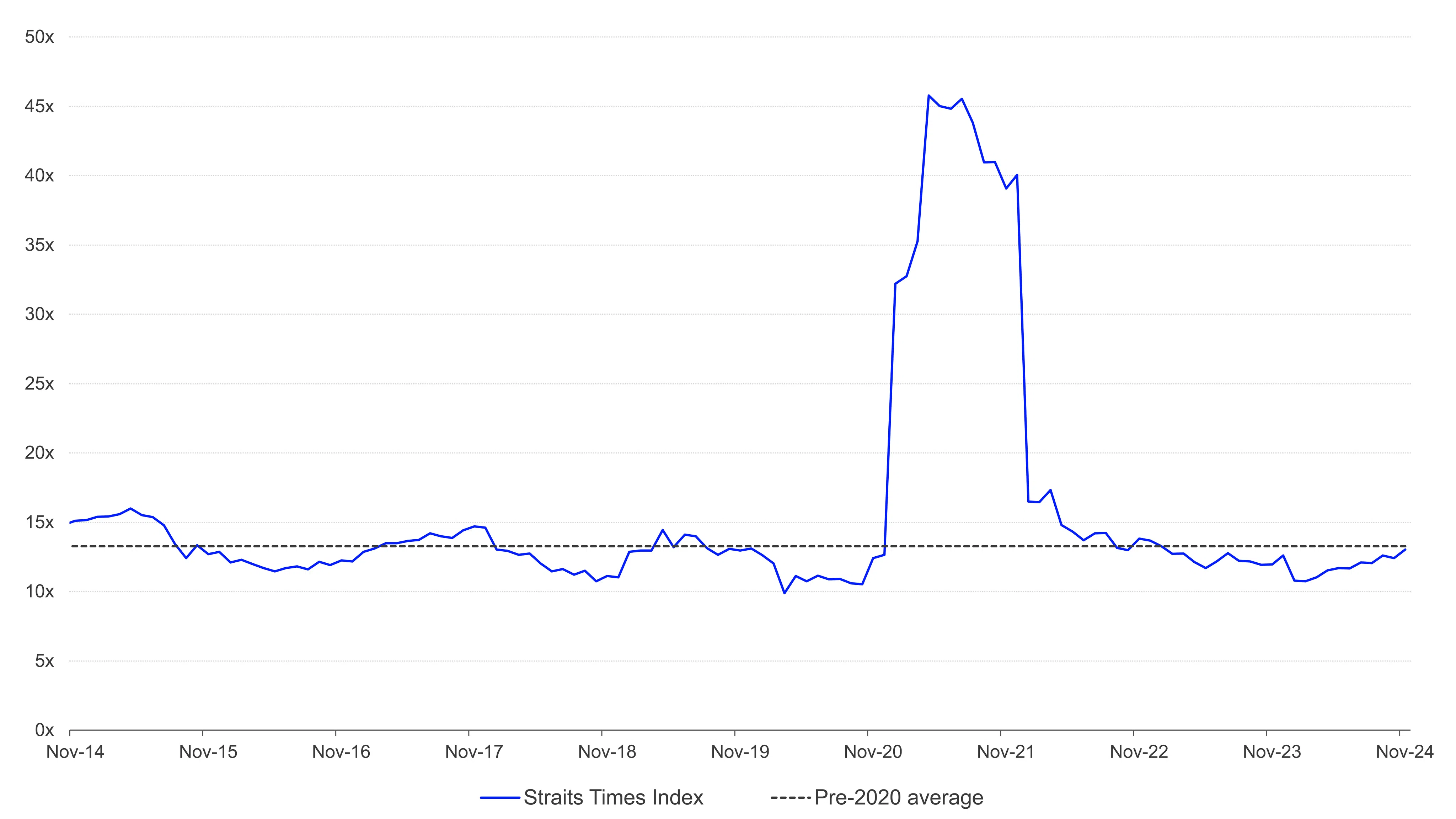
The valuation of Straits Times Index is relatively low compared to its APAC peers, and even more so compared to developed market peers. After recovering from the distortions of the Covid pandemic, the trailing P/E ratio is 13.0x as of November 2024, around the same level as the pre-pandemic average (Exhibit 8). One major characteristic of the Singapore market is a stable valuation – which is an important element for income investing strategies.
Exhibit 8: STI trailing P/E ratio
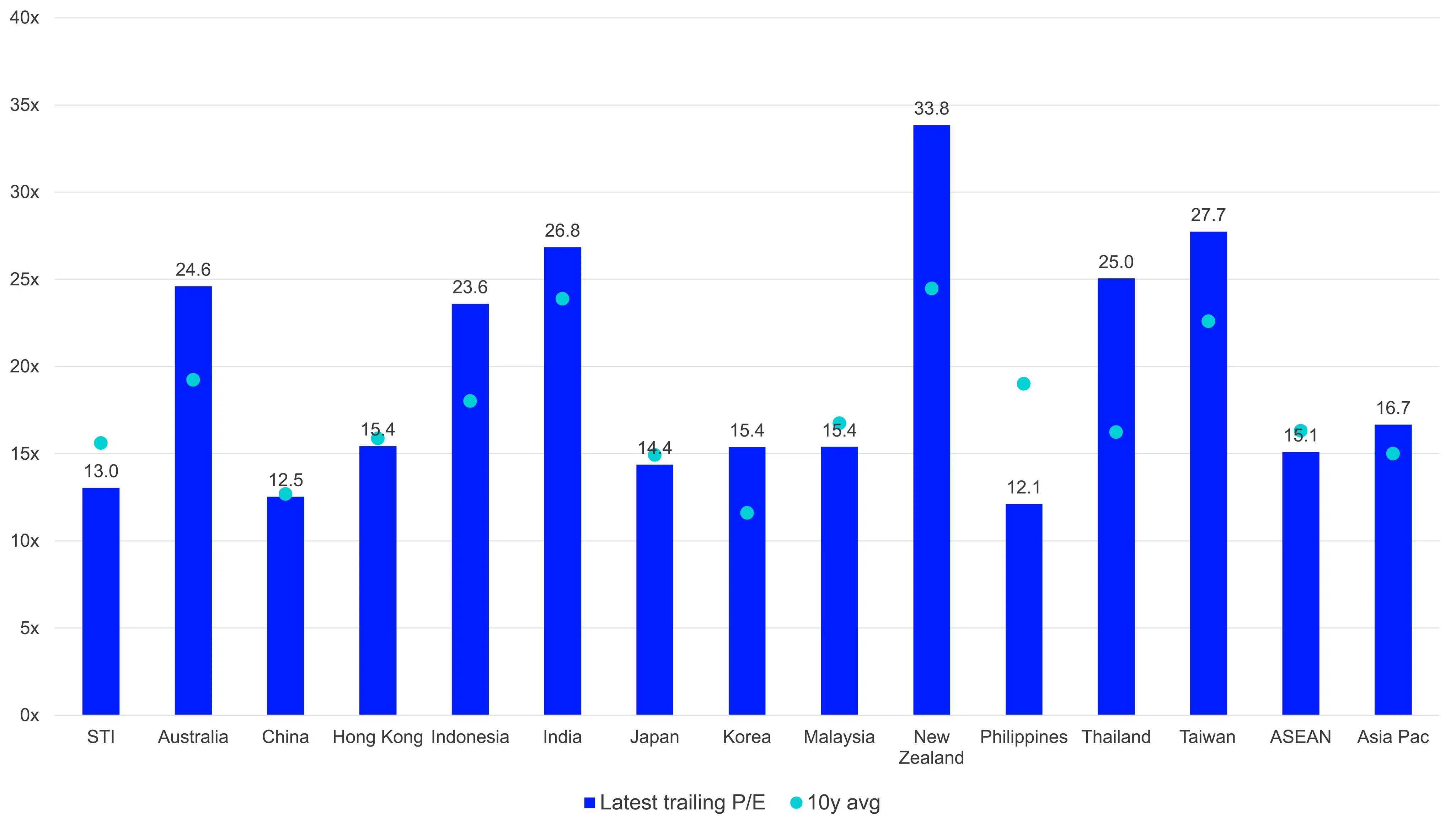
When compared to other APAC markets (Exhibit 9), the relatively low valuation can be attributed to its low weight in Technology and other growth stocks. Additionally, the growth outlook for DM markets is naturally less strong than high-growth emerging markets such as India and Indonesia.
Exhibit 9: STI vs FTSE Asia Pacific trailing P/E ratio
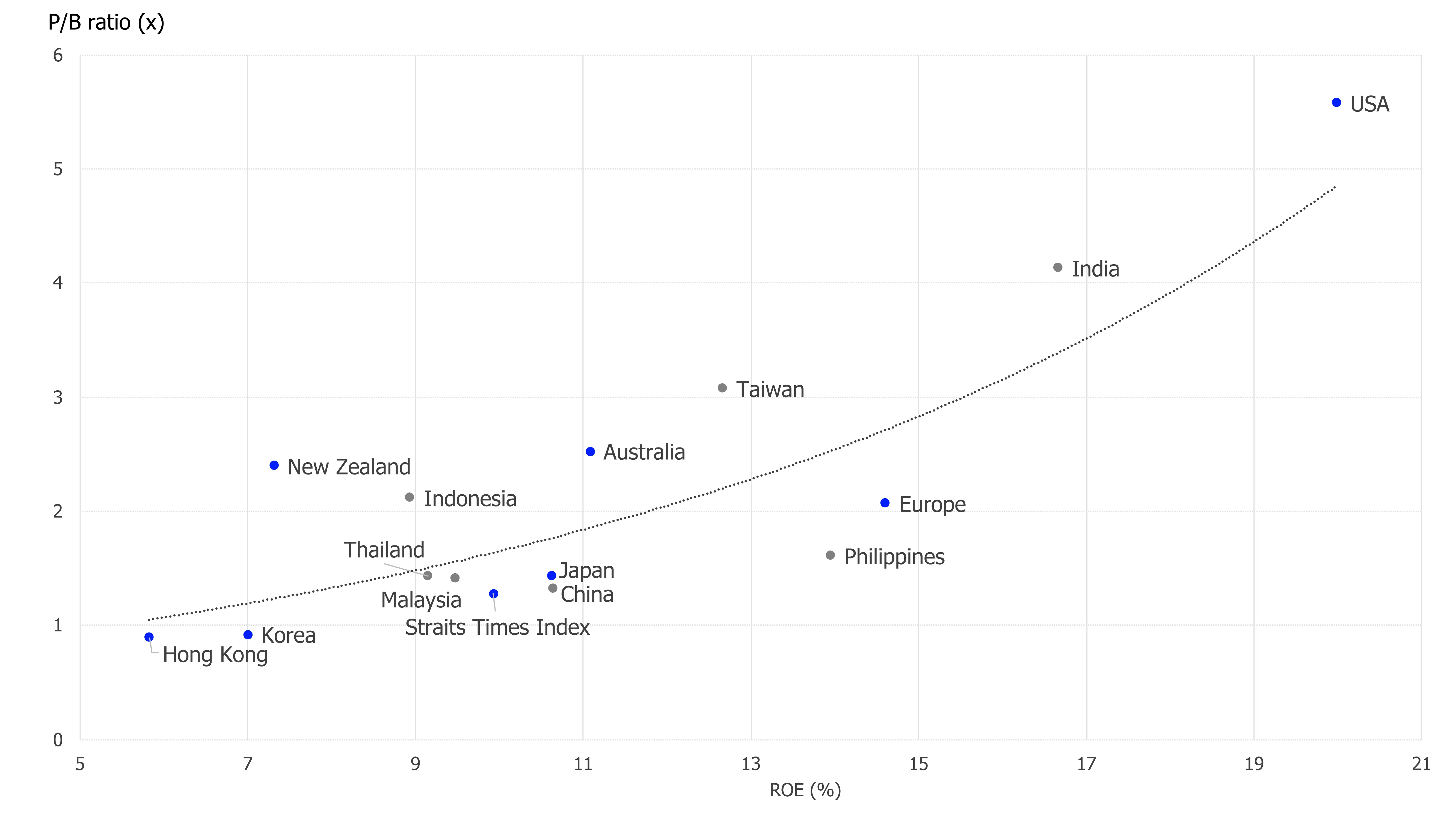
If we compare the valuation and return at the same time (Exhibit 10), the Straits Times Index also looks attractively valued. The valuation of STI is one of the lowest among the APAC markets, while the ROE is relatively high, especially when compared with its ASEAN peers, many of which also have relatively high industry weights in Financials.
Exhibit 10: P/B ratio and ROE of STI vs major FTSE All-World equity indices
Conclusion
The Straits Times Index offers an investment opportunity to diversify regional concentrations in Technology and conventional cyclical industries such as Basic Materials, Consumer Discretionary, and Industrials. Some industries, such as Technology, are relatively expensive and more heavily positioned among global investors. In addition, the index’s 5% high dividend yield and low volatility can be particularly attractive for income-focused investors amid a rate cut cycle and demographic shifts as a defensive investment option. Lastly, the Singaporean equity appears to be attractively valued compared to its own history and regional peers, particularly ASEAN peers.
Share with us your feedback on BT's products and services