

Will the world continue in the way we know it?
History has shown that despite recent blips, relationships that bring people together will lead to progress for all
HUMAN beings differ from most other animals on this planet in that we are able to defer gratification and imagine a future. That's one of the factors that made us so successful as a species.
When we plan for something in the future, there are some assumptions we make. Chief among them is that we and the world will still be around then.
Similarly, when we invest, we forego our purchasing power today for hopefully a greater purchasing power sometime in the future. There are numerous fundamental assumptions that we make when we decide to invest our money.
Common interests
Let's articulate what these assumptions are and re-examine whether they are, and will still be, valid.
I think the very first assumption we make is that the world as we know it will continue. What is the world as we know it today?
To most of us who were born in the last four to five decades, it means a peaceful world where most people don't expect their country to go into a full-scale war with another. It also means a capitalist world where your property right as an individual is honoured and protected. It also means a world where people trade with one another, if they see a benefit in doing so, and as a result everyone prospers. It means a world where there is constant innovation and improvement in lives in general.
All the above cultivated in us a trust in a better future. That's why we make plans, we defer our consumption today for a time in the future when we may need to consume more, and hopefully by then, our money can buy more if we invest them well today.
Are any of the above assumptions going to be proved baseless? For months now, our headlines are dominated by the trade war between China and the US and the race of these two superpowers to gain supremacy in the tech world. Will tensions escalate into a full-scale war?
Yuval Noah Harari's book Sapiens - A Brief History of Humankind puts some of these questions in perspective. He noted that scholars have identified several contributing factors why humankind has broken the law of the jungle and have managed to enjoy peace for a relatively long period of time.
First and foremost, the price of war has gone up dramatically. "The Nobel Peace Prize to end all peace prizes should have been given to Robert Oppenheimer and his fellow architects of the atomic bomb," he said. "Nuclear weapons have turned war between superpowers into collective suicide, and made it impossible to seek world domination by force of arms."
Secondly, while the price of war soared, its profits declined. Today's wealth mainly consists of electronic numbers that show up on computer screens, human and intellectual capital and organisation know-how which can't be conquered by military force.
Thirdly, while war became less profitable, peace became more lucrative than ever. Countries can prosper by trading with one another, investing in one another's country, collaborate to discover the next breakthrough for humankind.
Fourthly, ours is the first time in history that the world is dominated by a peace-loving elite - politicians, business people, intellectuals and artists who genuinely see war as both evil and avoidable.
Finally, no country is independent anymore in this global empire of ours. No country can really execute independent economic policies. Case in point: the crash in the US housing market in 2008 nearly brought the whole world's economy down with it. It took a coordinated macroeconomic policy around the globe to bring calm back. Another example - a country's excessive carbon emission or the clearing of the Amazon rainforest has consequences for all countries in the world.
Noted Dr Harari: "States are increasingly open to the machinations of global markets, to the interference of global companies and NGOs, and to the supervision of global public opinion and the international judicial system. States are obliged to conform to global standards of financial behaviour, environmental policy and justice. Immensely powerful currents of capital, labour and information turn and shape the world, with a growing disregard for the borders and opinions of states."
The global empire being forged before our eyes is not governed by any particular state or ethnic group. It is held together by a common culture and common interests. "Throughout the world, more and more entrepreneurs, engineers, experts, scholars, lawyers and managers are called to join the empire," opined Dr Harari. "They must ponder whether to answer the imperial call or to remain loyal to their state and their people. More and more choose the empire."
Up to a few years ago, all the above appear to be valid. But today, in numerous parts of the world, we have leaders who disbelieve climate change, who think they can build up walls, who couldn't care less about global public opinion and international judicial systems. While conventional war may be unlikely, confrontations may take other forms like trade wars, cyberwar or Cold War.
Global empire
However, it is common for humans to take the most pessimistic view as we are going through a rough patch. Take, for example, in Sept 30, 1981. Oil price surged because of the Iraq-Iran war which claimed between one million and 1.25 million casualties. In the US, inflation rose to some 15 per cent. The US government 30-year bond was yielding 15.2 per cent then. The fear was that inflation would continue to run away. As it turned out, the crisis resolved by itself. New sources of energy have been discovered since then.
Had an investor bought the supposedly risk-free US government bond then, he or she would have received a 15 per cent yield a year for the 30 years till 2011. That more than beat the S&P 500's return during the same period of 9.1 per cent, assuming dividends received every year were spent.
With this perspective in mind, perhaps we have some basis to believe that what we are going through now is yet another blip in our general progression as a human race towards a truly global empire.
Share with us your feedback on BT's products and services
TRENDING NOW
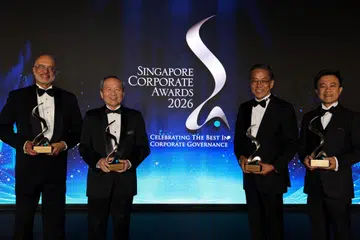
32 companies, 6 individuals bag accolades at Singapore Corporate Awards 2026

He built the Vingroup empire. Now South-east Asia’s richest man is handing some key roles to his sons
URA to review guidelines on floor space to give developers more design flexibility: Chee Hong Tat

Chagee, Mixue and Luckin won the market. Sustaining their edge is the harder part

