

Will the US and China equity markets diverge further in 2025?
US equities have scaled new highs, while China’s strength has faded – both partly because of the implications of Trump’s presidential victory
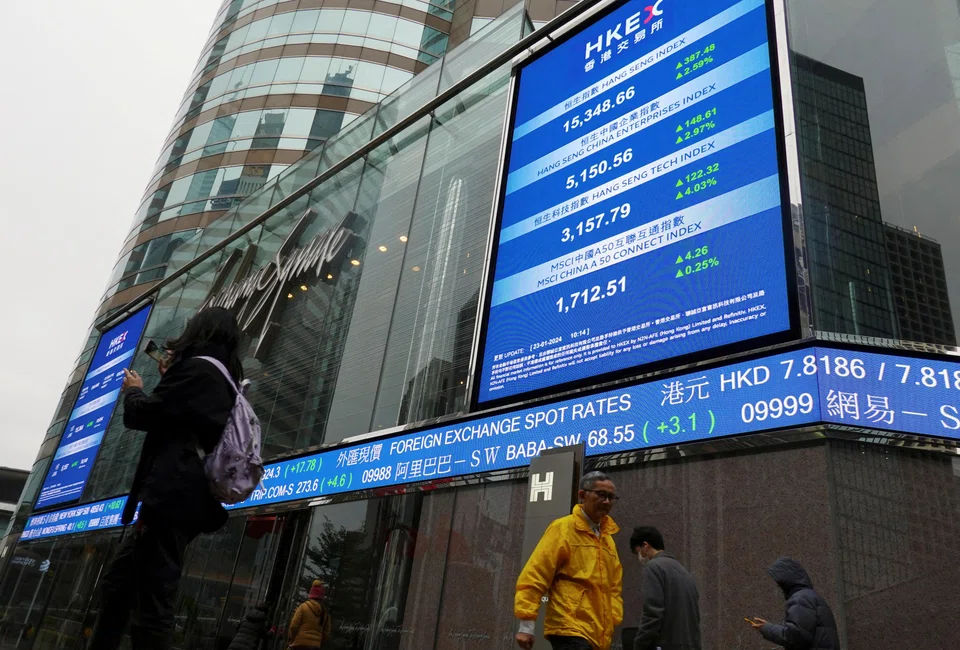
AS THE year draws to a close, it is interesting to look back and observe that US equities have defied valuation concerns and delivered stellar returns throughout the year, whereas China markets have been lacklustre.
China equities did see a remarkable turnaround in September on expectations of fiscal support. However, performance of US and China markets diverged again in the fourth quarter, with US equities scaling new highs, while China’s strength faded – both partly because of the implications of Donald Trump’s presidential victory. The big question is: Will this performance divergence continue into 2025?
US equity outperformance to broaden
Markets have cheered Trump’s return on perceived policy benefits to the US economy and stock market. The Republican party’s clean sweep of the presidency and the two houses of the Congress suggests Trump will likely face little resistance in implementing his policy agenda following his inauguration on Jan 20.
Trump’s “America first” and pro-growth policy priorities, which include tax cuts and deregulation, are expected to extend the US economic expansion into the new year. We expect US equity strength to broaden out beyond the technology sector into traditional industries, as small-cap and financial sectors likely emerge as the largest beneficiaries of Trump’s policies.
Trump’s efforts to impose tariffs are aimed at establishing trade barriers and insulating small businesses from the competition of imported goods. Banks are also likely to benefit from deregulation and relaxation of capital adequacy requirements, meaning more capital will likely be freed up to fund loan growth and stock buybacks.
China’s fading equity strength
The Hang Seng Index rallied 35 per cent in mid-September on speculation that Chinese policymakers will unveil large-scale stimulus, only to give back more than half of its gain since then, not only in response to Trump’s victory, but also due to disappointment with the outcome of November’s National People’s Congress (NPC) meeting.
Trump’s election campaign focused on US trade imbalances with China and other perceived competitive threats, so the negative stock market reaction to his victory was well anticipated. But why did the NPC meeting disappoint?
The announcements from the meeting were in line with the expectation of addressing the local governments’ hidden debt issue, with the 10 trillion yuan (S$1.9 trillion) debt swap programme. However, the lack of a clear fiscal boost to consumption was seen as clouding China’s recovery path, since many global investors regard this as critical to countering ongoing deflationary trends.
Patience required for clarity on fiscal stimulus
NPC and the latest Politburo meeting in December hinted at more forceful fiscal measures and “moderately loose monetary policy” in 2025. Given this, we believe the announced debt swap programme was just the beginning, not the end, of a multiyear fiscal expansion plan.


Therefore, patience is warranted for further re-rating of China equities. Until we get more clarity on the fiscal stimulus from the Two Sessions in March 2025, we expect the Hang Seng Index to trade in the 20,000 to 22,500 range. Should a fiscal boost come sooner or in a greater magnitude, potentially to overcome Trump’s tariff threat, the index could trade back up to 22,500 to 24,500.
If policy stimulus is more drawn out, or if earnings outlook remains murky, dampening business and investor confidence, we see downside risk to the index towards our bear-case range of 18,000 to 20,000.
Until we have more clarity, we continue to favour quality, high-dividend non-bank and state-owned enterprise shares listed in Hong Kong, while adding on pullback to consumer discretionary, communication and technology names that are expected to benefit from potential fiscal stimulus.
Compared with offshore Hong Kong-listed shares, we favour China onshore A shares, which are more sensitive to domestic policy and insulated against global fund flows.
Trump policies cloud Fed rates outlook
There is, of course, a need to position for the risk of any reversal in market sentiment. This is especially so if attention shifts to long-term economic and geopolitical risks emanating from the incoming Trump administration. We assume US import tariffs and immigration curbs will be implemented in phases for now.
However, any radical approach could revive inflationary expectations, derailing the Fed’s rate-cutting path and our base case of a US economic soft landing next year.
Diversify with gold and quality bonds
Trump’s plan to extend tax cuts by the end of next year will likely turn the focus on the growing US budget deficit. This could cause long-term bond yields to surge. While we are wary of upside risks to bond yields in the near term, given Trump’s policy agenda, we forecast the US 10-year government bond yield to moderate towards the 4 to 4.25 per cent range over the next 12 months.
This is predicated on our view that the US job market is continuing to soften, as evidenced by a downtrend in US job openings and new employment.
Therefore, we view any spike in bond yields as an opportunity to average into quality bonds. US high-yield corporate bonds also look interesting, given that the resilient economic outlook should keep corporate default rates contained.
Meanwhile, the European Central Bank is likely to cut rates at a faster pace than the Fed in the coming months, considering the more evident disinflationary trend in the eurozone, domestic political challenges and Trump’s tariff threat. This justifies increased allocation to euro area government bonds.
Finally, we remain buyers of gold, which has proven to be an effective hedge against any upside risk in inflation, in addition to providing a buffer against impact of any extreme geopolitical and economic tail risks.
The writer is chief investment officer for North Asia at Standard Chartered Bank’s wealth solutions unit
Decoding Asia newsletter: your guide to navigating Asia in a new global order. Sign up here to get Decoding Asia newsletter. Delivered to your inbox. Free.
Share with us your feedback on BT's products and services
TRENDING NOW

Once staunchly pro-China, Malaysian Chinese businesses are now distancing themselves from Beijing

Inside Singapore’s government team that kills its own products

Johor’s investment boom is real, but actual contribution from JS-SEZ unclear

Inside F1: How ‘reactive’ DHL acted quickly to fit Malaysia race just before Singapore’s

