Winning the argument on sustainable investing in Asia
A GROWING number of young Asians have been taking to social media to debate how to live more sustainably. In China, a discussion group titled “Leaving No Trace” on Douban, a social network platform popular among young Chinese, has attracted more than 40,000 members.
Tips are traded on reducing carbon footprints such as turning old jeans into chic denim bags, using worms to make fertiliser out of food waste, or bringing reusable cups and straws to enjoy bubble tea – a favourite drink among young people in Asia.
The eco-conscious youth are not only seeking to build sustainability into their daily lives. They are demanding investment portfolios do the same, too.
According to a 2024 survey by Fidelity International and YouGov, close to 70 per cent of Asia-Pacific youngsters aged below 30 say it is important to act responsibly or sustainably as investors – keeping up a trend set by millennials (30 to 44 years old). The survey also showed both cohorts to be equally optimistic about the power of investing to make a positive impact on the world.
Most of the world’s emissions come from Asia, where robust economic growth has increased the region’s carbon footprint. Channelling funds to local companies that take the lead in the energy transition could have enormous consequences for the fight against climate change.
Encouragingly, regulatory regimes are growing more supportive of the type of sustainable investing that drives capital to these companies – and ensure that they are using the money wisely. Most notably, mandatory environmental, social and governance reporting frameworks are starting to replace voluntary ones across the region.
Mainland China introduced guidelines that require some 400 listed companies to publish sustainability reports by 2026. It will be mandatory for listed companies in Singapore and Hong Kong to make climate-related disclosures from 2025.
Greater transparency helps paint a clearer picture for investors about what companies are doing on the ground.
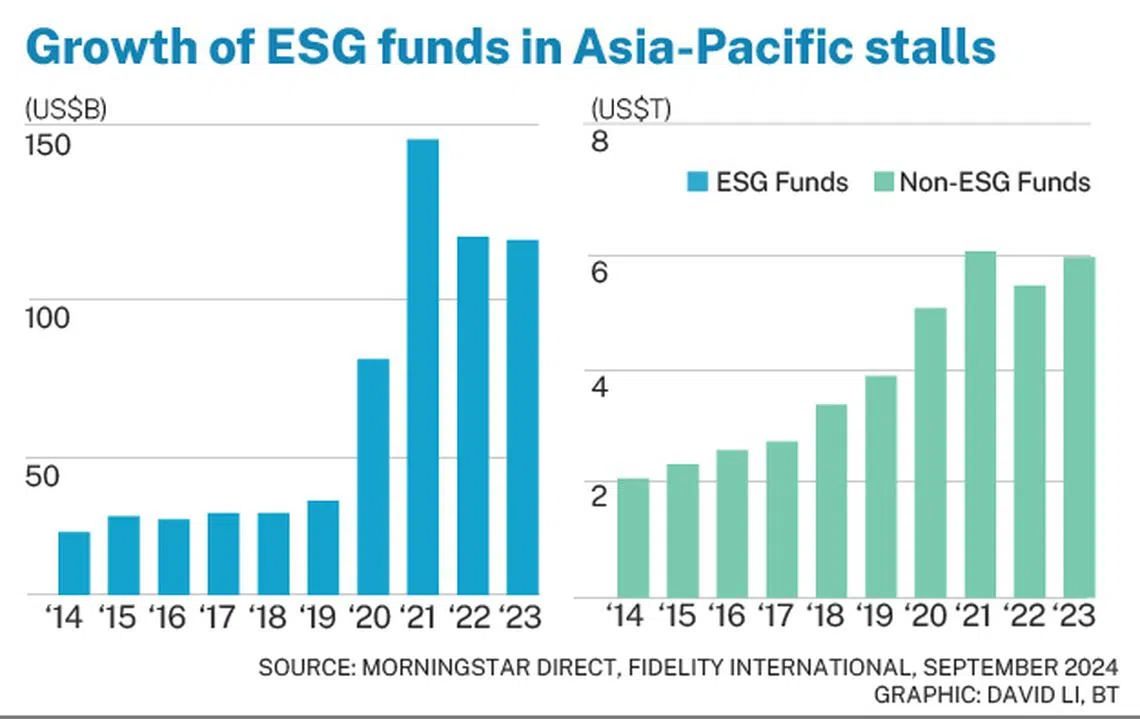
The first stages of the ESG revolution led to a jump by almost seven times in Asia-Pacific’s ESG funds between 2014 and 2021, from US$21 billion to US$145 billion. That was, of course, still a tiny proportion of investors’ overall capital, but it represented a much faster expansion than that of non-ESG funds, which trebled during the same period.
Weak performance of ESG-focused portfolios, coupled with concerns about geopolitics and greenwashing, led to a 22 per cent drop in ESG funds in the two years that followed.
Green gold
Despite the decline, there are reasons to believe in the potential for ESG investors in Asia over the long run.
The region is home to the world’s leading manufacturers of electric vehicles, solar panels and critical components of green technologies, with many high-emitting companies progressively replacing coal-fired power plants with clean energy sources.
As investment in the energy transition builds and environmental awareness pushes changes in consumer behaviour, avenues of growth available to these companies will multiply.
Meanwhile, substantive changes in corporate governance are under way in Asia. More effective board structures and greater diversity at the most senior levels will bolster oversight and protection of a broader group of stakeholders, including minority interests.
We expect Asian companies to manage ESG risks better as a result – including a prioritisation of long-term over short-term targets. Those that do are more likely to create value for investors through resilient growth. And over the medium to long term, this should improve the risk-reward equation for ESG investors.
There is still a long road ahead for sustainable investing in Asia. The total size of associated assets is tiny compared to the entire fund universe in the region. And there remains plenty of room for Asian regulators to do more to improve disclosure standards and weed out greenwashing. This will be an ongoing process, but we believe Asia is up for the challenge.
The writer is portfolio manager, Fidelity International