Withdrawals in retirement: Be flexible and have guard rails
These are important considerations as people live longer and expenses rise


HOW much can you withdraw safely from your retirement savings to ensure that your funds last your lifetime? This remains a vexing question, as people live longer and are likely to spend more as they age.
There is a wealth of products to encourage people to save for retirement. But in retirement, options for a level of assured income appear mostly confined to the Central Provident Fund (CPF) Life scheme and insurance products. Both have their merits, but also have limitations.
The CPF Life scheme, for instance, pays an income for life but may replace only a fraction of your pre-retirement income. According to CPF calculations, a male member who turns 55 in 2025 will receive S$3,330 monthly when he turns 65, if he tops up his Enhanced Retirement Sum to the maximum of S$426,000. Insurance products’ payouts are typically for a term and they may also suffer bonus cuts.
The CPF Board’s Retirement and Health Study, published last year, found that retirees’ non-healthcare expenses rose after retirement, particularly among those who were less likely to afford it.
It found that among retirees in the bottom 30 percentile of non-housing wealth (cash, CPF balances), nominal spending rose by 4.9 per cent a year, compared with 1.6 per cent for those in the top 30 percentile.
It also found that those who live in smaller flats spent more, mainly because they hired domestic help in their later years. Those in larger flats already had helpers. When expenditure on domestic help was excluded, the difference in expenses became less stark.
But the issue of how much is a safe withdrawal level is a puzzle even in mature markets such as the United States. Larry Fink, chairman of fund management giant BlackRock, wrote extensively on the issues facing retirees in his 2024 annual letter. “As a society, we focus a tremendous amount of energy on helping people live longer lives. But not even a fraction of that effort is spent helping people afford those extra years.”
Defined contribution plans, he noted, “don’t come with instructions for how much you can take out every month”. “Individual savers first must build up a nest egg, then spend down at a rate that will last them the rest of their lives. But who really knows how long that will be?”
Eric Veiel, T Rowe Price head of global investments, who was recently in Singapore, said that the firm is looking into “new and innovative” options to cater for decumulation in retirement. “It’s important to recognise that there isn’t a single product that solves everyone’s needs.” He added that the firm has developed three approaches. First is a “pay cheque” approach, similar to an “endowment model that pays a consistent percentage of trailing return”. Second, is to link savings to an insurance product with a guarantee. This, however, tends to tie up a larger amount of capital or savings.
Third, is a “personalised retirement manager”, which takes a customised approach to withdrawals based on individuals’ circumstances and risk tolerance. This product was recently rolled out in the US. “We think there is a huge opportunity because this is an issue across the world, not just in the US.”
Here are some considerations, based on JP Morgan Asset Management’s (JPMAM) guide to retirement for Singapore.
• Plan to live longer. JPMAM’s guide finds that, in Singapore, at least one partner in a couple aged 65 today has a 56 per cent chance of living to 90 or beyond, and a 5 per cent chance of living past 100. There is also high dependence on cash allowances from children. These allowances can comprise up to 35 per cent of the retirement income for some households.
• Are you on track? The study gives some guidelines for how much in savings will be needed for one to have enough for retirement. For instance, a 40-year-old with a household monthly income of S$10,000 should have saved S$150,000 today to maintain an equivalent lifestyle in retirement. This assumes a 10 per cent annual savings rate going forward.
But a 40-year-old with an annual household income of S$120,000, who begins saving only today, would need to set aside 19 per cent of his income every year until retirement.
• How safe is the 4 per cent annual withdrawal rule in retirement? This rule is attributed to a US financial planner in the 1990s who concluded from decades of return history that a retirement fund can last 30 years if withdrawals do not exceed 4 per cent. Morningstar has been revisiting this rule since 2021. According to the investment research firm, the highest amount that could be withdrawn safely in 2021 was 3.3 per cent, and 3.8 per cent in 2022.
Finally in 2023, it affirmed that retirees can withdraw 4 per cent as an initial spending rate thanks to higher bond yields and a “slightly more optimistic forecast” for equities. At the end of 30 years, there was a 90 per cent probability of still having a positive balance. The way this works is that the first withdrawal is 4 per cent, and subsequent withdrawals are inflation-adjusted.
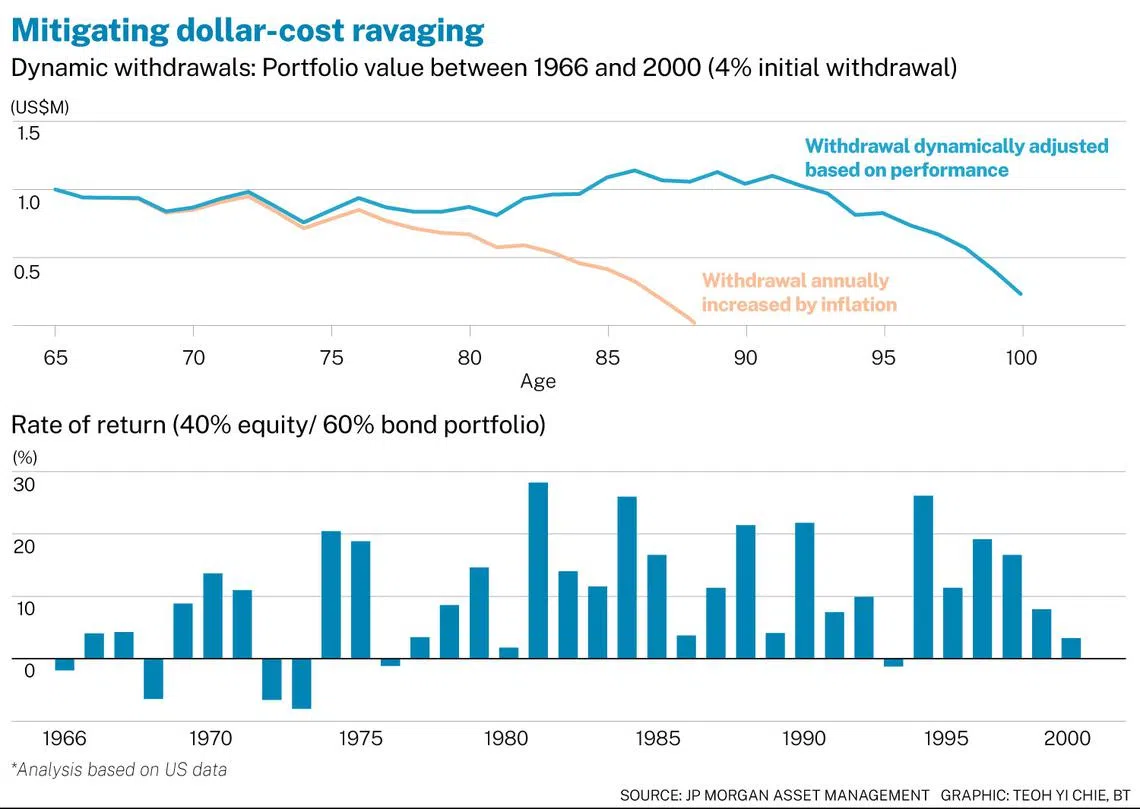
Morningstar analyst John Rekenthaler also advocates “flexible” spending and “guard rails”. This means that if the market sees a downturn in one year, withdrawals are reduced in the following year.
• “Dynamic” withdrawals. JPMAM also found that spending the same amount regardless of market volatility can “ravage” your kitty. Between 1966 and 2000, a 40-60 portfolio (40 per cent stocks, 60 per cent bonds) generated an annualised return of 9.5 per cent. But withdrawing 4 per cent, adjusted annually for inflation, would deplete a US$1 million fund before a retiree turns 90. “Dynamic” withdrawals according to market returns may ensure that the fund lasts longer.
DBS’ digibank app has a “Map Your Money” financial-planning feature, powered by artificial intelligence, which enables savers to view their projected retirement income, how long their funds would last, and any savings gap. In partnership with JPMAM, the bank offers a Retirement digiPortfolio which has seen “healthy” interest among savers, said Ling Seng Chuan, the bank’s head of financial planning, insurance and investment.
The digiPortfolio automatically adjusts the asset allocation based on a client’s life stage and retirement timeline, based on a “glide path”. In November, digiPortfolio will roll out an automated withdrawal feature where clients can set and adjust a monthly withdrawal amount to be transferred to their savings account. They will also be able to view the longevity of their payouts.