MIND THE GAP

Your portfolio in a Trump administration: Should you take action?

Broad-brush prognosis based on several strategists is that US equities are seen as a clear winner, but the outlook for Asian equities is less clear

Genevieve Cua
Published Mon, Nov 11, 2024 · 05:00 AM
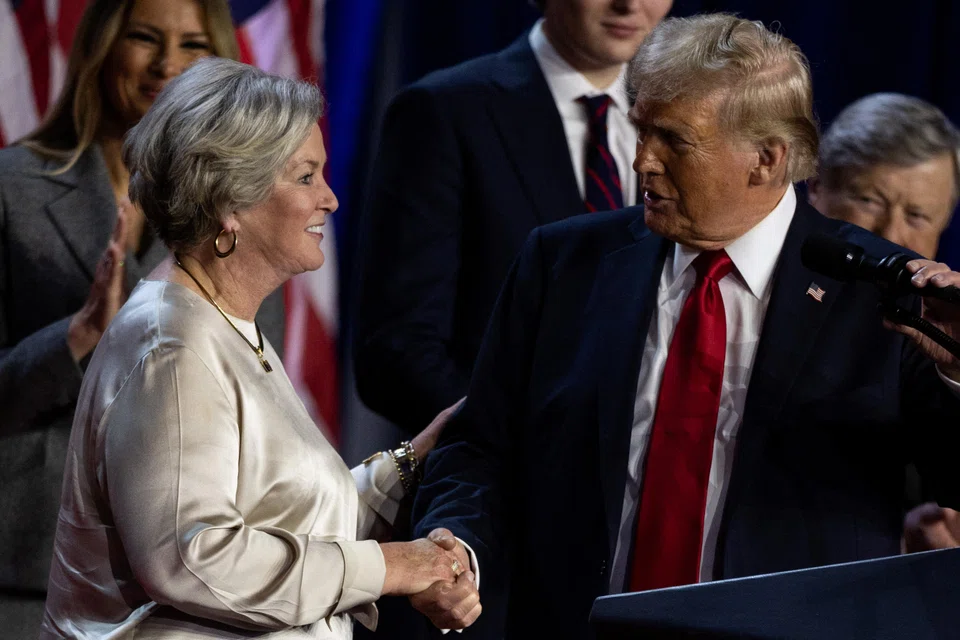
    • US president-elect Donald Trump his senior adviser Susie Wiles. Analysts upgraded their calls on US equities in anticipation of tax cuts and pro-growth policies that would benefit the economy and companies.
    • US president-elect Donald Trump his senior adviser Susie Wiles. Analysts upgraded their calls on US equities in anticipation of tax cuts and pro-growth policies that would benefit the economy and companies. PHOTO: REUTERS

    DONALD Trump has chalked up a decisive win as US president-elect, with a majority for the Senate and a slim edge to date for the House of Representatives.

    What does this mean for markets and portfolios?

    Here’s the broad-brush prognosis based on several strategists’ reports – US equities are seen as a clear winner, thanks to pro-growth policies expected to boost the US economy and earnings. The outlook for Asian equities is less clear, given the expectation of higher tariffs and a stronger US dollar.

    As for fixed income, higher inflation and a higher US deficit may be headwinds. Hence, interest rates are expected to stay high even though the US Federal Reserve has just reduced them by 25 basis points. Strategists advise against long-duration assets.

    Should you take action?

    If you are investing for a long-term goal such as retirement, your portfolio will be guided by an overall strategic asset allocation (SAA) based on factors unique to yourself which include age, investment goal and horizon. The SAA, which may be revisited annually, should not vary too much from year to year unless you have a major change in your circumstances.

    You may, however, consider tactical shifts at the margin. Policy changes under Trump, including taxes and tariffs, will emerge over the next few months. Until then, market volatility is likely to be elevated. If you feel the urge to make a tactical bet, it is prudent to ensure it is a small proportion of your overall portfolio.

    For now, here’s a bird’s eye view of analysts’ calls.

    Risk-on for US equities

    Strategists have upgraded their calls on US equities. Those who were previously underweight notched up their calls to an overweight; those previously underweight now hold a neutral position.

    Eli Lee, Bank of Singapore (BOS) chief investment strategist, said the risk-reward of US equities has turned positive for three reasons. First is expected tax cuts, a positive for corporate earnings. Second, fiscal policies under Trump are likely to be stimulative, including higher military spending. The third is a deregulatory approach which is seen as pro-growth.

    Tan Min Lan, Asia-Pacific head of UBS’ chief investment office, is among the more bullish in her forecast for the S&P 500, which she expects to reach 6,600 by end-2025. This is a rise of about 10 per cent from the current level of 5,995. Markets had rallied strongly last Wednesday (Nov 6) as the election results unfolded – briefly touching 6,000. Investors rushed into the expected beneficiaries of deregulation – financials and energy.

    “That was in line with our view that these sectors would likely outperform in the event of a Trump victory. The tech sector also advanced. The industry could face headwinds from trade tensions, but we do not believe this will outweigh the structural growth story over the medium term, including optimism over the accelerating commercialisation of AI (artificial intelligence),” said Tan in a note. Year to date, the S&P 500 has returned 25.7 per cent.

    Pictet Wealth Management expects a “clean sweep” with Republicans in eventual control of the House as well. This is supportive of US equities relative to the rest of the world, but fiscal policy, tariffs and immigration curbs are likely to be inflationary, “constraining the Federal Reserve’s room to cut interest rates”.

    BlackRock’s overweight on US equities is also tempered by inflation concerns. “We see multiple factors, including supply constraints like an ageing workforce, keeping inflation above pre-pandemic levels. Higher-for-longer inflation and policy rates could eventually challenge risk sentiment.”

    Higher bond yields

    As election results rolled in last Wednesday, stocks soared but bond markets were cautious. Ten-year Treasury yields jumped last Wednesday to around 4.35 per cent; they currently stand at around 4.32 per cent, compared to 3.8 per cent in October.

    AXA Investment Management’s Chris Iggo said in a note that bond yields’ behaviour so far is reminiscent of 2016. On a net basis from the low before the 2016 election to the peak two years after Trump’s victory, yields rose by 180 basis points.

    The chief investment officer for core investments added: “If the pattern of 2016 is repeated, we could be looking at yields continuing to increase another 100 basis points or so over the next year or two, giving a nominal yield of around 5.5 per cent.”

    “Real yields are getting close to levels suggested by real GDP growth… Equities (currently expensive) have gone up in price. Bonds (fair value to cheap) have gone down in price. Policy uncertainty puts risky assets more at risk,” Iggo said.

    Pictet Wealth Management expects longer-term interest rates to rise, thanks to an upward repricing of the term premia on 10-year US Treasuries, as investors seek more compensation for longer-term instruments.

    BOS’ Lee has an underweight on fixed income. He expects Treasury yields to trade in a higher range over the next year and could rise to around 5 per cent.

    Taking the longer view

    Endowus chief investment advisory officer Hugh Chung said your strategic asset allocation matters much more than who is in the White House. “We believe that ‘time in’ the markets with a diversified portfolio is much more important than timing the markets, and would discourage retail investors from trading the markets or (attempting to) pick the winners.”

    This advice is buttressed by long-term market data and research by Dimensional Fund Advisors (DFA). The firm cautions against making changes to a long-term plan in the effort to profit or avoid a loss from changing political winds.

    DFA said in a note: “It’s natural for investors to look for a connection between who wins the White House and which way stocks will go. But shareholders are investing in companies, not a political party. And companies focus on serving their customers and helping their businesses grow, regardless of who is in the White House.”

    Over nearly 100 years of US presidential terms (1926-2023), DFA finds that stocks have consistently marched upwards – at a rate of about 10 per cent a year – regardless of whether the US administration was Republican or Democratic. While US presidents may have impacted returns, so have other factors such as changes in interest rates, oil prices and technological advances.

    Control of Congress wasn’t a reliable market gauge either. Stocks trended higher even when control of Congress was mixed.

    DFA said: “Remember, shareholders are investing in companies, not politicians, and stocks haven’t shown much of a party preference… The market isn’t a reflection of who gets elected president, but of the efforts of companies to solve problems and provide goods and services. In the long run, innovation succeeds no matter what politicians do.

    “Stocks have rewarded disciplined investors over the long term… Accordingly, there is a strong case for investors to rely on a consistent approach to asset allocation – making a long-term plan and sticking to it.”