Four powerful Singaporeans share how they change mindsets, build confidence and succeed at work
Lessons (and stories) from a bank CEO, a C-suite bank executive, a minister and a law firm founder.

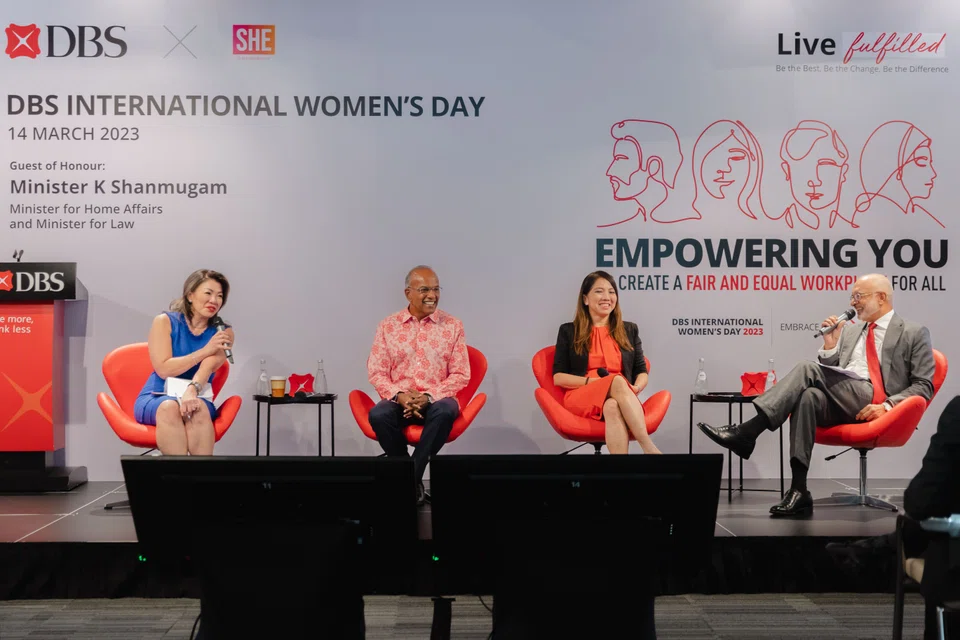
LAST week, four pretty powerful people came together for a panel discussion on empowering women – a minister, a C-suite bank executive, the CEO of that same bank, and a law firm founder.
The event was women-centred and focused on improving the lives, work culture and environment of women, as well as encouraging women to return to the workforce.
But I must say I personally gained the most from the stories and principles these individuals shared – the session was moderated by influential lawyer Stefanie Yuen Thio, the joint managing partner of TSMP Law Corporation, who brought up very relatable issues and asked very direct and pointed questions of the panellists – and gleaned lessons that I think both men and women can apply to their lives and careers.
Here are three key lessons I learned from these successful leaders:
1. How to change mindsets? Create programmes of change
In a speech at the session, Law and Home Affairs Minister K Shanmugam said Singapore has come a long way in terms of gender equality since before the 1960s, but one thing that will always present a challenge is the changing of mindsets towards treating and regarding men, women and their respective roles in society.
Responding to this point he made, DBS chief executive officer Piyush Gupta said the most decisive way to do this is to create programmes of change.
And what does that mean? In his words, “if you want to get mindset change, it won’t happen from just willing it or wishing it, you’ve got to create programmes of change… which capture the imagination of people, and bring focus to issues. That’s what I found in running companies... So from two weeks you’re going to four weeks paternity, that’s a classic programme of change, because it focuses the people’s mind on the fact that - there is an issue, - you create a programme around it, and then - you can drive energy around the programme.
So it’s not just idle wishing; it puts something on the table.”
Therefore, implement a change that is decisive enough to capture people’s attention and imagination, as well as bring focus to an issue you’re trying to change mindsets about.
2. What to do if the men aren’t taking you seriously? Attitude.
Tan Su Shan, who is group head of institutional banking at DBS, recounts the time she spent in the 1990s in dealing rooms in London and New York, where men were brusque, vulgar, throwing balls around and thumping their chests.
On her first trip to the United Arab Emirates, everyone in the room at her first meeting gasped in horror that she was a woman, and mid-way through her presentation she decided to stop and ask them to give her a test since she could see they thought she wasn’t worth dealing with. She passed it, and the men in the room volunteered to inform all the other men she would be meeting that she was worthy of a chance.
It’s safe to say she knows a thing or two about being thought of as less capable, not worth taking seriously, and worse, completely ignored. Just for being a woman.
Her advice: “It’s attitude, it’s agility, and it’s accountability. You’re accountable for your own career path, right? There are a lot of people who we can call upon to help, but at the end of the day, you make that final decision.
But the attitude matters, and having a resilient attitude. Sometimes just saying, okay, these guys… so if they throw something at you, throw it back, throw it back with gusto, whether it’s a curveball or a bally joke.
Or take it in your stride, you know – don’t go to the bathroom to cry. And see it from their perspective… they don’t know how to deal with a woman. Then make them feel that it’s okay, that you’re not that bad, that actually, you know as much as they do, and maybe you can bring something to the table that they need.”
3. How do you build confidence at work?
For Piyush, it’s a) building a network of good mentors who can build you up in the direction you want to go and b) practice, practice, practice.
By the sixth time he asks you to go up and give a speech, you would have built your confidence in public speaking, he says. And if you have a group of people you can tap on for advice on what to do in various situations and circumstances, that helps assure you that you are on the right track.
Now, for women that can sometimes be tricky, if the mentors you find most suitable happen to be men – how would that look, right? That notwithstanding, Piyush says headspace insecurities aside, the most important thing is to have senior mentors you can consult with and rely on for good advice.
For Shanmugam, the first step is in identifying your skill sets and picking roles that play to your strengths, while the second lies in seeking out an environment that supports your development.
The latter can include changing environments, where that is possible, or looking for a new one that does, if the current one you exist in does not permit or support that.
And here’s a bonus tip on how to get yourself recognition for the work you have been doing – especially if you’ve been feeling unappreciated or disenfranchised – from Tan:
- Don’t assume your boss knows everything. Get the data together to show that there is a clear trend of men getting promoted or paid more than women at every level – if you’re setting out to show that there is an unconscious bias at the workplace.
- Beyond the data, get into the qualitative – I’ve done this, please recognise me for these outcomes. Get the outcomes together, and present them to your boss, and seek out that validation.
There you have it – tools and tips from those who are succeeding in their careers. The devil always lies in the details, but I suppose it’s encouraging to hear that for Tan in particular, she’s been there and gone through what many of us may have before too.