

In a hot job market, the minimum wage becomes an afterthought
 Add BT as a preferred source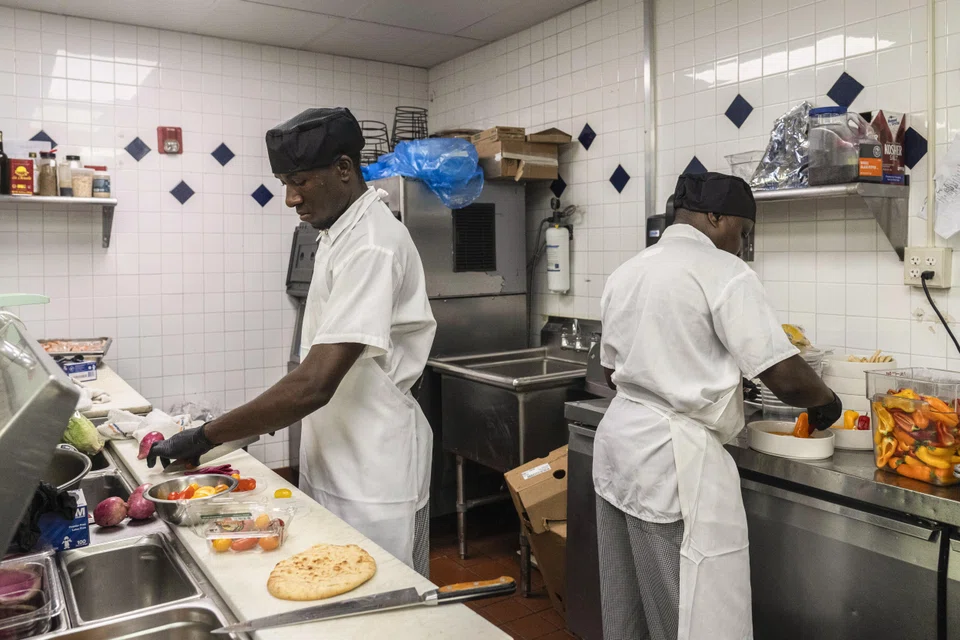
UNDER New Hampshire law, Janette Desmond can pay the employees who scoop ice cream and cut fudge at her Portsmouth sweet shop as little as US$7.25 an hour.
But with the state unemployment rate under 2 per cent, the dynamics of supply and demand trump the minimum wage. At Desmond’s store, teenagers working their first summer jobs earn at least US$14 an hour.
“I could take a billboard out on I-95 saying we’re hiring, US$7.25 an hour,” Desmond said. “You know who would apply? Nobody. You couldn’t hire anybody at US$7.25 an hour.”
The red-hot labour market of the last two years has led to rapid pay increases, particularly in retail, hospitality and other low-wage industries. It has also rendered the minimum wage increasingly meaningless.
Nationally, only about 68,000 people on average earned the federal minimum wage in the first seven months of 2023, according to a New York Times analysis of government data.
That is fewer than one of every 1,000 hourly workers. Walmart, once noted for its rock-bottom wages, pays workers at least US$14 an hour, even where it can legally pay roughly half that.
Navigate Asia in
a new global order
Get the insights delivered to your inbox.
There are still places where the minimum wage has teeth. Thirty states, along with dozens of cities and other local jurisdictions, have set minimums above the federal mark, in some cases linking them to inflation to help ensure that pay keeps up with the cost of living.
But even there, most workers earn more than the legal minimum.
“The minimum wage is almost irrelevant,” said Robert Branca, who owns nearly three dozen Dunkin’ Donuts stores in Massachusetts, where the minimum is US$15. “I have to pay what I have to pay.”
SEE ALSO



As a result, the minimum wage has faded from the economic policy debate. President Joe Biden, who tried and failed to pass a US$15 minimum wage during his first year in office, now rarely mentions it, although he has made the economy the centrepiece of his re-election effort.
The Service Employees International Union, which helped found the Fight for US$15 movement more than a decade ago, has shifted its focus to other policy levers, though it continues to support higher minimum wages.
Opponents, too, seem to have moved on: When Pennsylvania’s House of Representatives voted this year to raise the state’s US$7.25 minimum wage to US$15 by 2026, businesses, at least aside from seasonal industries in rural areas, shrugged. (The measure has stalled in the state’s Republican-controlled Senate.)
“Our members are not concerned,” said Ben Fileccia, a senior vice-president at the Pennsylvania Restaurant and Lodging Association. “I have not heard about anybody being paid minimum wage in a very long time.”
The question is what will happen when the labour market cools. In inflation-adjusted terms, the federal minimum is worth less than at any time since 1949. That means that workers in states like Pennsylvania and New Hampshire could struggle to hold on to their recent gains if employers regain leverage.
Congress hasn’t voted to raise the minimum wage since George W. Bush was president; in 2007, he signed a law to bring the floor to US$7.25 by 2009. It remains there 14 years later, the longest period without an increase since the nationwide minimum was established in 1938.
As the federal minimum flatlined, however, the Fight for US$15 campaign was succeeding at the state and local levels. Cities such as Seattle and San Francisco adopted a US$15 minimum wage, followed by states such as New York and Massachusetts. And while Republican legislatures opposed raising minimums, voters often overruled them; Missouri, Florida, Arkansas and other Republican-dominated states have passed increases through ballot measures in the last decade.
Nationwide, the number of people earning the minimum wage fell steadily, from nearly two million when the US$7.25 floor took effect to about 400,000 in 2019. (Those figures omit people earning less than the minimum wage, which can in some cases include teenagers, people with certain disabilities or tipped workers.)
Then Covid-19 upended the low-wage labour market. Millions of cooks, servers, hotel housekeepers and retail workers lost their jobs; those who stayed on as “essential workers” often received hazard pay or bonuses.
As businesses began to reopen in 2020 and 2021, demand for goods and services rebounded much faster than the supply of workers to deliver them. That left companies scrambling for employees – and gave workers rare leverage.

When the Fight for US$15 movement began, many economists warned that raising the minimum wage too high or too quickly could lead to job losses. Some studies did find modest negative effects on employment, particularly for teenagers and others on the margins of the labour market. But for the most part, researchers found that pay went up without widespread layoffs or business failures.
Some economists still wondered what would happen as US$15 minimum wages spread beyond high-cost coastal cities. But that was before the pandemic reshaped the low-wage labour market.
Still, economists say the minimum wage could become relevant again when the labour market eventually cools and workers lose bargaining power.
David Neumark, a professor at the University of California, Irvine, said states with high minimum wages could be at a disadvantage in a recession, because employers would have to keep pay high as demand softened, potentially leading to layoffs.
Other economists have the opposite concern: that workers in states where the minimum wage remains US$7.25 could see their recent gains evaporate when they no longer have the leverage to demand more.
“It’s as tenuous as it gets,” said Kathryn Anne Edwards, a labour economist and policy consultant. “The labour market has gained ground, but policy has not cemented that territory.”
Despite the strong labour market, many workers say they barely get by.
KaSondra Wood has spent much of her adult life working for the minimum wage, from the army depot where she held her first job, earning US$5.15 an hour, to the Little Caesars where she made US$7.25 as recently as last year.
But not anymore: This summer, she started a job cleaning rooms at a local hotel, earning US$12 an hour. Even in Oneonta, Alabama, a rural area with few job opportunities, employers know better than to try hiring at the minimum wage.
“They wouldn’t advertise for it, knowing they wouldn’t get anyone in there,” she said.
But Wood, 38, hardly feels that she is getting ahead. The hotel is a 45-minute drive from her home, so petrol eats up much of her paycheque, even though she carpools with her mother. Groceries keep getting more expensive.
“A couple years ago, US$12 an hour would’ve been killer money,” she said. But now it isn’t enough to pay her bills.
“I don’t ever get caught up,” she said. “I’m broke by the time I get paid.” NYTIMES
Decoding Asia newsletter: your guide to navigating Asia in a new global order. Sign up here to get Decoding Asia newsletter. Delivered to your inbox. Free.
Share with us your feedback on BT's products and services
TRENDING NOW

Middle East-linked energy supply shocks put Asean Power Grid back in focus

Malaysia’s 8th richest man Jeffrey Cheah wants Sunway business to last 10 generations
Wing Tai, Metro outbid 5 others for Dunearn Road site with bullish S$1,625 psf ppr bid at just under S$533 million
How China’s young workers are securing their future even as AI disrupts job market, triggers pay cuts

