

Embracing AI at work requires emphasising human skills
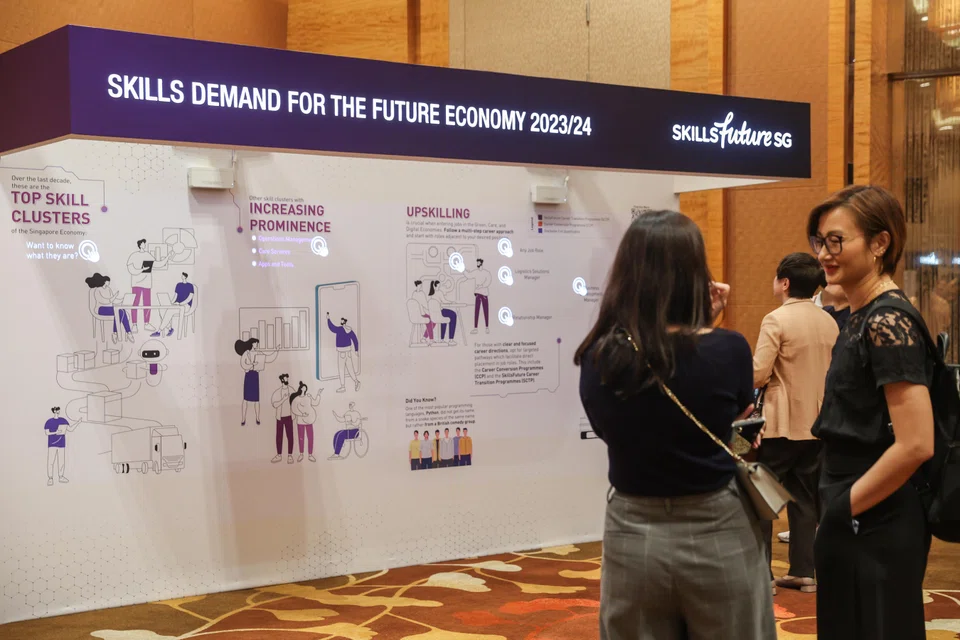
I WAS delighted to see Singapore’s Budget 2024 include help for workers who want to be equipped with new skills, especially in emerging areas such as digitalisation and artificial intelligence (AI).
In my conversations with partners and customers, I am seeing business leaders recognise that they cannot rely on old talent playbooks to help them navigate the rapidly evolving workplace.
I believe embracing AI implies several strategic shifts that can help business leaders set up their workforces for new levels of success.
Investing in talent
First, as AI continues redefining work, organisations must bring skills development and a culture of continuous learning to the centre of their workforce strategies.
LinkedIn research found that the skills needed for jobs globally will change by at least 68 per cent by 2030 due to the rapid impact of AI.
Focusing on skills and nurturing talent will become even more vital as the pace of change continues to accelerate.
Talent management leaders must pay more attention to individual career progression pathways to attract and retain top talent.
LinkedIn’s latest Workplace Learning Report found that 91 per cent of Asia-Pacific organisations plan to enhance their workforce’s skills and abilities this year.
Talent leaders also said that learning and development has become their top retention strategy. They are paying attention to individual career growth, as career pathways become more of a critical consideration for jobseekers and professionals.
We found that 48 per cent of Asia-Pacific talent leaders now regard offering career progression opportunities as a top priority.
The renewed focus on internal mobility and professional development reflects an evolution of strategic priorities.
As well as strengthening their ability to attract and retain top talent, organisations are aiming to ensure their workforce is equipped with the skills needed to stay agile at work. That is a proactive stance, given how quickly workplace requirements are evolving.
Prioritising soft skills
Business leaders should consider embracing AI tools to help them keep up with the sheer pace of change. Successfully integrating AI into business operations doesn’t depend on technical skills alone, though.
Human intelligence, creativity and adaptability are all crucial for collaborating effectively with AI systems, interpreting AI-generated insights and making informed decisions based on combining data and human judgement.
Organisations need to ensure their workforce is equipped with the soft skills needed to work effectively with and alongside AI systems. That means improving abilities to communicate and collaborate creatively and with emotional intelligence.
Professionals, meanwhile, can boost employability by sharpening skills in these areas. Above all, adopting a mindset of adaptability is crucial even as technologies continue to evolve.
Our research shows organisations are embracing this view as they hire, with 94 per cent of Asia-Pacific learning and development professionals of the view that human-centric soft skills are becoming the most competitive in our economy.
Skills such as critical thinking, communication and problem-solving are becoming the most sought-after by employers in the age of AI. These three skills are also among the top five capabilities that Asia-Pacific hiring managers now consider most important, alongside AI, IT and Web skills.
Employers are especially interested in communication abilities – this ranks top in LinkedIn’s 2024 list of the most in-demand skills.
Equally valuable to hiring managers is the ability to rapidly embrace new skills. We found organisations are increasingly prioritising candidates who demonstrate a strong potential for growth and a keen ability to learn.
Winning in an AI-driven future of work
We are in the early stages of a world of work that is – perhaps counterintuitively – more human than before.
AI’s impact on workplaces is exponential and requires a workforce that can adapt and evolve with technological trends. Yet, it is ultimately human intelligence that deploys this powerful technology, makes strategic decisions and drives innovation.
By grasping the significance of uniquely human skills in our modern professional landscape, organisations and professionals alike can be better positioned to seize new opportunities, collaborate productively, and make work more meaningful and fulfilling as they achieve their goals.
The writer is Asia-Pacific managing director at LinkedIn
TRENDING NOW
Nvidia CEO Jensen Huang’s confession engulfs chip giant in spying controversy
China recruited exec at Singapore data centre firm to spy on Nvidia CEO Jensen Huang: US intelligence

Higher rates, weaker spending: Is the Philippines entering stagflation?

Could Japan trigger the next global financial crisis?

