Here’s a loophole that is causing completely preventable worker deaths in Singapore
Can we actually profess to prioritise workplace safety if we have rules that specifically permit the endangerment of our workers?

WE HAVE a workplace safety issue in Singapore.
The number of workplace deaths has been on the rise since 2016. In 2022, there were 46 workplace fatalities in Singapore, the highest in years.
In response, the Ministry of Manpower (MOM) has called on employers to instil a strong safety culture and implement good safety practices.
Since Sep 1, 2022, MOM has implemented a six-month heightened safety period across the country. The safety period was set to end in February 2023 but was extended to end May 2023 to curb a “concerning” rise in workplace deaths. The heightened safety period ended recently without any further extensions.
During the heightened safety period, mandatory safety time-outs and the upfront debarment of companies from hiring migrant workers could be meted out to errant companies, if serious safety lapses were uncovered by the authorities.
Nurul Asshekin, chair of Singapore’s chapter of the international Institution of Occupational Safety and Health, has been quoted in media reports as being concerned by the rise in workplace deaths. Her view is that the deaths may “emphasise the lack of leadership and commitment towards a safe working environment”.
The most ridiculous thing that is still legal in Singapore: lorry-back transportation
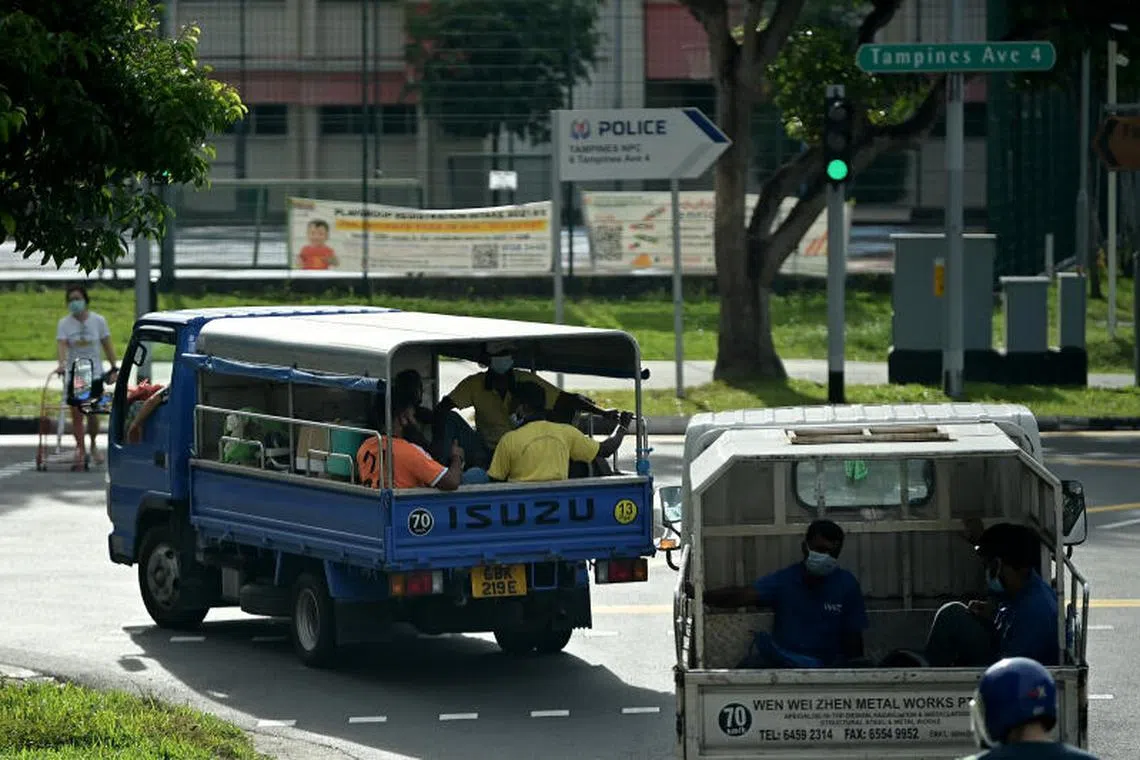
Despite the calls to make safety a priority from all quarters, I find there is a glaring area that remains unaddressed. It concerns how hundreds of thousands of workers are transported to and from construction sites each day.
The construction industry is a high-risk sector and is the highest contributor to the country’s 46 fatalities in 2022 with 14 deaths. One in three of Singapore’s workplace fatalities come from the construction sector.
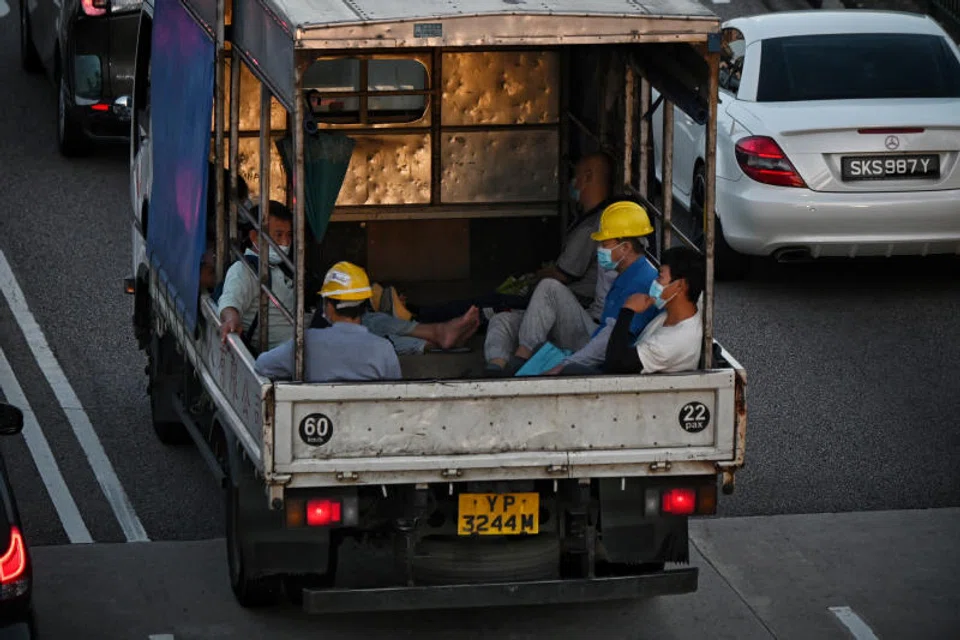
Despite the clear inherent risks involved, construction workers continue to be transported in lorries without seat belts.
Some regulations have been implemented requiring that railings and canopies be put on trucks that transport workers. These, however, have been described by Dr Stephanie Chok of non-profit organisation Transient Workers Count Too as “grossly inadequate” because “sitting on the open cargo deck of lorries is an inherently unsafe way to travel”.
Indeed, as one might surmise, railings and canopies do nothing to address the laws of physics when a moving vehicle decelerates quickly or swerves to avoid something on the road.
These same laws of physics are the reason why the Road Traffic Act requires the driver and every passenger of a motor vehicle “wear a body-restraining seat belt or a lap belt where such a seat belt or lap belt is available for his (her) use”.
If I may belabour this point further, what happens to crash test dummies – without seat belts on – in a car making a sudden stop also applies to workers on the back of a lorry, obviously without seatbelts: broken bones, internal bleeding, and possibly the loss of life.
In 2021, two workers lost their lives when a lorry transporting them collided into a stationary tipper truck. From that accident, two other workers landed in the intensive care unit, with an additional five warded in hospital.
What’s the government’s rule on this?
Here’s the Land Transport Authority (LTA)’s wording, per its website: “Lorries cannot be used to transport passengers except for ferrying workers between their lodgings and workplace (emphasis added).”
In view of what I undoubtedly see as heightened public and societal awareness of the importance of workplace safety, is it time for this loophole in Singapore’s regulations to be closed?
It makes no sense to have one safety culture for workers being transported between their lodgings and workplaces and another for everyone else.
Most of the workers being ferried in lorries are migrant workers. Companies are allowed to transport workers in lorries, but not allowed to transport non-workers in the same way, for safety reasons.
In cities like London, Hong Kong, and Bahrain, transporting workers on the backs of lorries has been banned. It bears noting, too, that Bahrain has a sizeable migrant worker population, similar to Singapore.
In 2008, when Bahrain banned the transportation of workers in lorries, its Interior Minister said that the move was implemented to ensure the safety and welfare of workers, in compliance with international treaties and agreements.
So why won’t we ban it? Is it the $$$?
Cost has been cited as a reason not to implement seatbelts in vehicles transporting construction workers. Practical constraints have also been cited about how the installation of seatbelts could affect the structural integrity and stability of lorries, posing danger or risk to the drivers and passengers.
Is cost as a reason for the loophole defensible in light of clarion calls to create a safety culture for workers in the country?
If the mere installation of seatbelts can affect the structural integrity and stability of lorries, one wonders if it really makes sense to have the same lorries carry human cargo.
In the same way that the government has passed a law to make the charging of plastic bags compulsory this year, perhaps the same can be considered to close the loophole in road safety guidelines on how workers are transported?
But do people care about this?
The issue has popular support. An online petition started two years ago garnered 40,000 electronic signatures.
Even President Halimah Yacob spoke out against transporting workers in goods vehicles as a labour Member of Parliament (MP) in 2009.
More recently in 2020, current labour MP Melvin Yong, who double-hats as NTUC’s Assistant Secretary General, wrote a compelling appeal in a blog post to have workers moved in buses with seatbelts and not in goods vehicles.
His impassioned call acknowledged the cost implications of making this change, with excellent ideas for the government to offset the cost burden on employers to ensure the safety of workers.
One of these that I found certainly warrants deeper consideration was exempting buses transporting workers from the Certificate of Entitlement (COE) system in the same way that school buses are.
Ruth Chow, whose brother was killed in a workplace accident at Rifle Range Road in December last year, called for more to be done to prevent workplace accidents. She was quoted in media reports asking whether it was time to admit there is a lack of safety culture here.
“We want to know why this accident couldn’t be prevented,” she said. “Every time we read the news, there are so many fatalities.”
Ultimately, workplace safety culture in Singapore is a broader discussion about doing what is correct versus doing what is convenient or cost-effective.
I resolutely believe that closing the loophole of transporting workers in lorries will send a strong signal in the drive for worker safety in Singapore. It would show how serious Singapore is on the topic of worker safety because every workplace fatality is just one too many.
Abel Ang is the chief executive of a medical technology company and an adjunct professor at Nanyang Business School