

SGInnovate CEO is driven by his desire for problem-solving
Lim Jui knows building Singapore's deep tech scene will be an uphill task, but he believes the vision is clear.

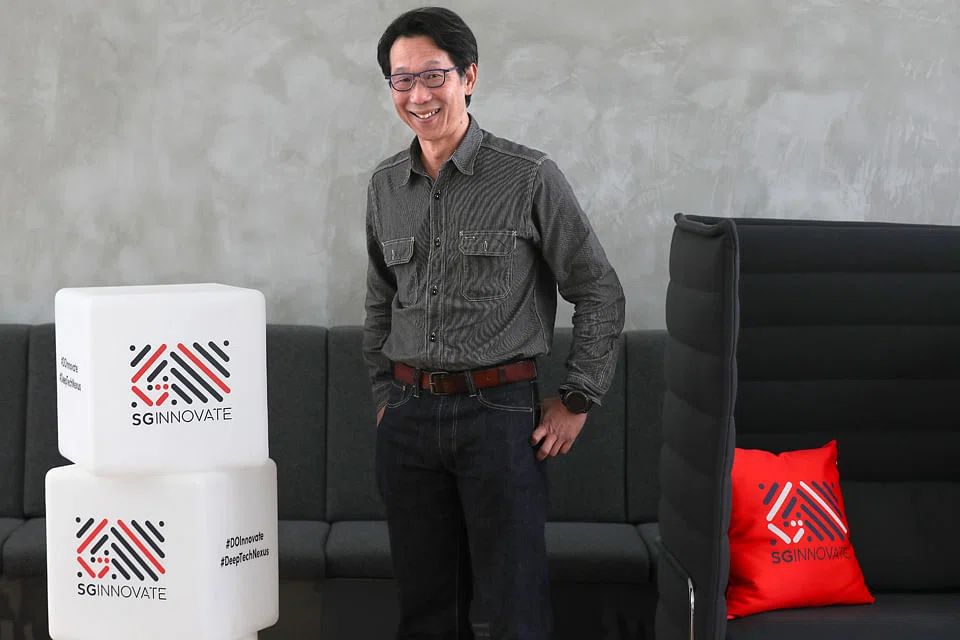
A DOCTOR. A businessman. An armchair philosopher with a fondness for military metaphors. All are fitting descriptions for SGInnovate's new chief executive, Lim Jui.
Lim left a career in anaesthesiology to become a venture capitalist, then helped turn a failing medical device company around.
He subsequently plunged into supporting the public sector and academia in their innovation activities.
And should anyone ever fancy a Manhattan, Lim could probably do the mixing himself. Who said a stint as a bartender in Harlem during college wouldn't come in useful?
With all that experience under his belt, Lim might even be described as a Swiss Army knife. It is quite fitting that the organisation he's currently heading is shaping up to be one, too.
Lim took over as CEO of government-owned SGInnovate in May last year - at a time when deep tech was attracting mounting interest but faced the pains of a nascent industry.
SGInnovate was set up to champion the deep tech ecosystem in Singapore. It has an early-stage investment arm and talent programme, and frequently runs events to connect a range of industry players.
Some might regard the organisation's task as unenviable. In spite of Singapore's thriving startup scene, deep tech companies struggle to get funding as it takes years for them commercialise a product. Founders often fret over the lack of tech talent in Singapore, and are all too aware that the big markets for deep tech are in the West.
The way Lim sees it, the role of the government is to intervene where there is slack not taken up by the private sector. "Let's do the things that nobody else wants to do, because those are the areas that need the most help," he tells The Business Times in an interview at SGInnovate's Carpenter Street office.
SGInnovate has invested in startups working on artificial intelligence (AI), blockchain technology and quantum computing - investments for which Lim gives credit to his predecessor Steve Leonard. It has now shifted its focus to underserved areas such as advanced manufacturing and sustainability.
Over S$60 million has been pumped into deep tech startups, and the organisation's more than 80 portfolio companies have gone on to raise over S$800 million from other investors.
Leading a government-owned deep tech agency was never part of Lim's plan. After six years at Nanyang Technological University's innovation and enterprise arm, he was toying with the idea of setting up a family medicine practice.
"I would have been very happy to do that to the end of my days. And then this came up, and it was just so interesting that I couldn't say no," he said.
"It almost represented the opportunity to address the culmination of all my frustrations."
Universities like the one Lim was at easily secured grants for deep tech ventures. But the lack of talent bit hard whenever they started companies.
"Today, it's still an issue. Talent is probably our greatest Achilles heel. And secondly, funding was always like squeezing blood from stone."
At SGInnovate, Lim has the chance to preside over a pot of money for deep tech and help entrepreneurs find the talent they need.
The organisation has rolled out talent programmes and apprenticeships that attract international applicants. It is also looking into formalising its database of industry players to help startups make vital connections.
Lim believes SGInnovate can form deeper collaborations with other organisations to address issues in commercialisation, intellectual property, business expansion and leadership. Recently, it entered a three-year partnership with SingHealth for health-science innovation, beginning with AI in healthcare.
Keeping SGInnovate small makes it flexible and agile, but it is also the organisation's weakness. "Sometimes, it's like a teenager going to a board meeting," Lim said.
He has always been a straight-talker. In his free time at Columbia University, he did plenty of political writing and immersed himself in an environment of strong opinions.
As a result of the college's strong liberal arts core, he studied a year's worth of literature - starting with the Bible - and a year's worth of philosophy.
He still leans on that education when he muses about leadership. "Aristotle and his three components of rhetoric are so applicable. Ethos, pathos, logos: appeal to ethics - something higher; appeal to emotion; appeal to logic - facts and figures."
Lim also references military history with ease, dropping references to German general Erwin Rommel and 19th-century Prussian Army tactics. He whips out lessons from his days as a commanding officer to explain his hands-off leadership style, inspired by the notion of "subordinate initiative".
"The idea is that you cannot control everything, so you must empower your subordinates," he said.
Lim knows building Singapore's deep tech scene will be an uphill task, but he believes the vision is clear.
"If you look at SpaceX or Tesla, they created new business in an economy where none existed before. Innovation opens new business. And these are very concrete, (like employment) and all the secondary effects like suppliers and a whole new generation of battery companies, AI companies and Lidar companies," he said."
"We want to be a partner in this transition to a deep tech economy."
TRENDING NOW

Keppel Reit to buy 51% stake in Keppel South Central for S$610.9 million

Singapore to use ‘every legal and regulatory lever’ against companies linked to haze: Shanmugam
Mi Material focusing on ‘things that we can control’ as it launches S$215 million SGX IPO

Once staunchly pro-China, Malaysian Chinese businesses are now distancing themselves from Beijing

