

The war for talent is real: LinkedIn Asia-Pac MD
LinkedIn Asia-Pac managing director Feon Ang shares how she nurtures and manages talent, as well as her belief in constant learning.
Singapore
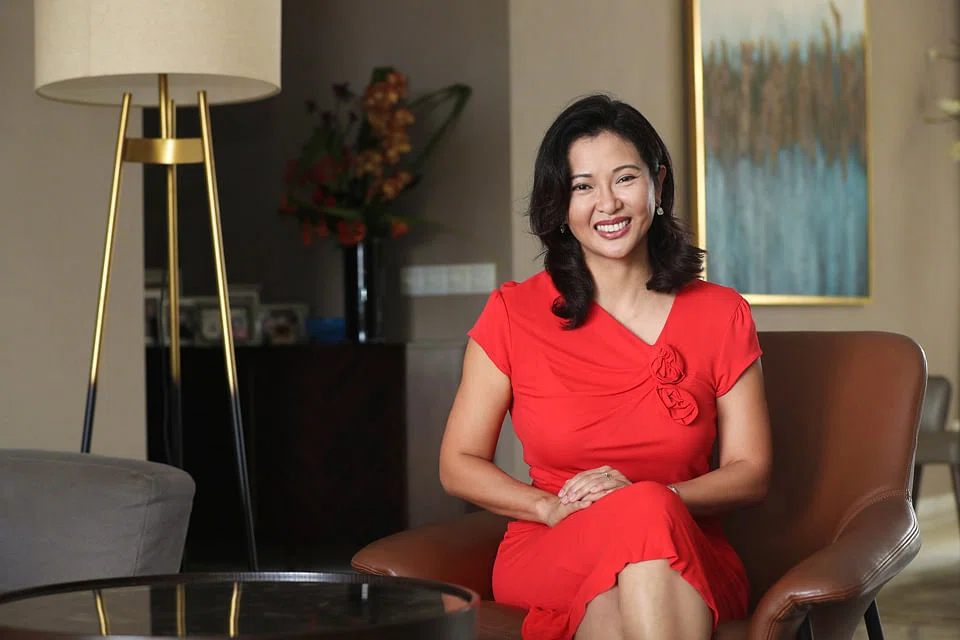
FEON Ang is in the people business and she does not waste time in trying to improve the way Singapore looks at human capital.
Having just been minted as managing director of LinkedIn Asia-Pacific in July this year, a month later she became the face behind LinkedIn's first-ever collaboration with a government globally, out of Singapore.
The programme, called Skills Path, allows job seekers to take courses in a chosen field to prepare themselves for their next career moves through a skills-based candidate selection approach.
Skills Path, notes Ms Ang, reflects a key direction the industry of hiring is headed - skills-based hiring, where a recruiter, instead of focusing on qualifications or accolades, might focus more on whether a prospective candidate for a position possesses the necessary skill set for the job.
Other than one's core skills needed for the role in question, Ms Ang says the key to skills-based hiring lies in a candidate's "transferable skills", meaning those that are needed across different jobs, companies or potentially industries.
Ms Ang's own career trajectory is intimately tied to the value of skills and learning. She joined the multinational in January 2013, taking on its talent acquisition service for the Asian markets, focusing first on Hong Kong and China, and expanding this to the Asia-Pacific region.
She was subsequently asked to also take charge of LinkedIn Learning. Ms Ang created EmergeIn (for nurturing leaders), EmpowerIn (for women in management), and annual training programmes that took off globally too.
In many ways, this reflects the notion of an attitude of constant learning - something Ms Ang herself espouses and embodies.
Her innate curiosity drove her to jump into the IT sector in the late 1990s, when everyone was talking about the "Y2K", and she would go on to spend a good decade in the industry ascending the ranks in sales at Gartner - until she learned that social media was the next big thing, so off she went to LinkedIn.
"I think when you see certain trends happening, you're interested, you're curious and you're keen to explore further. And then you make certain connections to find out from people what's going on in that industry, just having that mindset to learn and explore new things," she says. "So you connect the dots and (realise), 'hey, that's relevant'."
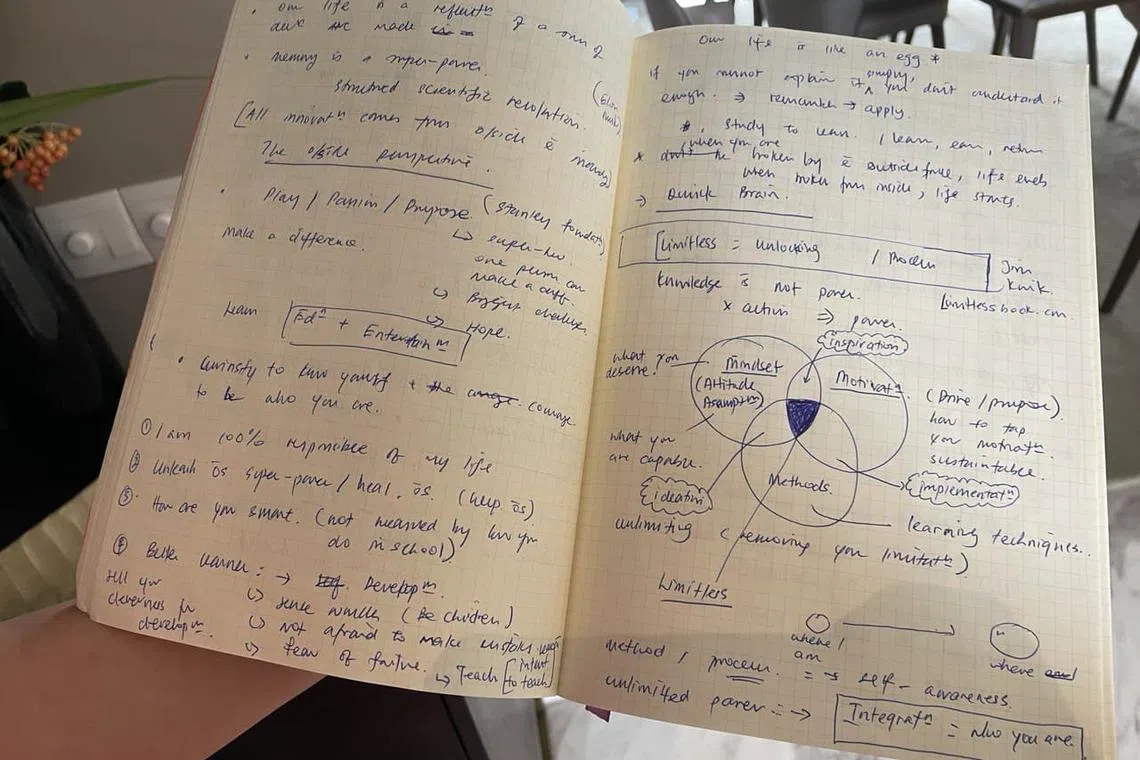
For a double-math and physics major who confesses to finding the study of words tedious, she's a voracious reader too, and goes all-in, annotating the pages of books she goes through, pasting Post-Its on certain pages with scribbles on them. Speaking to The Business Times from her home, she opens up a notebook that shows her written reflections from what she's read.
People management
To be an effective leader, Ms Ang says that one needs to possess conviction, courage, good communication skills and above all, the ability to inspire a vision.
"Conviction and courage comes from clarity of self, clarity of why you do certain things, and how the data backs up your decision to charge in a certain direction," she notes.
Data helps to drive the internal conviction, and that conviction drives courage to do the right thing, even if that means having difficult conversations. "People need clarity, not as much popularity," she adds.
Indeed, what people are truly looking for in a tricky discussion, according to Ms Ang, is to be heard and understood by their leaders.
"Listening is paying attention to what they're saying, and just making sure - 'just want to make sure I've heard you: this is your concern, this is what you're trying to tell me'," she says. "At the end of the day, even if the decision is not to go in that direction, they can feel that their point of view has been heard."
Ms Ang says that she always considers whether a topic that will be raised in an upcoming meeting requires the buy-in of participants. If such a situation arises, she conducts one-on-one chats with individuals ahead of time to apprise herself on where people stand, so she knows to tease out these differing opinions in the meeting discussion and encourage everyone to hear one another out.
"I think diversity of thought is really important, but I'm also grateful for the great culture we have that people don't feel like they need to add something that someone has already said before, just for the sake of speaking as well," she quips.
She also has a keen ear for conversations. The mother of three says ever since her children were about two or three years old, she would take them out on "one-on-one" dates in turns every weekend, without fail. It's become such a natural thing for her 20-year-old daughter and her two sons aged 18 and 14.
Remote work
Another recent development at LinkedIn that Ms Ang was heavily involved in was the company's decision to allow all its employees to choose to work from home permanently.
Coming to the conclusion of implementing work-from-home for all came from intense debate. It began, Ms Ang shares, with the struggle that many of LinkedIn's senior leaders had with the definitions of "remote" and "hybrid" work.
In many ways, she observes, big changes in work policy like this have to come from the top - in this case, LinkedIn CEO Ryan Roslansky, who emphasised the notion of empowerment and trust in the organisation.
"I think that's fundamentally what's really important - people want to feel empowered and trusted. It's understanding the human - we, as people - rather than organisations driving toward their agenda. And it really starts from the CEO and the culture of the company," she says.
And if an employer is afraid to trust, Ms Ang would point out that the world of work, especially in the ongoing pandemic, is evolving rapidly. Insisting on doing things the old way will challenge a company's ability to keep and attract talent.
"At the end of the day, the war of talent is real. And great talent chooses as well. So I think for organisations that are not thinking beyond the traditional way of working, then perhaps they might miss out on some of the great talent out there," she says. "Besides, the pandemic has shown that work can be done remotely."
Learning never stops
Given Ms Ang's self-starting mentality, her children initiate any tuition classes they feel they may need. She does not sit down with them to prepare for tests ("It's your job to learn, it's not my job to sit there and help you with that"). She has also refused to help her kids to bring their forgotten items to school, telling them to face up to consequences.
It's the journey that matters, and so Ms Ang sees no particular destination to her career - nor does she set specific end-goals.
"What can I do to grow and become a better person? It's not the title I'm after, it's about the opportunity to learn and to grow as a person. And that's what I want to teach my kids as well - it's not about the results; you can be a top student but if you are not a good person, then I don't think that's what I want in you."
TRENDING NOW

First Resources blames El Nino, outside fires for Kalimantan hotspots amid haze scrutiny

High Court rules against Julius Baer’s Singapore trust arm in US$50 million family trust dispute

Singapore key exports jump by higher-than-expected 68.4% in September, led by non-electronics

MSCI proposes downgrading Indonesia to standalone market status

