Reflections on BT’s path to a digital newsroom
The shift to a digital newsroom is a tough one and requires both work flow and technology changes

A media relations officer recently asked a colleague why a story on her boss’ speech had appeared online but not in print.
This is a common query in recent times, as some newsmakers continue to see The Business Times as a predominantly print medium. But newsrooms have changed. Publications are increasingly digital-driven and, although important, the printed newspaper is no longer the main product of news titles.
That is quite a reversal of BT’s set-up when it made its initial foray into the world wide web.
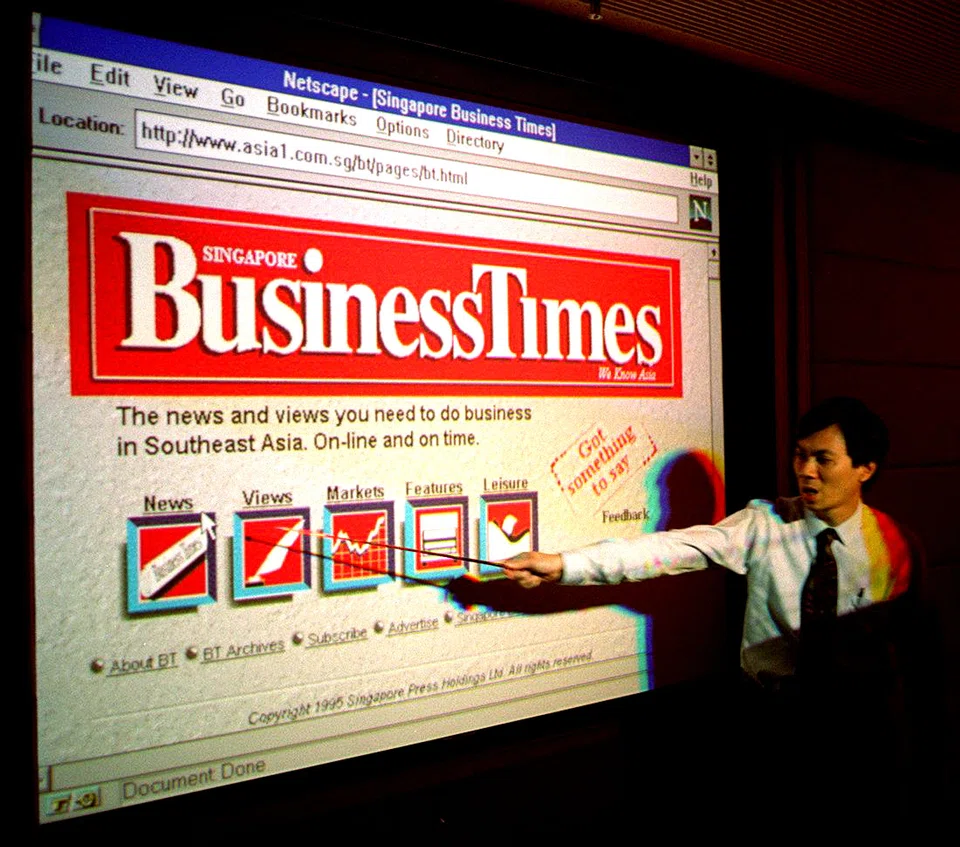
When the publication went online in June 1995 (nearly 20 years after being a pure print product), the web version of BT was essentially a digital replica of all stories from print. All articles flowed from print to digital.
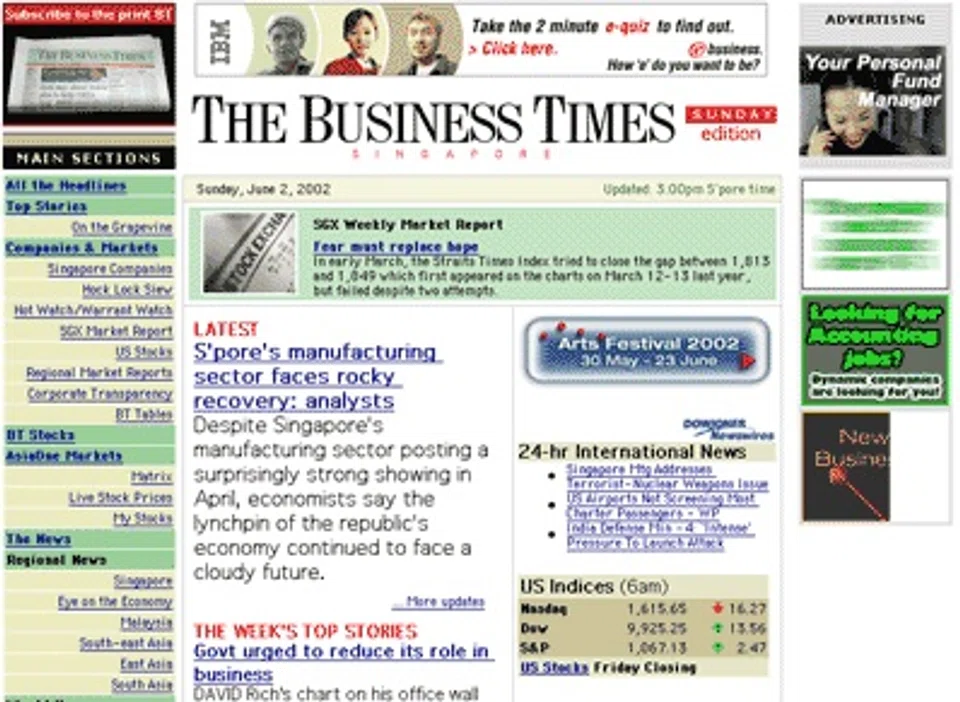
In 2000, the online version was published earlier – at 3am – and breaking news on the US and Singapore stock markets was filed throughout the day. Even when we formed a regular breaking news team in 2010,however, BT continued to be print-focused. Breaking news would be filed tight, with the best of our features, analyses and commentaries saved for the subscriber or newsstand buyer who paid for the hard copy the next day. Print stories uploaded onto the digital medium would always go behind a paywall.
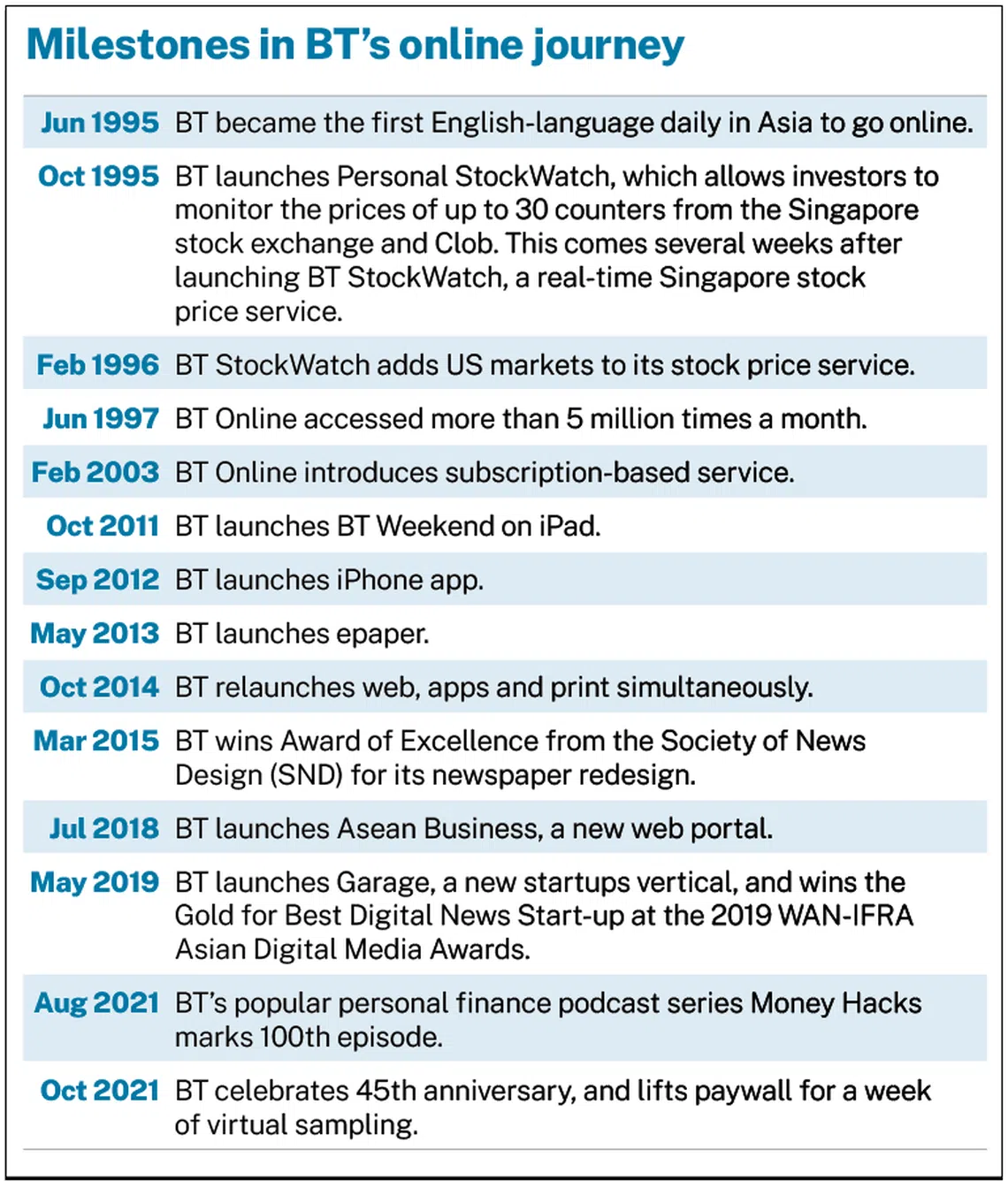
Things began to change in the last few years, as we observed how other news dailies transformed. The work-from-home trend also led more existing and new readers to access us on the web or on the BT app. With the rise in digital consumption, expectations of news are changing. We need to file not just breaking news quickly, but value-add stories in good time as well.
About 18 months ago, to meet the demands of news consumption in the digital realm, we devised a plan to decisively steer us towards digital readiness.
Journalists were given a crash tutorial on audience strategy. We were endowed with tools to help us monitor reach and engagement, as well as to test headlines, social media blurbs and newsletters. An online graphics team was formed. Templates to compute raw data were organised for speedy updates to interactive visuals. Social media capabilities were reinforced. New workflows were set up. We would aim to file most of our stories for digital first.
One of the challenges in mounting this shift was technology. Our core content management system (CMS) was made for print and didn’t allow us to embellish our online pages with photos, charts, videos, or podcasts. So we made do with a subordinate system online, while executing our digital-first workflow.
For months, we were stumbling along with 2 systems – filing a copy for online and another for print. Until April 25. BT became the first newsroom in SPH Media Trust to use a unified content management system (CMS) called Cue. Journalists only need to take care of one version – the digital version – that is also repurposed for print with minimal manual intervention. This has crystallised the reversal of the print-to-digital flow.
This shift has somewhat turned into a full circle for me, as I started my career in journalism as an online content producer for IT@AsiaOne in 1999. But digital journalism was relatively undeveloped then, so I opted for a transfer to BT in 2000.
For nearly 2 decades, the print copy of BT continued to be the primary product. The thinking was that, as long as the content is good, the product would sell, whichever the medium.
But digital journalism today demands much more. Good content needs to be complemented by savvy online marketing. Journalists today need to do more than care about the text. We need to think about the presentation, the social networks and other digital platforms to enlarge the reach and impact of our work. How do we write a headline that is optimised for search and yet doesn’t read like clickbait? How do we write a blurb that teases but doesn’t give away the crux of the story? How do we build our social media presence, or even a personal brand?
These questions were daunting to me, even as an editor driving change. I had to lean on the belief that if motherhood – the biggest change of my life – hadn’t killed me, this wouldn’t either. In the past 2 years, I got acquainted with digital analytics tools and academic learnings from other media organisations. I learnt about design apps, visualisation software and social media management kits. And yet, there is much I still don’t know.
When I became a mother, I didn’t know what it took to be one either. I read self-help books and obtained information from trusted people who have been one. But I still didn’t feel equipped. I ended up just making the best of the resources and intelligence available, and improvised along.
As with motherhood, so with this digitalisation journey: I have made mistakes. One thing I would have liked to do better, is perhaps not to force change far ahead of technology solutions. The original intention of implementing new workflows first was to change behaviour by building new habits, rather than to have both workflow and system changes happen at the same time. But the unified CMS that was to be a game changer ended up arriving later than expected. And this prolonged the pain of change, risking fatigue.
On the positive side, change can bring people together. It has been one of those whole-of-newsroom experiences that affects everyone. In the course of learning to use the new CMS, more people found reasons to turn up at the office after a long period of remote work -- to help one another with problems or to navigate new system features. As one journalist noted, when you are going through the pain of change, it feels better to know you are doing it together. And to keep in sight the ultimate purpose of serving our readers well.
Off The Record is a monthly column by BT’s editors on the modern news industry from an insider’s perspective. We welcome feedback and suggestions at btnews@sph.com.sg.