Stress is down, pay is fairer, but loyalty is dipping: what the regional employment outlook looks like

IN THE wake of seismic changes prompted by the global pandemic since 2020, the landscape of work has seen big shifts, with organisations grappling with the Great Resignation, quiet quitting, as well as many supervised layoffs and cutbacks to cope with economic upheavals.
We see a beacon of hope amid these transformative times, though. EngageRocket’s Workplace Snapshot 2023 reveals a heartening shift in areas such as employee well-being, fair compensation and organisational resilience.
By analysing over 2.5 million survey responses we collected over the past year from September 2022, we’ve uncovered three key insights into how employees feel about work:
Employees are confident about organisational resilience, but loyalty is dipping
The pandemic cast a long shadow of uncertainty over the workforce, with many employees facing concerns about their organisation’s future. In 2022, a mere 45 per cent of respondents expressed confidence in their organisation’s prospects. However, 2023 has witnessed a remarkable shift, with an overwhelming 90 per cent displaying optimism about their organisation’s future.
The majority, 83 per cent, are proud to work for their current employer, and a substantial 65 per cent would remain even if offered an equivalent role and compensation elsewhere.
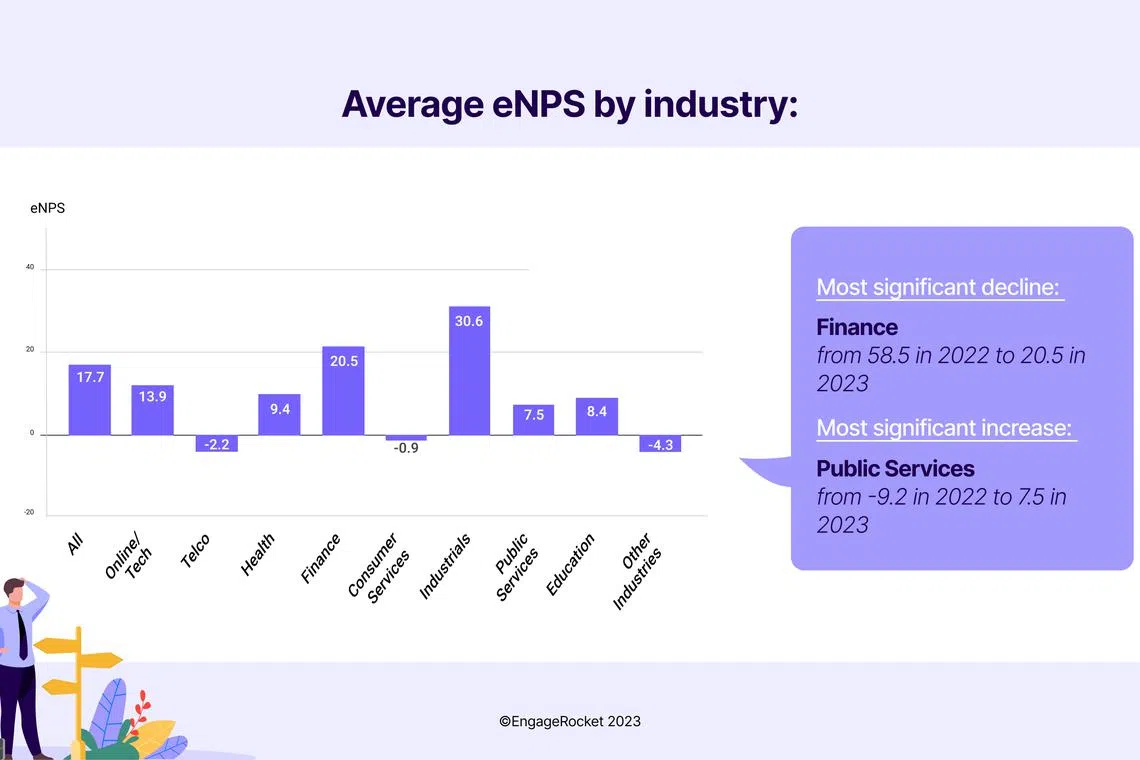
As businesses in Singapore emerge from the challenges of the pandemic, they are able to instil more confidence in their workforce. Yet, employee Net Promoter Score (eNPS) – an indicator of loyalty, reported on a spectrum between minus 100 and 100 – is seeing a decline on average.
How does it measure this? eNPS asks employees, for instance, how likely they are to recommend their workplace to others. In this year’s survey, 41 per cent said “Yes”, compared with 53 per cent in 2022. On the other hand, 23 per cent would not recommend their workplace, up from 17 per cent last year.
Importantly, employee loyalty can vary significantly from one organisation to another, and even between industries. For example, we found that eNPS actually increased from minus nine in 2022 to eight in 2023 in the public service sector. In financial services, however, it fell sharply from 59 to 21.
What makes a great workplace is clearly not a one-size-fits-all answer. Organisations need to tailor their own listening and analytics programmes to understand which levers to pull to make the most difference in retention or attrition. Otherwise, disengagement can take the form of quiet quitting or even outright resignation, despite the red flags not being immediately obvious.
Employees mostly feel they are compensated fairly, but there is rising frustration with how their work is evaluated
Performance management is another key aspect of workplace experiences. For human resource (HR) teams and managers, it means quantifying work output, objectively viewing both performance and potential, providing feedback, and deciding on the best compensation plan for each employee. At a time of inflation and rising cost of living, this makes a big difference in how employees feel about work.
For employees, the review and appraisal process is an added pressure to their daily workload. How they are perceived in this process has long-term consequences – it determines their career path, new responsibilities they may have to shoulder, improvements in quality of life, and the opportunity to explore new domains and roles.
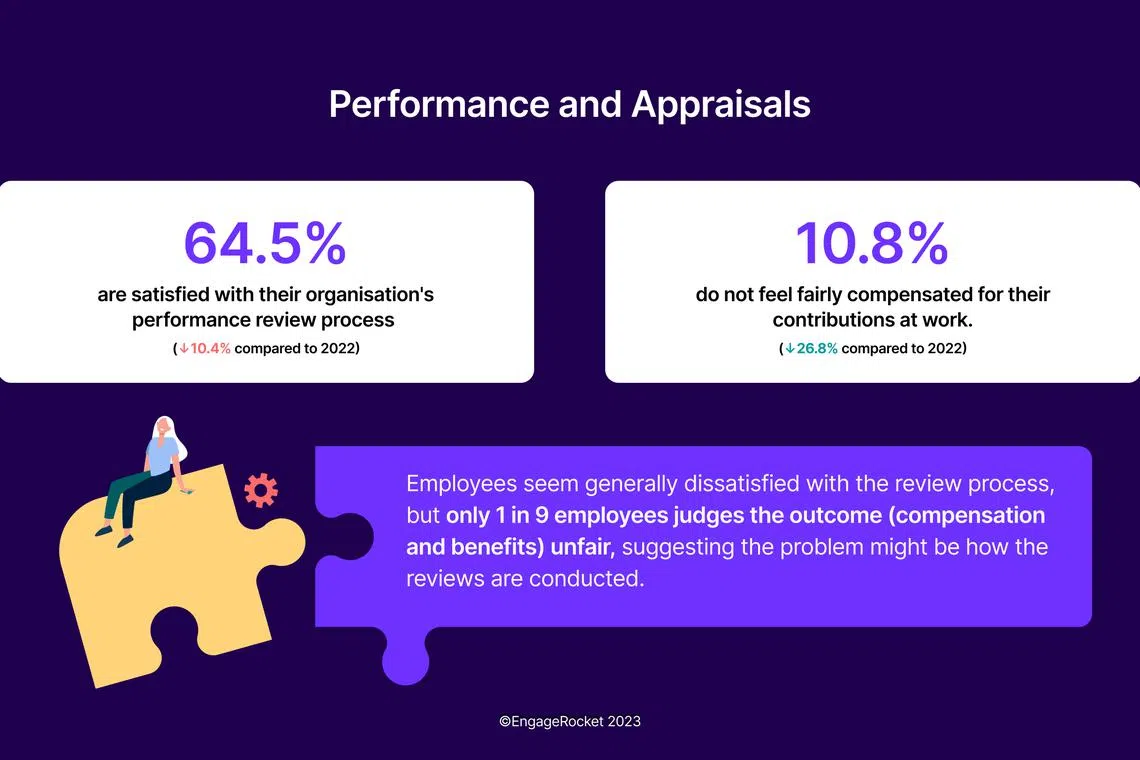
Organisations need to do everything they can to make this process simple, objective, transparent and standardised. The provision of performance conversation guides and individual performance data, for instance, will be a game changer for managers. The current level of satisfaction with the performance review process stands at 65 per cent among employees, a drop of almost 10 percentage points compared with the previous year.
Despite this, only 11 per cent of employees in our survey feel they are not being fairly compensated, a considerable drop from 38 per cent in 2022. We’re glad to see that HR teams and organisational decision-makers have been able to institute better parity between employee expectations and job compensation and benefits.
This is vital in the long term, since benefits are the No 1 reason Singaporeans stay with organisations. A study by Willis Towers Watson found that 85 per cent of the country’s employees are likely to remain with an employer who meets their benefits requirements.
Employees feel taken care of, and are less stressed
Stress is one of the biggest factors souring the employee experience at work. Feelings of stress leave employees unable to focus and be productive. When work is accomplished under stressful conditions, satisfaction takes a hit. Stress also spills over into one’s personal life, hindering work-life balance, which is a major source of concern for the country’s workforce.
Workplace stress can also have physical repercussions. At severe levels, it can cause burnout, making it extremely difficult for employees to go about their daily tasks, whether at work or at home. This also exacts a toll on healthcare costs incurred by employers.
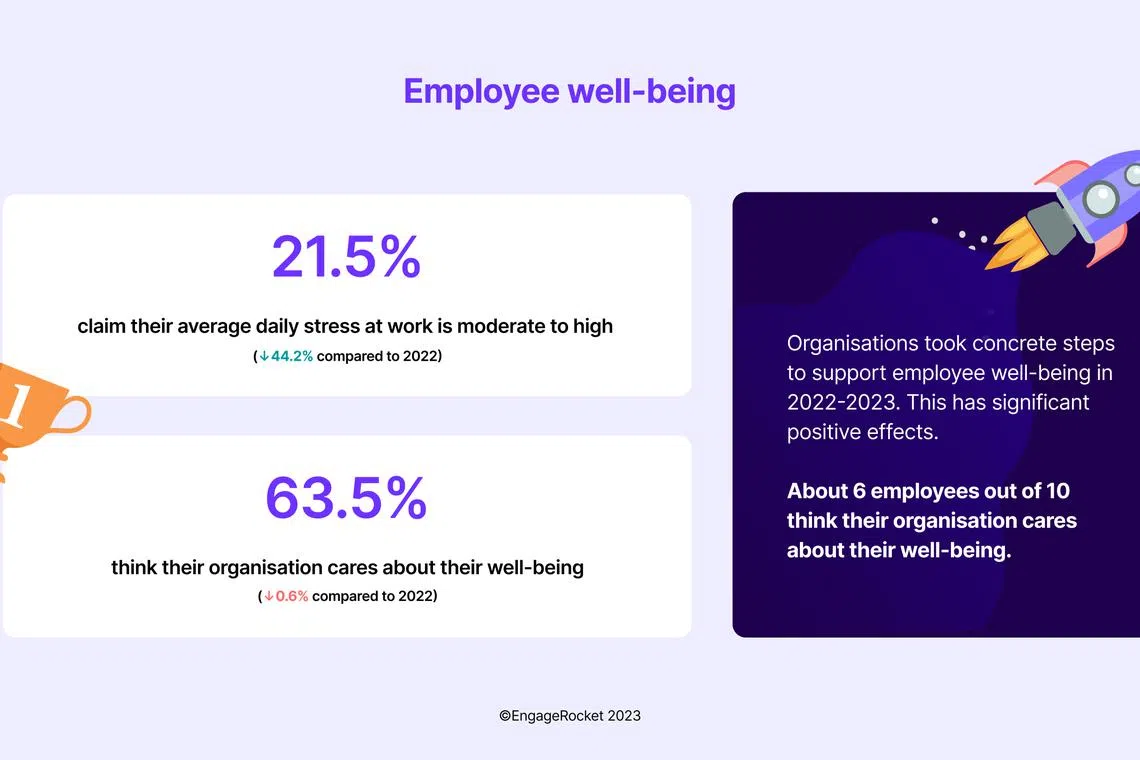
That’s why well-being is a critical point of discussion in our survey. We asked employees to score the degree to which they feel stressed at work.
The good news is that 22 per cent state their average daily stress at work is moderate to high, a significant improvement of 44 per cent from last year. Moreover, about six employees out of 10 think their organisation cares about their well-being.
This speaks to the concrete steps taken by organisations to support employee well-being in the past year, including offering flexible work arrangements so employees feel empowered to choose their best-fit productivity schedule and fostering open conversations around stress and its effects, to create a more inclusive work environment that’s psychologically safe for employees.
The good work does not stop here
We are now seeing the benefits of the people-focused programmes and initiatives rolled out in the past few quarters, with employees displaying a largely positive outlook towards work. It is important to keep moving in the right direction, prioritising well-being in the face of new challenges such as geopolitical conflict and climate change.
The demands on HR in modern organisations have become more strategic. By working with team leaders and managers on one end and organisational executives on the other, they can steer the workforce – and the business as a whole – towards a path that generates value and meaning to all stakeholders.
The writer is co-founder and chief executive officer of EngageRocket, an HR tech company that helps companies improve employee experience