

Pre-school sector outlay to reach S$1.7b in 2022
PM Lee says doubling of annual spending from 2017 will foster social mobility

Lee U-Wen
Singapore
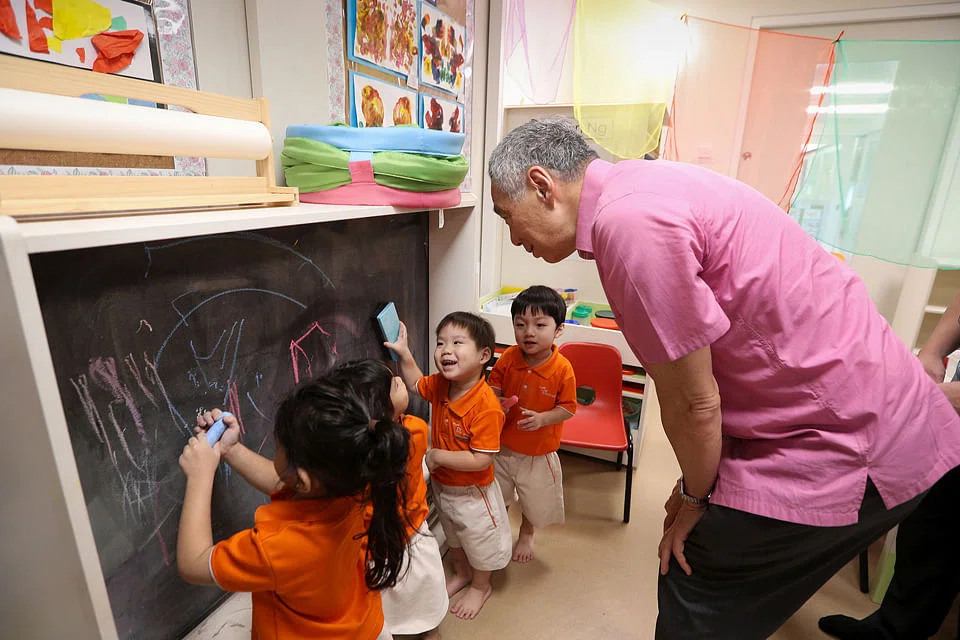
THE government is going to double public spending again on the pre-school sector to S$1.7 billion a year in 2022, which is up significantly from the annual expenditure of S$360 million in 2012 and S$840 million this year.
Describing this as a "heavy but worthwhile" investment, Prime Minister Lee Hsien Loong said that there is a broader social purpose to this emphasis on pre-schools.
He said at the National Day Rally on Sunday: "We're talking about infants to six-year-olds. Nowadays, even two-month-old babies are enrolled in infant-care, and that is part of pre-school. Pre-school is important to give our children a good start and have the best chance to succeed in life."
The social purpose that Mr Lee talked about was about providing access to affordable and quality pre-schools that will help greatly to level the playing field for young children, so that all children, regardless of their family background, have the "best possible start" in life.
"We must do this because every child counts. If we get this right, we will foster social mobility, and sustain a fair and just society," he said.
It was five years ago when the government "moved decisively" to build up the country's pre-schools and transform the entire sector.
Nearly 50,000 more childcare and kindergarten places were created, in particular in younger estates such as Punggol and Sengkang.
Subsidies were increased to make pre-schools more affordable, and efforts were made to raise the standards of anchor operators. The Ministry of Education (MOE) now runs 15 of its own kindergartens for children aged five and six.
Mr Lee announced three more initiatives to take the development of Singapore's pre-school sector to the next level.
First, there will be 40,000 new full-day pre-school places created in the next five years, a 30 per cent increase from the available places today that will take the total number to about 200,000.
Second, MOE will increase the number of its kindergartens to 50 in the next five years in a move that Mr Lee said will "influence and uplift" the quality of the entire sector.
Lastly, the pre-school profession will get a major upgrade in order to attract more capable people to join.
A new centralised institute, called the National Institute of Early Childhood Development (NIEC), will be set up. This institute will bring together the many existing pre-school teacher training programmes - at Temasek and Ngee Ann polytechnics, the Institute of Technical Education, and the Seed Institute - under one roof.
Set up under the ambit of the National Institute of Education, the NIEC's mandate is to develop early childhood professionals for the sector.
It will provide a full range of diploma and certificate programmes for pre-school professionals, and have the scale to develop curricula with different specialisations such as music, art, mother tongue and special education.
As for the faculty at the NIEC, Mr Lee said that they will have more opportunities for professional development and progression within a larger fraternity.
The prime minister added that the government will work with employers to ensure good career prospects and competitive salaries.
Noting that the pay of pre-school teachers has gone up over the last five years, he said that salaries need to improve further as the profession undergoes an upgrade.
"In particular, salaries will match career progression so that we can get not just good teachers, but able and committed specialists and leaders," he said.
The Early Childhood Development Agency said in a separate statement that it will embark on a three-year campaign to attract more people to join the early childhood sector. By 2020, some 20,000 professionals will be required to meet the sector's needs, up from around 16,000 today.
Meanwhile, children from low-income and vulnerable families will benefit from a programme called KidStart, which the government has piloted for a year.
KidStart, which now has 400 families on board, begins from the time a woman is pregnant. Trained officers visit the families at home to support her and share skills and knowledge on health, nutrition and child development.
After the baby is born, the officers continue to coach the parents all the way until the child is in pre-school. Mr Lee noted that the early feedback on KidStart is promising, and if proven to be true, the programme will be scaled up to benefit even more children in future.
He stressed, however, that the major investment in the pre-school sector will amount to nothing if the country's fertility rate does not go up.
"All this will be for nought unless young couples do your part. So please have more babies!"
More National Day Rally reports:
TRENDING NOW

SoftBank’s Son plans US$50 billion Malaysia tech outlay: Anwar Ibrahim

Singapore expects all parties to honour commitments, says PM Wong after Indonesia cuts gas exports
Gas Supply may pursue remedies if contract breached following Indonesia’s export cuts: Tan See Leng

Why the biggest business decision about AI isn’t which model to choose

