

Navigating the data centre boom
Where are the growth hotspots, and what to make of the inconvenient truth?







IN an era of autonomous vehicles, 5G, and artificial intelligence, data is the new oil. And across the globe, data centres are being built at a fast clip and snapped up like hot cakes.
Pitched as offering better-than-average yields compared to other real estate classes, these nondescript buildings are drawing not just developers and operators, but also private equity keen on the seemingly limitless potential of the data sector.
Mergers and acquisitions (M&A) in the data centre sector totalled 130 deals worth US$32.4 billion in 2020, slightly more than double what was sewn up in 2019 (US$15.1 billion across 115 deals), said Synergy Research Group.
Last week saw the biggest deal signed yet, when Blackstone Group agreed to acquire US data-centre operator QTS Realty Trust in a transaction valued at about US$10 billion, bringing year-to-date (YTD) deals pending closure to US$16.8 billion. Another US$6.3 billion worth of deals have already been closed YTD.
US-listed Digital Realty Trust is also said to be considering an initial public offering of a trust here that could raise US$300-400 million.
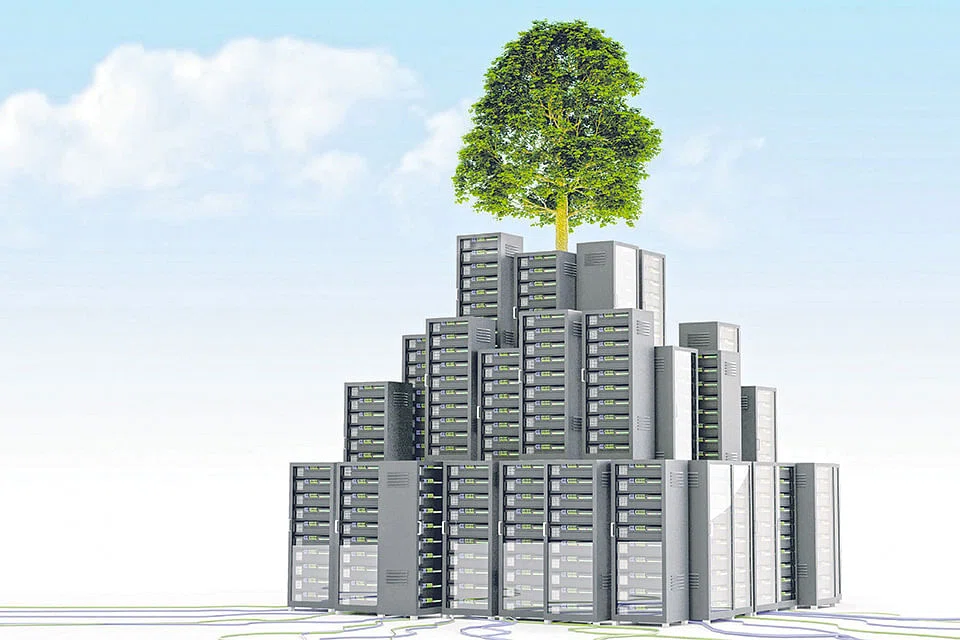
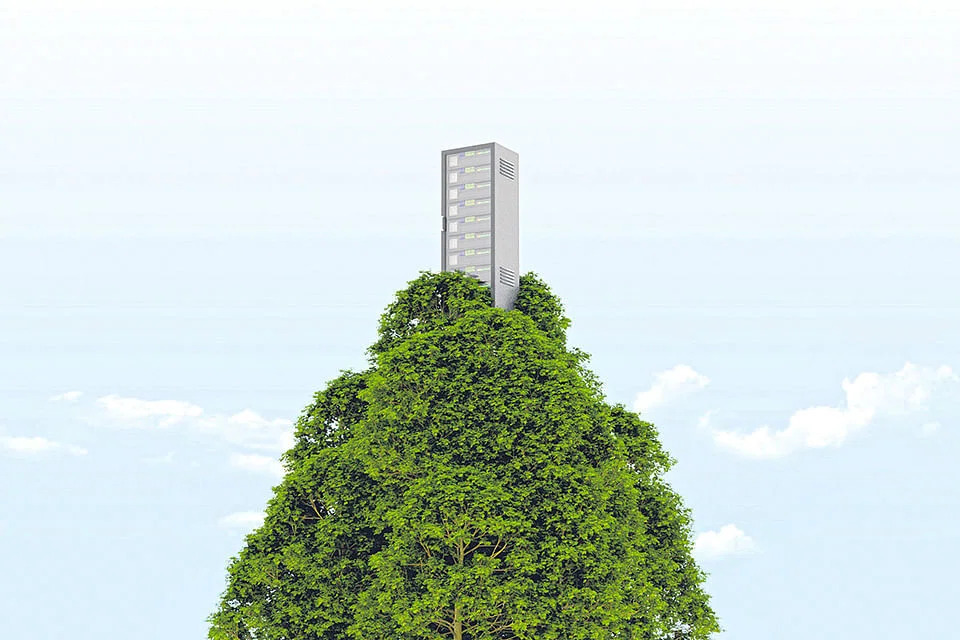
Yet data centres are giant energy guzzlers and account for 2 per cent of the world's total greenhouse-gas emissions, a level that puts the sector on par with aviation. And data centre emissions are only expected to rise - to 3.2 per cent by 2025, and 14 per cent by 2040.
For investors looking to ride the boom, are the biggest markets for these now-essential buildings the best bets, or do emerging markets that are currently underserved offer better prospects? And what are stakeholders to make of the not-so-small problem of keeping them green?
Emerging markets
Mature markets in North America, Europe and the Asia Pacific continue to attract investors. Vacancy in the most in-demand hubs ranges from a tight 2 per cent (Northern Virginia) to 8-9 per cent (Frankfurt), said a January report from Cushman Wakefield.
That draws the likes of private equity group KKR, which will invest US$1 billion building data centres in Europe, while Singapore's GIC has teamed up with US data centre provider Equinix to develop six hyper-scale centres in Europe for over US$1 billion.
Yet as real estate consultant JLL noted in a February report: "2021 is likely to be the year where new market protagonists of China, India and Indonesia will lead the regional growth story."
The ongoing moratorium on building new data centres in Singapore - considered a developed primary market - may have derailed expansion plans for some data centre operators locally, but some are casting their net wide.
ST Telemedia Global Data Centres (STT GDC) has partnered with Temasek and Indonesian conglomerate Triputra Group to develop a new data centre operating platform in Jakarta, Indonesia.
President and group chief executive Bruno Lopez says: "The underlying growth that we're seeing in this industry is very significant."
Heavyweight players such as Tencent are already muscling in. The Chinese tech giant operates about 20 data centres outside China, mainly in Europe and the US, and plans to open two centres in Indonesia by the end of 2021. It is also eyeing South Korea and Thailand, and the Middle East.
Meanwhile, Alibaba already has three data centres up in Indonesia, while Google, Microsoft, Amazon and Facebook all have plans to build their first data centres in the country, said Nikkei.
Data from Structure Research shows that in 2020, the Asia-Pacific (Apac) region took up the biggest share - 45 per cent - of the world's data centre co-location market, amounting to US$24.1 billion.
North America accounted for 37 per cent of the market, at US$19.8 billion. This was followed by the Europe, Middle East and Africa (EMEA) region at 17 per cent or US$9.3 billion, and Latin America at 1 per cent or US$0.7 billion.
Come 2025, the firm expects the Apac market to reach US$45.8 billion and account for half of the global co-location market, while the North American market is expected to reach US$27.4 billion. The EMEA and Latin American markets are expected to reach US$16.8 billion and US$2.4 billion respectively.
Jabez Tan, head of research at Structure Research, says that in the Apac region, Jakarta, Mumbai and Tokyo "have some of the highest growth potential in terms of overall market size in the next five years".
Among mature markets, Tokyo, Shanghai, Beijing, Singapore, Sydney and Hong Kong are top of the list. "We expect these mature markets to continue to exhibit healthy growth trajectories moving forward - barring any regulatory intervention which prevents the development of new data centre supply," he adds.
Lynus Pook, Colliers' senior director of industrial advisory in Asia, says the fastest-growing markets over the past five years - in terms of investment volumes - include China, Australia, Japan, Taiwan, and Singapore. In the past year, strong volumes have also been seen in Hong Kong, South Korea, and India.
Structure Research's Mr Tan says that China is often not compared on the same playing field as other markets due to its high barriers to entry for international companies. Because regulatory restrictions require foreign companies to work through a local operating entity or joint venture, "many global data centre providers have largely bypassed expanding into China".
Nonetheless, the country is "absolutely a top-ranked data centre market" in terms of market size, he adds.
This is not lost on CapitaLand, which in April said it would invest 3.66 billion yuan (S$757.7 million) to acquire its first hyper-scale data centre campus in China, in Shanghai.
Counting the costs
Across the region, operators are "expanding at breakneck speed" due to the demand for these assets, says Bob Tan, senior director of alternatives and capital markets for Apac at JLL.
While build costs can run into hundreds of millions for a typical hyper-scale centre associated with Big Tech users, governments often dish out tax incentives and packages that reduce the cost of power, for instance, for operators.
Based on a 2020 data centre cost index by Turner & Townsend of 40 key markets, Zurich emerged as the most expensive. Build costs for data centres in the Swiss city stand at US$11.40 per watt. Data centre capacity ranges from below three megawatts (MW) for smaller edge centres, to up to 20 MW for co-location centres, to up to 200 MW for hyper-scale centres. (One MW is equivalent to one million watts.)
Tokyo ranked second with build costs of US$10 per watt, followed by Silicon Valley and New Jersey which tied at US$9.80 per watt. In Singapore, build costs are some US$6.60 per watt.
Meanwhile, costs could continue to increase.
Dan Ayley, Turner & Townsend's London-based director and global head of data centres, says that as a whole, construction material costs are on the rise globally as a result of the pandemic.
And in data centres, where the "speed to market is critical", delays in the construction schedule, along with material shortages, will have a direct impact on critical path activities.
"Lead-in times for standard materials are, in some instances, now double what they were pre-pandemic. Delays ultimately equate to increased costs and the potential for financial penalties," he adds.
Climate action
As demand for data centres continues to grow, stakeholders are starting to come to terms with the impact these buildings have on the climate.
In some jurisdictions, regulators have already taken action. The Singapore government is not alone in its hard stance against new builds. Amsterdam had, in 2019, also imposed a one-year moratorium, which has since been lifted. Shanghai and Beijing have started to impose restrictions on new power provisions for data centres.
Riding on sustainable concerns, Iceland has welcomed data centre builders to its frigid shores, where the constant cold provides natural cooling for data centres that generate vast amounts of heat. In addition, almost all of Iceland's power comes from renewable sources: geothermal and hydroelectric.
Colliers' Mr Pook notes that globally, governments are still "very much at the nascent stages" of their ambitious climate goals.
Patricia Ribeiro, senior vice-president and senior portfolio manager at American Century Investments, points out that leading operators in China, such as GDS Holdings and 21Vianet Group, have committed to more usage of renewable energy. China has also committed to carbon neutrality by 2060, and is in the early stage of drafting new regulations on energy usage, she adds.
Collaboration seems to be the way forward for many. Amazon is said to be in talks with Japanese power companies and trading houses to build a renewable energy plant for its data centres in Japan.
"Data centre providers - be it the global giants who have over a hundred sites or smaller operators who have standalone facilities in a few countries - would probably find it economically unfeasible to set up green power plants specifically to cater to the needs of the data centre," says Mayank Srivastava, senior vice-president of design, build and hyper-scale engagement for data centre provider BDx. "There has to be a larger partnership collaboration model."
Countries that have deregulated energy markets tend to be better suited for sustainable centres, as real estate asset holders are allowed to procure green energy, says Indraneel Karlekar, global head of research at Principal Real Estate Investors.
Markets with immediate access to renewable energy or have a high portion of energy in the national grid coming from renewable sources, such as the UK and Sweden, would also do well, he adds.
Do the current environmental challenges faced by the sector pose conflict for environmental, social and governance (ESG) investors?
Mr Karlekar says that while data centres tend to be energy-intensive and thus emissions-intensive, "that also means they are ripe for improvements that can drive both cost savings and deep emissions reductions".
"By acquiring data centre properties, forward-thinking investors may have an opportunity to achieve improvements in ESG metrics relative to the baseline, while saving money and providing greater value to tenants. Because data centres are large energy consumers, they can also sometimes negotiate favourable terms for green power procurement."
American Century Investments' Ms Ribeiro also notes that hyper-scale projects tend to not present sustainability concerns as they "generally speaking, have (the) highest energy consumption efficiency."
Imminent challenges
New challenges are arising as markets expand. BDx's Mr Srivastava says that what the "sheer growth explosion" translates to is a lack of people with the relevant expertise who are able to enter growth markets and drive the business there.
"A lot of this growth is happening in countries where the data centre penetration has been extremely low . . . Data consumption is going up, but there isn't enough talent available locally to be able to support a data centre project or construction, or even operations," he adds.
Will green solutions drive up costs? Turner & Townsend's Mr Ayley says: "The pressure is on to keep capital costs low and yields high; the added recent dynamic of targeting net-zero carbon emissions adds complexity to a highly competitive industry."
However, he says, given how providing green technical solutions will become the industry standard, "that doesn't mean we should expect to see a spike in capital costs. Our industry will continue to innovate, (as) data centre developments need to be faster, cheaper, greener."
Still, external risk factors could hinder the construction of these assets. In a Turner & Townsend survey on industry trends with 162 respondents, 79 per cent indicated that Covid-19 had caused productivity losses and higher operating costs on data centre construction sites.
Additionally, 55 per cent believe that there will be a rise in data centre construction claims and litigation in 2021 linked to Covid-19.
Fifty-seven per cent of respondents said that market conditions in 2020 have driven up data centre construction prices.
"The current crisis and increasingly competitive nature of the market has starkly exposed the fragility of the global supply chain and its potential to curb future growth. Data centre providers need to be alive to the very real risks of contractor insolvency and knock-on impacts to projects," noted the report.
Meanwhile, Brenda Ong, executive director, logistics and industrial at Cushman & Wakefield, has also flagged that as a result of the increased demand for these assets, "prices have gone up and cap rates have compressed" in Singapore and for most developed markets.
Data centre prices in Singapore, based on price per kilowatt, have gone up by about 10-15 per cent over the last 12 months (Q2 2020 to Q2 2021).
"Nonetheless, the growth story for data centres remain positive, and we expect to see further growth and interest," she adds.
READ MORE: Data centre Reits navigate growth amid competing forces
TRENDING NOW
Far East Organization’s The Serra Residences sells less than a quarter of units released at average S$3,460 psf

MAS, SGX must address our IPO problem

A bumpy road ahead for some of Singapore’s fresh graduates in their job search

Once staunchly pro-China, Malaysian Chinese businesses are now distancing themselves from Beijing

