From AI financing to Indonesia outlook: 4 takeaways from Singapore banks’ Q3 results
The local lenders are staying focused on wealth growth and selective lending despite margin pressures, market uncertainty
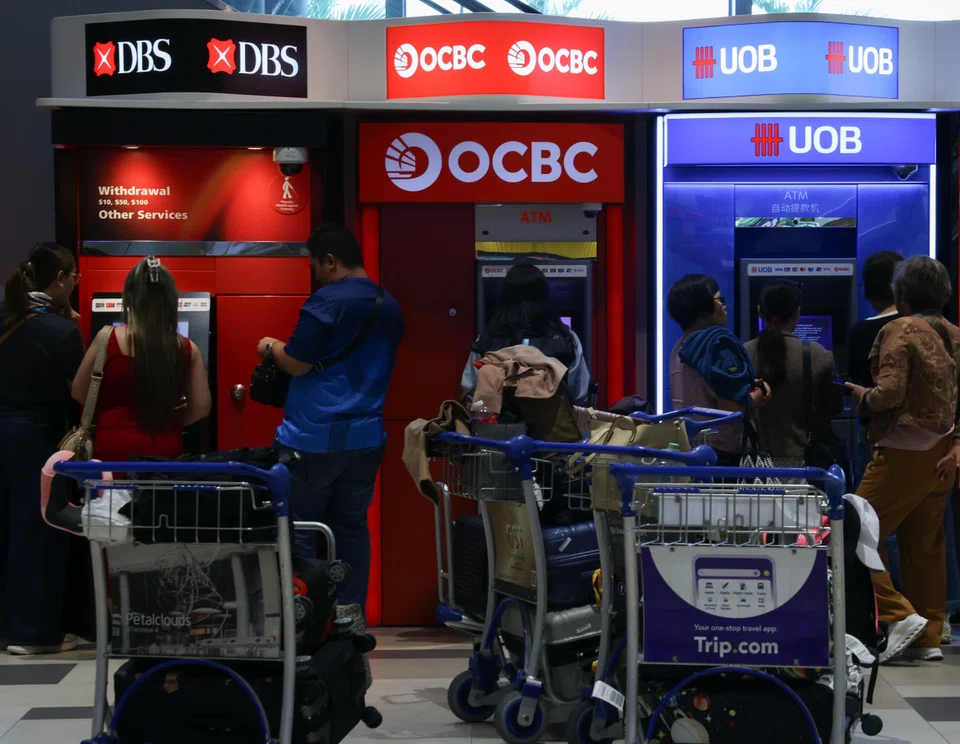
[SINGAPORE] Singapore’s local banking trio delivered mixed third-quarter earnings this week, as resilient wealth management income cushioned the impact of narrowing loan margins and rising funding costs.
DBS’ net profit fell 5 per cent year on year to S$2.81 billion, weighed down by lower market trading income.
OCBC’s earnings rose 3 per cent to S$2.22 billion from the year before as stronger performances in its wealth management and wholesale banking businesses offset lower contributions from insurance arm Great Eastern.
UOB’s net profit jumped 182.2 per cent to S$1.25 billion off a low base of S$443 million in the year-ago period, when it was weighed down by S$1.36 billion in allowances for credit and other losses.
Top-line results aside, all three lenders struck a more cautious tone on their outlook, even as they remained optimistic about longer-term growth opportunities.
Several themes stood out: disciplined financing of artificial-intelligence infrastructure, a long-term commitment to Indonesia despite market uncertainty, and continued investment in wealth management.

Here are four takeaways from their Q3 results:
1. Heading cautiously into 2027
Elevated energy prices, tighter financial conditions and geopolitical risks are clouding the outlook for Singapore’s banks, although loan growth is expected to remain resilient.
DBS expects total income growth in the mid-single-digit range for 2027, supported by mid-single-digit growth in net interest income.



Deposit growth will likely normalise to the mid-single digits next year, said chief executive Tan Su Shan, although higher Treasury bill rates could absorb some of this growth.
UOB projects 2027 net interest income to surpass this year’s levels, while loan growth is expected to be in the mid-single-digit range.
Leong Yung Chee, the bank’s chief financial officer, noted that it is becoming “quite difficult” to forecast margins reliably, given the uncertain flow-through of interest rate changes between benchmarks, particularly those from US Fed rates to the Singapore Overnight Rate Average (Sora).
To offset margin pressures, the banks are leaning further into non-interest income.
DBS expects non-interest income growth to hit the high-single or double-digits in 2027, depending on market performance.
UOB similarly expects mid-to-high-single-digit growth in fee income, though it warned of higher operating costs next year as it continues to invest heavily in wealth management and technology.
OCBC did not provide quantitative guidance for 2027, but group CEO Tan Teck Long remains optimistic about opportunities in its four key markets of Malaysia, Singapore, Hong Kong and Indonesia.
2. Funding AI infrastructure, not the hype
Amid growing concerns over an AI investment bubble, the three lenders emphasised their “prudent” approach to financing projects with proven cash flows.
OCBC’s Tan noted that the bank prefers hyperscalers with a portfolio of businesses, as opposed to a mobile-wide business.
The bank’s total loan book exposure to AI-related financing is less than 1 per cent, and its exposure to data centres is around 3 per cent.
Similarly, DBS focuses on high-quality investment-grade hyperscalers. It has around S$14.6 billion in exposures to data centres and outstanding loans of around S$8.98 billion, which accounts for 2 per cent of its total loan book, Tan said.
UOB’s Leong concurred that while AI-related financing is a “growth area”, there is a need for portfolio limits. AI-related financing now accounts for under 5 per cent of UOB’s loan portfolio, and consists of a mix of short and long-term facilities, Leong added.
3. Indonesia: committed long-term, but monitoring risks
Singapore’s banks are maintaining their long-term commitment to Indonesia despite currency weakness and uncertainty over the country’s investment outlook, including Indonesia’s potential reclassification by MSCI from emerging-market to standalone-market status.
DBS’ Tan noted that the bank’s franchise in Indonesia is down around 9 per cent this year, largely reflecting a depreciation of the Indonesia rupiah against the Sing dollar of about 8 per cent.
While the bank has been de-risking in terms of unsecured consumer loans and loans to small and medium-sized enterprises, the balance sheet has remained “resilient”, she said.
OCBC’s Tan similarly acknowledged that while the loan book in Indonesia grew about 10 per cent, it translates to about 5 per cent in Singdollar terms due to currency depreciation.
The market accounts for around 5 per cent of the bank’s operating income.
The bank is “managing its exposure conservatively” while having identified sectors with sustained growth potential, such as data centres and logistics.
UOB’s deputy chairman and chief executive Wee Ee Cheong said the bank takes a long-term view on the country, which accounts for under 3 per cent of its loan and profit contributions.
4. Wealth remains a key growth engine
Despite climbing interest rates, intense competition for quality lending assets has limited banks’ ability to raise pricing, noted UOB’s Leong.
However, wealth management continues to be a key focus for Singapore’s banks.
UOB’s net fee income for Q3 2026 climbed 19 per cent on the year to S$733 million, as wealth-management fees hit a record S$258 million.
In Q3, OCBC’s clients remained invested despite being more cautious, the bank noted. This activity was captured under customer flow trading income, which rose 29 per cent to a record S$480 million, driven by both wealth and corporate segments.
Wealth fees also rose 3 per cent to S$442 million, the second-highest quarter on record after the second quarter.
DBS said that it expects structural growth in wealth management to continue. The bank’s wealth fees for Q3 increased 8 per cent year on year to S$864 million.
DBS shares ended 2.1 per cent or S$1.48 lower at S$69.72 on Friday (Nov 6), OCBC closed down 0.7 per cent or S$0.20 at S$27.73 and UOB shed 2.5 per cent or S$0.93 to S$36.88.
Decoding Asia newsletter: your guide to navigating Asia in a new global order. Sign up here to get Decoding Asia newsletter. Delivered to your inbox. Free.
Copyright SPH Media. All rights reserved.