

All eyes on Fed chief Powell if he can pull off high-wire act of balancing growth and inflation
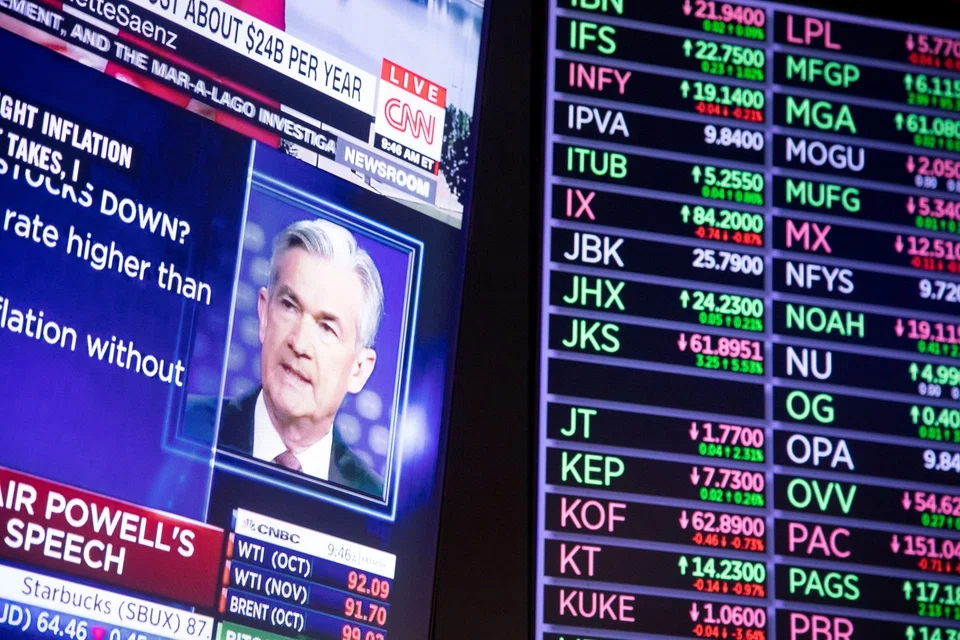
US Federal Reserve chairman Jerome Powell used his appearance at Jackson Hole last Friday (Aug 26) to shut the door on hopes for a “pivot” in central bank policy.
He caught bullish stock-market traders’ horns in the door, causing one of the biggest routs on broad indexes this year. Strategists say the bear market could be back with a vengeance as investors hunker down for a long winter of sky-high fuel prices and an aggressive central bank.
In the weeks leading up to the central-banking confab, the speculation on stock and bond markets was that the Fed would use the occasion to acknowledge a lessening of inflationary pressures and a moderation in economic growth, setting the table for a pivot in rate policy.
Far from a dovish message, Powell projected a hawkishness seldom seen outside the sport of falconry. Many armchair economists have cited the 1970s stagflation era as an important precedent for the Fed’s current battle.
Powell effectively told the symposium – and the rest of the world – that the Fed stood at the same precipice as the policymakers at that time, and that he was determined not to repeat their dovish mistakes. Where many central bankers failed to act, believing the Fed’s policy would be ineffective against commodity-driven inflation, Powell vowed to raise interest rates until inflation was definitively tamed, and to hold the rates at an elevated level until there was no chance of it returning.
The message was rapidly processed in markets, and the Dow Jones Industrial Average closed down by more than 1,000 points. Jim Paulsen, the chief investment strategist at money manager The Leuthold Group, said there are already signs of a Fed victory in the data.
On the same day that Powell addressed the Rocky Mountain gathering, a report showed that personal consumption expenditure inflation index - the central bank’s preferred measure of price increases - rose 6.3 per cent, down significantly in July from 6.8 per cent a month earlier.
It’s one of a handful of data suggesting that inflation in the US may have already peaked. That’s partly because the yield on the 10-year Treasury, which is the most influential on credit costs in the US economy started rising a year ago, said Paulsen. “The lagged impact of all that tightening is working about a year later,” he said.
Despite the aggressive rhetoric, the Fed would likely downgrade the size of the rate hike at its September policy meeting to 50 basis points from 75 basis points at the last meeting. And that, said Paulsen, could be their last hike.
The US Commerce Department confirmed last week that gross domestic product shrank for the second straight quarter. While Powell hinted that the Fed was willing to wreak more economic damage to bring inflation back in line, no central banker wants to be remembered for creating years of hardship.
“I don’t think they have an inherent desire to kill the US economy. As bad as inflation is for the economy, as bad as it is for people’s lives, a recession is worse,” said Paulsen.
There is a risk, of course, that the Fed makes a policy error. Many economists believe the central bank waited too long to start its rate-hiking cycle. If Powell waits too long to pause, there’s a risk he could end up causing a deep recession.
Other strategists argued that he could still pull off a high-wire act of balancing growth and inflation. Rather than signaling a policy shift, Powell was using the “jawboning” power of his platform as a weapon in his fight against inflation. The central bank was attempting to “talk” the market down, hoping to avert the kind of speculation in stocks and real estate that contributes to inflation, said portfolio strategists at money manager Alpha Capital Management.
The Fed often treats the stock market as an erratic child, prone to misinterpreting parental guidance and irresponsible behaviour. Last Friday, Powell gave the market the scolding of a lifetime, warning that it had gotten too far ahead of itself with dovish fantasies.
The S&P 500 had risen almost 20 per cent from its lows around 3,600. After a 3 per cent selloff last Friday, most strategists expect the broad index to come close to those lows again.
Few strategists anticipate a plunge to new lows, however, unless the energy crisis set to grip Europe in the winter spreads to the US.
“Earnings have remained quite strong, as have earnings forecasts, and while we see pockets of weakness in the economy that may result in a mild Fed-induced recession,” said the Alpha Capital strategists.
Ultimately, the fate of the US economy and inflation could be out of the Fed’s control. European stock markets are priced for a brutal recession because of Russia’s embargo on natural gas. If gas prices in the US keep on rising, something similar could happen there.
Anyescalation of the situation in Ukraine could “re-spike” energy prices worldwide, said Paulsen. The commodity spike and “deglobalization” effects of the war are a major cause of this bout of inflation. But the mercurial, inscrutable nature of Russian President Vladimir Putin means there’s also a possibility of a de-escalation.






