

Analysts raise target prices, dividend estimates on UOB as they get positive on earnings outlook
Maybank forecasts return on equity to increase, thereby driving higher valuations

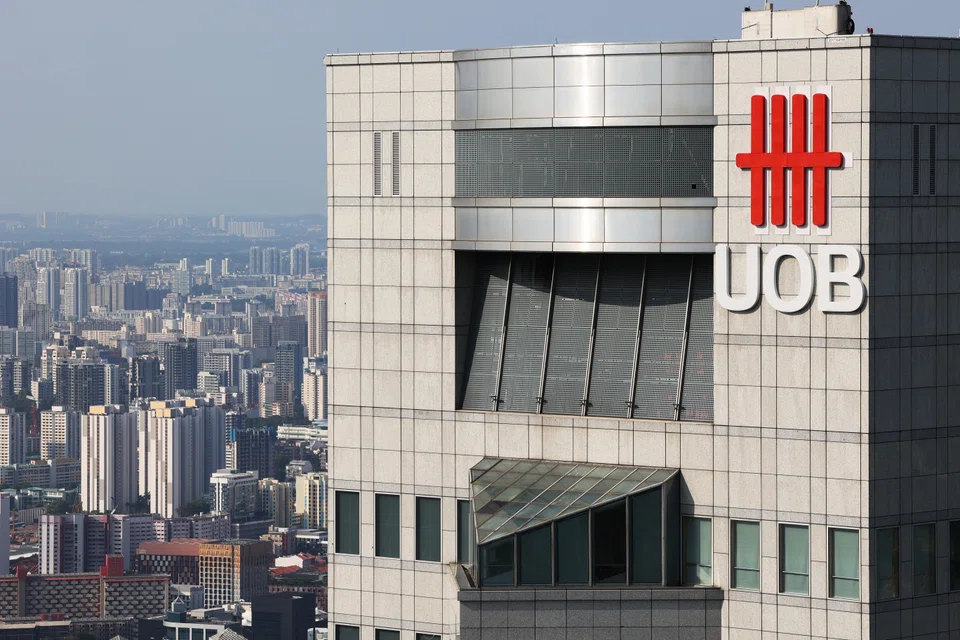
ANALYSTS have raised their target prices for UOB after the lender on Wednesday (Feb 19) posted full-year net profit that reached a record of S$6.05 billion.
It also announced a S$3 billion package to distribute surplus capital over the next three years, through special dividends and share buybacks.
Maybank Securities raised its target price for UOB by nearly 15 per cent to S$44.32 from S$38.75, with a “buy” rating. RHB maintained its “buy” rating, and raised its target price to S$41.60 from S$40.20.
OCBC investment research maintained its “hold” rating, but raised its fair-value estimate of the stock to S$41.50 from S$37.50.
Morningstar also raised its fair-value estimate for UOB to S$41 from S$40.
Shares of UOB closed S$0.07 or 0.2 per cent lower at S$38.58 on Wednesday.
Maybank said: “While margins should be under pressure, the group’s integrated Asean strategy can catalyse fees and credit growth going forward. This can also help diversify the loan book towards growth sectors with better credit quality such as digital economy, data centres and consumer device production.”
Alongside capital management, Maybank Securities’ head of equity research Thilan Wickramasinghe forecasts UOB’s return on equity (ROE) for FY2025 to FY2027 to be “at least three percentage points higher than the past 10 years”.
“A structurally higher ROE should drive higher valuations, in our view,” he said.
UOB on Wednesday announced a special dividend of S$0.50 per share to be issued over two tranches in 2025. This represents a payout of S$800 million of the lender’s surplus capital.
After factoring in the capital distribution, RHB’s estimate for UOB’s FY2025 dividend per share is lifted to S$2.12 from S$1.94.
The research house said that in the near term, investors stand to enjoy an estimated dividend yield of 6.1 per cent for 2025. It thinks that the lender is “well-poised to capture trade and investment flows arising from the shift in supply chains”.
OCBC’s Carmen Lee, head of investment research, also projected an increase in base dividend. From a base dividend in FY2024 of S$1.80 and S$0.50 special dividend, OCBC is projecting an increase to S$1.90 for FY2025. That does not take into account any special dividend.
From 5 per cent in FY2024, Maybank’s net dividend yield estimates for UOB are 6.4 per cent by the end of FY2025, 5.4 per cent by the end of FY2026, and 5.9 per cent by the end of FY2027.
For 2025, UOB is aiming for high single-digit loan growth, as well as double-digit fee increase led by cards, wealth, trade and loan-related fees.
Morningstar senior equity analyst Michael Makdad said: “While we believe the loan and fee growth targets may be somewhat ambitious, we remain positive on UOB’s earnings outlook for 2025 and expect its ROE to increase from 12.6 per cent in 2024.”
He said that UOB’s one-time Citigroup integration costs had been inflating its cost-to-income ratio by two to three percentage points through the first half of 2024.
He added: “These costs, which continued to add 50 to 100 basis points to the ratio in the second half of 2024, are expected to no longer weigh on efficiency starting in 2025.”
OCBC investment research revised its earnings estimates for UOB for FY2025 and FY2026, taking into account fewer interest rate cuts and better fee income.
Carmen Lee, head of OCBC investment research, said: “While geopolitical tensions remain and trade tariffs could disrupt regional trades, we believe that South-east Asia is more resilient due to rising inter-regional trades.”
On Wednesday, UOB chief executive Wee Ee Cheong said at the results briefing that mega trends – such as supply chain diversification, digitalisation and the green economy – are driving investments into the region.
There has also been closer cooperation among Asean countries, such as the Johor-Singapore Special Economic Zone and integrated cross-border retail payment systems.
“These should help boost intra-Asean connectivity and growth, and reinforce the region’s position as a key player in the global economy,” he noted.






