Asian markets to expect short-term pressure from Fed rate cut: analysts
Despite an ‘unexpected hawkish restraint’, a December cut remains likely

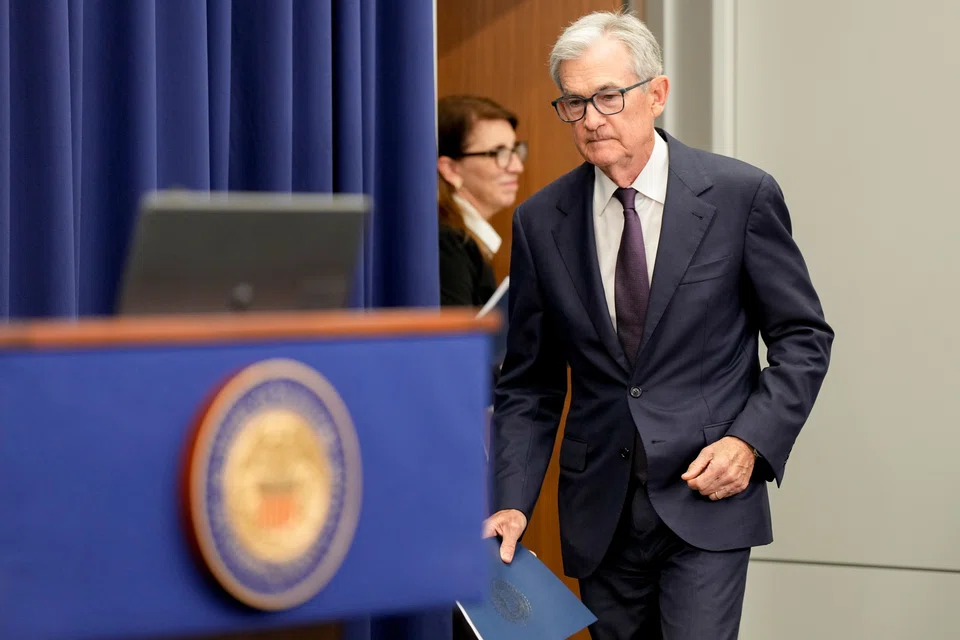
[SINGAPORE] Asia markets are likely to face short-term pressure from the US Federal Reserve’s latest interest rate cuts, but expectations are already priced in, analysts said.
The Federal Open Market Committee (FOMC) lowered interest rates by 25 basis points for the second straight time on Wednesday (Oct 29). The latest moves come on the heels of six consecutive meetings prior where rate cuts were paused.
“Short-term pressure on Asian markets is likely, given the rebound in the US dollar and bond yields,” said Tai Hui, Asia-Pacific chief market strategist at JP Morgan Asset Management (JPMAM).
He noted that the 10-year Treasury yield rose from 3.99 per cent to 4.07 per cent, while the two-year yield rose from 3.5 per cent to 3.6 per cent.
The US dollar index also rose above 99.3. The SPDR Gold Shares ETF closed 0.4 per cent lower on Wednesday after the Fed’s latest rate cut.
Asian markets were mixed on Thursday’s close. Hong Kong’s Hang Seng Index was down 0.2 per cent, Japan’s Nikkei 225 was flattish, and South Korea’s Kospi had gained 0.1 per cent. Singapore’s Straits Times Index, inched down 0.1 per cent.
Lorraine Tan, director of equity research in Asia at Morningstar Research, said: “Nonetheless, we think expectations for US rate cuts are factored in by the market through 2026.”
Paul Chew, head of research at Phillip Securities Research, noted that Singapore is already benefiting from 200 basis points in rate cuts over the past 12 months.
Tech exporters less impacted
JPMAM’s Hui noted that, similar to the US market, there might be a divergence within the Asia market.
With tech exporters in Asia feeding into the artificial intelligence investment cycle, markets such as Taiwan, South Korea and Japan could see less impact, he said.
China’s onshore market, on the other hand, would be influenced by government policy to boost consumption and economic growth.
“The easing of US-China trade tensions, as indicated by Treasury Secretary (Scott) Bessent and the summit between presidents (Donald) Trump and Xi (Jinping), is expected to be formalised today,” he added.
Tan said Morningstar expects China company share prices to be “hesitant to move much” ahead of the China-US trade agreement.
“Hawkish restraint” hard to ignore
Though the rate cuts were largely expected, analysts were surprised by an “unexpected hawkish restraint” driven by the Fed’s polarisation and data uncertainty from the ongoing US government shutdown.
But Philip Wee, senior FX strategist at DBS, cautioned against “reading too much into the US dollar’s knee-jerk reaction” to the FOMC’s decision.
He added that Fed chair Jerome Powell is managing significant risks amid the shutdown.
Eugene Leow, senior rates strategist at DBS, also highlighted that markets are awaiting Trump’s nomination of Powell’s successor after Thanksgiving.
“The situation is forcing the Fed to rely on limited and less comprehensive data, which Powell himself has compared to ‘driving in the fog’,” he said.
One more cut?
Powell said that a December rate cut is not a “foregone conclusion”.
Jean Boivin, head of the BlackRock Investment Institute, labelled Powell’s comments as “performative”. He noted that there was no articulation of the macro case for pausing rate cuts.
“Rather than a signal on the likely December outcome, we think the Fed will cut again,” he said.
JPMAM’s Hui noted that the committee will receive three job reports and two inflation reports before its next meeting.
“An improvement in employment conditions or a spike in inflation could keep the committee on hold, but if conditions evolve as we expect, a December rate cut remains likely,” he added.
He added that JPMAM expects the Fed to continue with rate cuts in the quarters ahead, moving toward the neutral long-run rate of 3 per cent.
“But the timing may be less predictable,” he added.
Taimur Baig, chief economist at DBS, said: “Regardless of the jolt provided by Powell overnight, we think the hurdle for not cutting in December is very high.”
He added that a major jump in jobs and inflation would be needed to cross that hurdle.
“Neither is very likely, in our view,” he said.
Alvin Liew, senior economist at UOB, said the bank projects one more rate cut of 25 basis points in December.
He attributed this to “downside risks to growth and employment, especially if the government shutdown is stretched to a new record duration”.