

BNP Paribas reports 9% rise in Q1 profit, investment bank stutters
The bank has reported a more modest 2.5% rise in trading revenues, with fixed income, currencies and commodities broadly stable
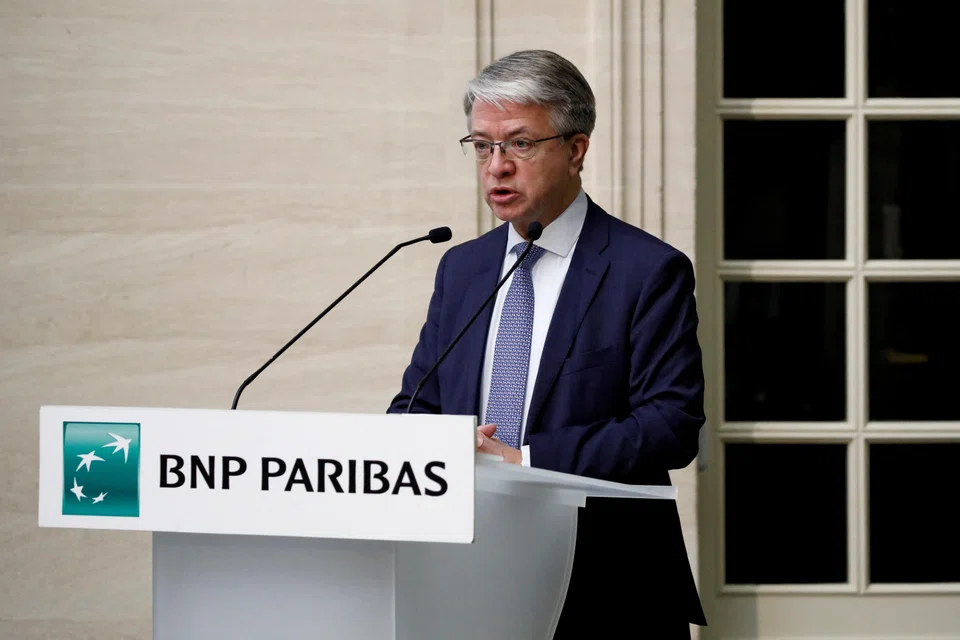
[PARIS] BNP Paribas reported a forecast-beating 9 per cent rise in first-quarter profit on Thursday (Apr 30) thanks to its retail bank, after its investment bankers and traders failed to capitalise on market turbulence caused by the war in Iran.
The eurozone’s largest bank by assets also struck a note of caution by setting aside more cash against heightened uncertainty linked to the war, one of several European lenders to do the same this week.
BNP’s net income in the January-to-March period rose 9 per cent year on year to 3.2 billion euros, comfortably above the 2.9 billion-euro average of 14 analyst estimates compiled by the company. Revenues increased 8.5 per cent to 14.1 billion euros, also exceeding expectations.
The French lender’s investment bank trailed peers.
Unlike Wall Street heavyweights and Swiss rival UBS, which posted their strongest trading quarters in years, BNP reported a more modest 2.5 per cent rise in trading revenues, with fixed income, currencies and commodities broadly stable.
BNP’s investment banking overall revenue edged down just 0.8 per cent, partly reflecting the impact of a weaker US dollar. Activity in its global banking division, which serves corporate, institutional and financial clients, fell by close to 10 per cent, with the bank saying the geopolitical situation delayed some transactions in March.
Chief executive Jean-Laurent Bonnafe, who has led the group since 2011, has gradually turned investment banking into a key growth engine alongside retail banking, insurance and asset management.
That universal model has helped position BNP as one of Europe’s leading investment banks. But it also brings greater operational complexity and higher costs at a time when Wall Street rivals are benefiting from lighter regulation and deeper capital markets.
In the retail unit, momentum remained strong, supported by improving net interest margins in France and Belgium.



BNP shares, which fell after an October 2025 US court ruling linked to a Sudan-related case, have since rebounded after the bank pledged to lift its common equity tier 1 (CET1) capital ratio to 13 per cent by 2027, a target it reiterated. The ratio stood at 12.8 per cent at the end of March.
The bank hiked its provisions for credit losses to 922 million euros in the quarter from 766 million euros over the same period in 2025, to cover macroeconomic uncertainty tied to the Middle East – a cautious stance also seen at Deutsche Bank and Lloyds this week. REUTERS
Decoding Asia newsletter: your guide to navigating Asia in a new global order. Sign up here to get Decoding Asia newsletter. Delivered to your inbox. Free.
Share with us your feedback on BT's products and services
TRENDING NOW

Once staunchly pro-China, Malaysian Chinese businesses are now distancing themselves from Beijing

Looking beyond looming CEO succession, should UOB potentially pursue a transformative merger?

Could stablecoins be the future of money?

Grab CEO’s wife Chloe Tong on life with Anthony Tan and finding her purpose

