BOJ keeps rates steady but hawkish split points to June hike
The central bank also sharply revises up its price forecasts and stresses vigilance to the risk of an inflation overshoot
[TOKYO] The Bank of Japan (BOJ) kept interest rates steady on Tuesday (Apr 28) but three of its nine-member board proposed hiking borrowing costs, signalling policymakers’ concerns over inflationary pressures from the Middle East conflict.
The central bank also sharply revised up its price forecasts and stressed vigilance to the risk of an inflation overshoot, signalling a strong chance of a rate hike in coming months.
“While the BOJ kept rates on hold, the three dissenting votes highlight the tensions monetary officials face,” Fred Neumann, chief Asia economist at HSBC in Hong Kong, said, noting energy shocks were fanning inflation and curtailing growth.
“Given elevated inflation expectations in Japan, which have increased further due to the energy crisis, the BOJ will need to raise interest rates in due course to prevent price pressures from building further,” he said.
As widely expected, the BOJ left unchanged its short-term policy rate at 0.75 per cent in a two-day meeting that ended on Tuesday.
In a surprise move, however, three bank board members dissented and instead called for a rate hike to 1 per cent. Naoki Tamura and Junko Nakagawa joined Hajime Takata, who unsuccessfully made a solo proposal to hike in March.
It was the biggest number of dissents the board has seen since January 2016, when the BOJ adopted negative interest rates by a narrow 5-4 vote.
The yen rose after the policy announcement, as investors priced in the chance of a rate hike as soon as the central bank’s next meeting in June.
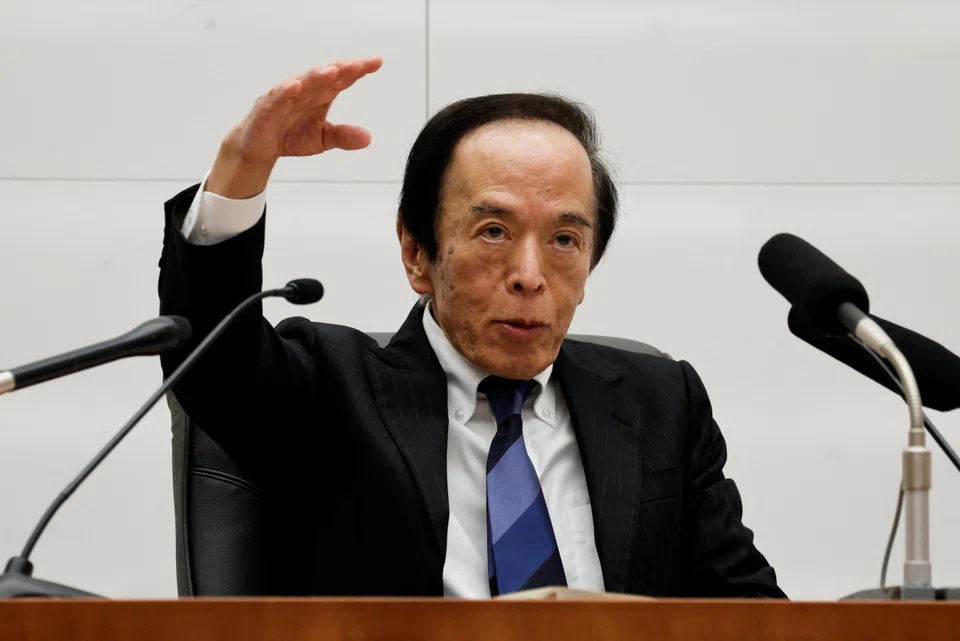
BOJ governor Kazuo Ueda said the central bank decided to stand pat for now to spend more time gauging the fallout from the conflict, and to look through what it still considered to be a temporary, supply-shock-driven inflation.





But he stressed the bank’s readiness to raise rates to prevent the energy shock from fuelling broader inflation, as long as any economic slowdown from the Iran war proved moderate.
“If inflationary risks could materialise or if they heighten significantly, we could raise interest rates on condition that downside economic risks or the risk of a sharp economic worsening are limited,” Ueda told a press conference.
While offering few clues on the timing of the next rate hike, Ueda said the BOJ was mindful that its policy rate remains below levels judged to be neutral to the economy.
The US-Israeli war with Iran has complicated the BOJ’s efforts to raise still-low interest rates gradually to levels deemed neutral to the economy, seen by markets at around 1.5 per cent.
The BOJ is the first among a flurry of central banks expected to keep policy steady this week, including the US Federal Reserve, as the Middle East war muddles the economic outlook.
Nearly two-thirds of economists polled by Reuters expect the BOJ to raise its benchmark rate to 1 per cent by end-June.
Inflation overshoots risk
In a quarterly outlook report, the central bank sharply revised up its core inflation forecasts for the fiscal years ending March 2027 and March 2028.
The BOJ also tweaked its policy guidance to allow itself more flexibility in timing further rate hikes.
“Given that underlying inflation has been approaching 2 per cent and real interest rates are at significantly low levels, the BOJ will continue to raise its policy rate in response to developments in the economy, prices and financial conditions,” the BOJ said.
The new guidance compared with the previous one that spelled out improvements in the economy as among prerequisites for further rate hikes.
The BOJ maintained its projection that underlying inflation will converge to levels consistent with its price target sometime between the latter half of fiscal 2026 through 2027.
But it took particular note of inflationary risks.
With companies already keen to pass on rising costs, price pressures from high oil prices could spread to various goods and services more than they have in the past, the report said.
“Even though risks to growth and inflation could both heighten ... the BOJ must pay particularly strong attention to the risk of inflation deviating sharply upward and thereby exerting an adverse impact on the economy,” it said.
Japan’s heavy reliance on oil imports makes its economy vulnerable to surging oil prices and supply disruptions from the effective closure of the Strait of Hormuz.
But the risks of looking through war-driven price pressures have increased as firms become keener to pass on higher costs including from a stubbornly weak yen, keeping inflation above the BOJ’s 2 per cent target for four years. REUTERS
Decoding Asia newsletter: your guide to navigating Asia in a new global order. Sign up here to get Decoding Asia newsletter. Delivered to your inbox. Free.
Share with us your feedback on BT's products and services