

China’s central bank debuts overnight reverse repo operation, withholding key interest rate
The bank conducts 300 billion yuan of overnight reverse repurchase agreements in open market operations
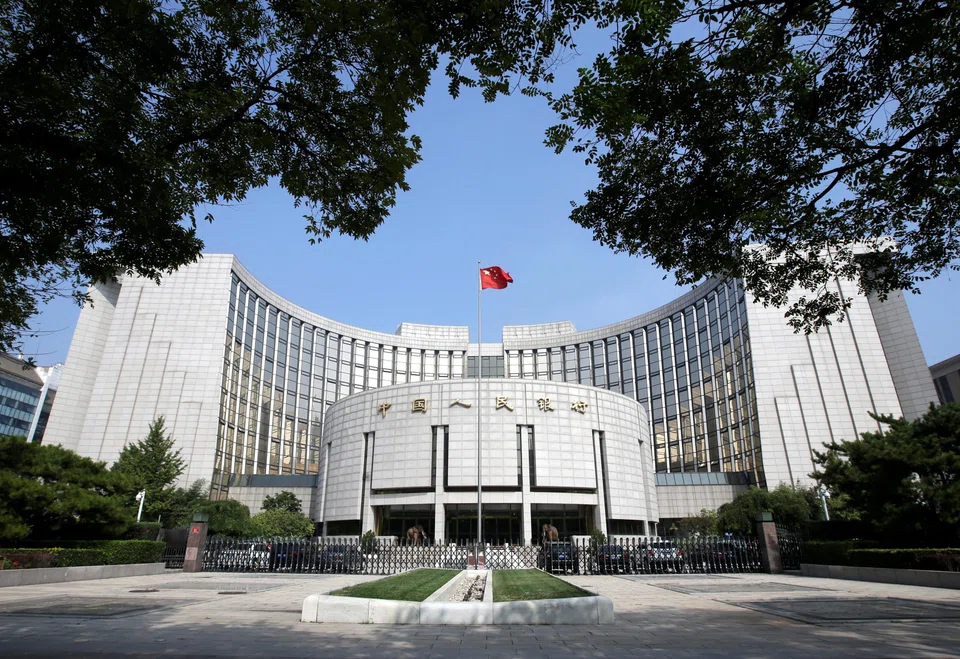
[BEIJING] China’s central bank launched overnight reverse repo operations on Monday (Jun 29), a move markets interpreted as deepening its control over liquidity conditions and aligning its policy framework more closely with global peers.
The People’s Bank of China (PBOC) said that it conducted overnight reverse repos in open market operations for the first time, offering 300 billion yuan (US$44.1 billion) to financial institutions, according to an online statement.
The PBOC did not announce the borrowing cost for the overnight reverse repos.
The PBOC also said it injected 157.5 billion yuan through seven-day reverse repos, with the rate unchanged at 1.4 per cent, according to the statement.
The volume-weighted average rate of the benchmark overnight repo traded in the interbank market, a gauge measures general liquidity conditions, was 1.3533 per cent on Monday, down about two basis points from the previous close.
Sources told Reuters that the overnight reverse repo rate in its inaugural operation was set at 1.25 per cent, 15 points below the seven-day tenor.
The seven-day reverse repo rate serves as China’s primary policy rate.
The overnight reverse repo, the latest addition to the PBOC’s toolkit, could help the central bank better manage liquidity conditions and borrowing costs to aid the broader economy, especially at month- and quarter-end when money market rates tend to be volatile.
By omitting the overnight reverse repo rate, “the PBOC does not want to dilute the signalling effect of the seven-day rate at this point”, said Lynn Song, chief economist for Greater China at ING.
SEE ALSO



“Markets have been speculating on the overnight rate, and generally agree it will come in lower than the seven-day rate at around 1.3 to 1.35 per cent. It’s likely that the PBOC doesn’t want any confusion on rate cuts at this time as well before the actual easing is made.”
Xing Zhaopeng, senior China strategist at ANZ, said that the PBOC’s decision not to publicly announce the overnight rate suggested it had no intention to “undermine the status of the seven-day reverse repo rate”.
He added that the overnight rate was likely priced at “a spread below the seven-day rate, with the gap varying over time”.
The introduction of the overnight rate also further downplayed the role of longer-tenor policy rates. That is in line with shifts in China’s financial structure, where direct financing via bonds and equities has surpassed traditional bank lending to become a key source of new funding, with credit allocation gradually moving away from more credit-intensive sectors such as property.
Monday’s operation came after PBOC governor Pan Gongsheng told the annual Lujiazui Forum earlier this month that the central bank would increase the variety of overnight reverse repo operations and narrow the range of short-term rates to reduce money market volatility.
In the quarterly monetary policy implementation report published in May, the central bank said it would leverage its role in guiding overnight rates to move near the policy rate level.
“Since the volume of overnight interbank lending by financial institutions far exceeds that of other tenors, by strengthening control over short-term interest rates, the central bank can enhance the effectiveness of monetary policy transmission throughout the financial system,” the PBOC-run publication Financial News said, citing industry experts, earlier this month.
Overnight repo transactions dominate China’s interbank money market, accounting for more than 80 per cent of repo turnover. Many overseas global central banks, such as the Federal Reserve, have already adopted overnight rates as the main policy rates to better anchor the yield curve.
“I think we’ll eventually still move in this direction where the overnight rate takes precedence just like in many developed market central banks,” ING’s Song said, noting the PBOC will ensure a smooth transition and it will likely take some time. REUTERS
Decoding Asia newsletter: your guide to navigating Asia in a new global order. Sign up here to get Decoding Asia newsletter. Delivered to your inbox. Free.
Share with us your feedback on BT's products and services
TRENDING NOW

DBS, OCBC, UOB rout lops billions off STI as inflation, rate concerns spook investors

Grab CEO’s wife Chloe Tong on life with Anthony Tan and finding her purpose

OCBC sheds S$8 billion in value as shares close nearly 6% down; analysts cautious on banks

Deal between tycoon friends sparks scrutiny of Philippine power sector

