

China’s central bank hints at shift towards overnight policy rate to match global peers
Such a move would mark another step in the PBOC’s revamp of its policy framework that began in 2024
[BEIJING] China’s central bank signalled a potential shift towards an overnight policy rate, a move that would bring it closer to global peers and give policymakers greater influence over short-term funding costs.
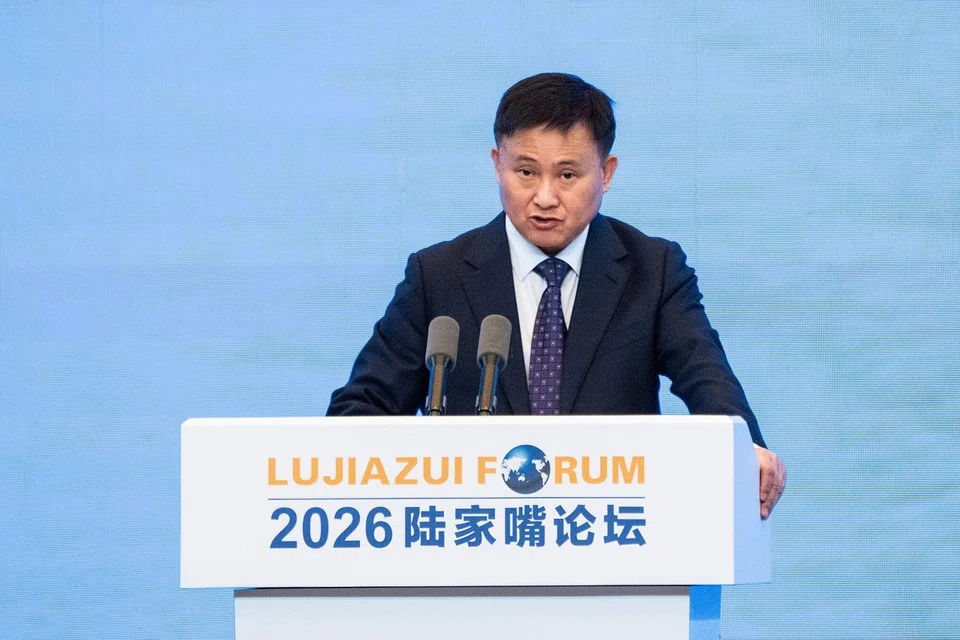
The People’s Bank of China (PBOC) will improve its adjustment of short-term interest rates and expand its suite of overnight reverse repurchase operations at an appropriate time, governor Pan Gongsheng said at the Lujiazui Forum in Shanghai on Wednesday (Jun 17).
The remarks add to signs that the PBOC may eventually move away from the seven-day reverse repo rate as its main policy benchmark.
Expectations for such a shift have grown in recent months as the central bank has placed greater emphasis on the overnight interbank rate, which accounts for the bulk of cash transactions in China’s financial markets.
A shorter-term policy anchor may give the PBOC greater precision and flexibility in steering market conditions. Financial institutions borrow from one another daily to manage liquidity and settle transactions, making overnight rates much more heavily traded than other tenors.
By exerting tighter control over those rates, the PBOC could improve the transmission of monetary policy through the financial system.
Such a move would bring the PBOC closer to major central banks such as the US Federal Reserve, which uses overnight rates as its main policy benchmarks.
Pan added that the PBOC will improve the use of temporary overnight reverse repo and repo operations, setting their rates at 25 basis points above and below the seven-day reverse repo rate.
That will narrow the interest-rate corridor to 50 basis points from 70 basis points previously, according to the governor, tightening the range within which market borrowing costs can fluctuate.
The moves are intended “to promote the transformation of the monetary policy framework to a price-based model, and to enhance the precision and effectiveness of the PBOC’s adjustment of short-term interest rates”, Pan noted.
“PBOC will likely gradually move towards a new monetary policy corridor framework, with overnight repo rate being the likely new de facto policy rate,” said Becky Liu, head of China macro strategy at Standard Chartered.
“China’s interbank rates will likely to be even less volatile ahead.”
The Fed operates a similar framework, setting a target range for the federal funds rate at which banks charge to borrow from each other overnight. That range is currently at 3.5 to 3.75 per cent, narrower than the new corridor announced by the PBOC.
A shift towards the overnight rate would mark another step in the PBOC’s revamp of its policy framework that began two years ago and was first signalled by Pan at the same forum.
Under the reform, the central bank sought to simplify a system that relied on multiple policy tools and instead centreed policy signalling around a single key rate – the seven-day reverse repo rate – in order to guide markets more efficiently.
At the same time, the central bank has gradually reduced the role of longer-tenor policy tools by adjusting bidding mechanism and scrapping a unified cost.
In July 2024, it announced plans to conduct temporary overnight repo and reverse repo to help guide market rates within a narrower range, though it has yet to carry out such operations.
Rate outlook
The PBOC last cut its seven-day policy rate by 10 basis points to 1.4 per cent in May 2025, far less than the 40 to 60 basis points of reductions many economists had expected for the year.
This year, many economists have pushed back their forecasts for the next rate cut to 2027 as factory-gate inflation picks up, driven by the Iran war and higher oil prices.
Still, weak consumer spending and investment data released this week suggest growth risks are mounting, potentially adding pressure on policymakers to ease.
The PBOC has in recent weeks guided overnight funding rates to rebound to the 1.4 per cent policy rate level, after abundant liquidity pushed market borrowing costs down to around 1.2 per cent and fuelled concerns of bubbles in the bond market.
The PBOC does not currently have a regularly used overnight policy rate. In recent months, it has signalled that it is monitoring the overnight market borrowing costs more closely instead of the seven-day tenor.
Since January, it has included analysis in its monthly reports tracking the spread between the overnight repo rate in the interbank market and the seven-day rate.
That focus became more explicit in its quarterly report released in May, when the PBOC pledged to “guide overnight interest rates to operate near policy interest rates”. It also reiterated a commitment to keep monetary policy “moderately loose”. BLOOMBERG
Decoding Asia newsletter: your guide to navigating Asia in a new global order. Sign up here to get Decoding Asia newsletter. Delivered to your inbox. Free.
Share with us your feedback on BT's products and services

