NEWS ANALYSIS

Stemming tide of SVB collapse may create other ripples
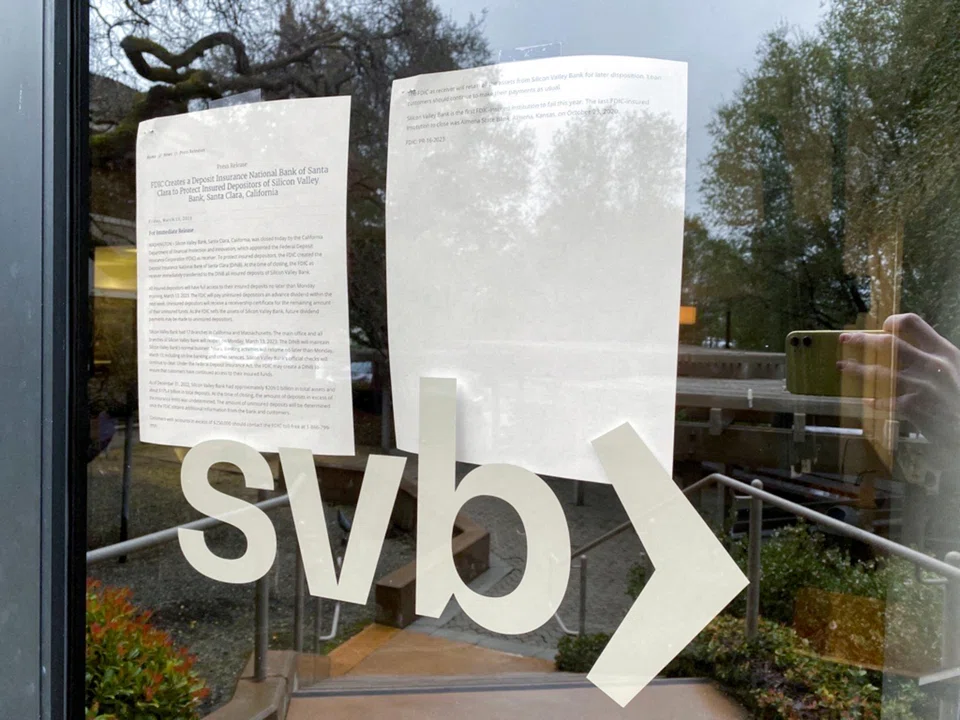
    • SVB, which failed last week, has been a key banker for some 3,000 British venture capital firms and startups.
    • SVB, which failed last week, has been a key banker for some 3,000 British venture capital firms and startups. PHOTO: REUTERS
    Published Tue, Mar 14, 2023 · 10:51 AM

    [LONDON] Central banks and regulators are doing their utmost to counter a nascent banking panic in the US and Europe – so much so that market participants now believe the European Central Bank will either delay or reduce an expected interest rate hike on Thursday (Mar 16).

    Planned rate rises by the United States Federal Reserve and the Bank of England in the coming weeks may also be smaller until the ongoing Silicon Valley Bank (SVB) crisis is contained.

    The danger is that US and European inflation may accelerate if money is flush. With the global economy on a tightrope, it is clear that central banks have little room for missteps.


    Illustrating the extent to which central banks are wobbling, gold surged by US$100 to US$1,912 per ounce in the last two trading days. The price of gold typically rises when investors get nervous about the direction of the economy and markets as well as when interest rates are expected to fall.

    Meanwhile, bank stocks on Wall Street, London, Frankfurt, Paris, Zurich and other exchanges have tumbled this week as traders worried about a potential credit crunch.

    US regional banks, in particular, find themselves under pressure. First Republic Bank fell 60 per cent, Western Alliance slumped 45 per cent and KeyCorp tumbled by almost 30 per cent.

    In Europe the worst decliners on Monday (Mar 13) were Credit Suisse, which was down 10 per cent after initially falling 13.5 per cent. This was followed by Unicredit (down 9 per cent), UBS (down 7.7 per cent), BNP (down 7 per cent), Standard Chartered (down 6.9 per cent); and Deutsche Bank (down 5 per cent). HSBC, which is buying SVB UK for a nominal £1 (S$1.64), fell by 4 per cent.

    Dealers think that bank shares and other stocks may rally in the coming days. So far, there are no indications that depositors are withdrawing their cash from these banks.

    US Treasury Secretary Janet Yellen, British Chancellor of the Exchequer Jeremy Hunt and various European Union regulators have insisted the global financial system is sound, and that the US and European governments will underpin shaky institutions.

    Despite these assurances, however, investors still fear a recession, which would bring in its wake bad debts and losses for banks.

    Oxford Economics warned in a recent paper that investors should be wary of corporate bonds, especially high-yield “junk bonds”. The research outfit forecasts a global recession “in the near term” that will cause a “deterioration in corporate earnings and an eventual rise in defaults”.

    It added that “global credit standards have sharply tightened recently, (which) will weigh particularly heavily on the profitability of lower-rated (companies) and lead to a rise in bankruptcies.”

    In the UK, the main concern in the wake of SVB’s failure is to support the UK’s thriving tech industry. The latter has become a significant part of the economy in the last few years, and is involved in significant trade and investment with the US, Singapore and other countries.

    According to George Windsor, director of data and research at Tech Nation, a platform that advises tech companies, the UK is currently one of only three countries in the world whose tech economy is valued at over US$1 trillion. The other two are the US and China.

    SVB was a key banker for some 3,000 British venture capital firms and startups, analysts estimated.

    The HSBC acquisition “would provide SVB UK customers with confidence and security” said British Prime Minister Rishi Sunak. “They will be able to access their deposits and banking services as normal. No taxpayer money is involved, and customer deposits have been protected.”

    What was not mentioned was HSBC’s pivot towards Hong Kong and the rest of China.

    Sunak stressed that he wants the UK government to continue with its trade and making deals with China. But there is a contingent of Tory politicians, known as the China Research Group (CRG), that vigorously oppose Chinese businesses that control several key UK businesses.

    CRG members were unavailable for comment, but they could make their voices heard later now that HSBC has access to confidential plans of its new British tech clients.

    On its part, the UK government has established a National Protective Security Authority that will offer businesses direct help in dealing with alleged China and Russian spying. News of the entity was released on Monday, as part of the UK government’s Integrated Review – a report commissioned to respond to emerging geopolitical threats.

    In a statement accompanying the review’s release, Sunak said: “We have seen all too clearly in the last year how global crises impact us at home.”

    He was referring to Russia’s invasion of Ukraine, but he could just as well have been referring to SVB’s collapse.