

Beyond hospitality: Far East Orchard leans on student accommodation for recurring income
It aims to expand the segment and build up fund management capabilities

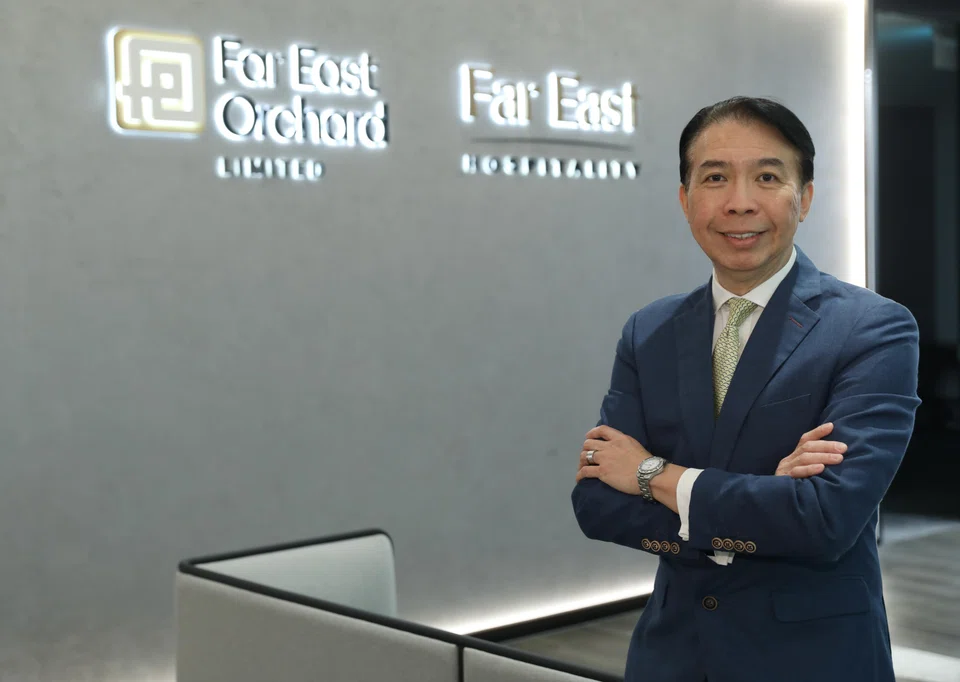
[SINGAPORE] When real estate veteran Alan Tang took over as group chief executive officer of Far East Orchard (FEOR) on Jan 1, 2020, few could have foreseen how quickly the world would change with the spread of Covid-19.
Within weeks, borders closed and travel collapsed – a sudden shock for a company heavily exposed to global hospitality.
“The first year was trying,” Tang recalled in a recent interview with The Business Times, just after the group reported that its net profit had doubled year on year to S$37.6 million for the nine months ended Sep 30.
“I was trying to understand the business, and getting to know my colleagues and teams, all in the midst of lockdowns and restrictions,” he said.
Yet the upheaval also opened a window of opportunity.
While hotels went dark, the group’s UK purpose-built student accommodation (PBSA) portfolio remained stable, as most students continued living on-site and attending classes virtually.
On the hotel front, Tang credited his team for securing government business to keep operations running, even as the crisis exposed hospitality’s vulnerability.
By mid-2020, Tang convened a strategic review that led to FEOR25 – a five-year plan to build a more resilient lodging platform by growing hospitality and PBSA to 25,000 rooms and 5,000 beds, respectively, by 2025.
“Covid helped us firm up our resolve,” he said, noting the need to diversify and strengthen recurring income beyond hotels.
Student accommodation a key profit driver
Since then, the group’s PBSA segment has expanded steadily and indeed, brings in more operating profit than hospitality. Based on its 2024 annual report, operating profit rose to S$37.1 million in 2024, more than double the S$13.6 million recorded in 2020.
Hospitality, meanwhile, recovered from an S$18.7 million loss in 2020 to a S$29.1 million profit in 2024 as travel resumed.
Assessing the outcome of FEOR25, Tang reflected that the group “gave it the best shot right in the midst of Covid”.
PBSA growth “overachieved”, aided by its majority stake in UK operator Homes For Students (HFS), which manages over 55,000 beds.
On the hotel side, however, Tang acknowledged that FEOR “will not be able to meet our hospitality target” of 25,000 rooms, citing reasons such as higher interest rates and elevated development costs.
Still, PBSA’s resilience helped balance the portfolio. “That’s why I think at the end of the day it’s always good to have levers you can pull,” Tang said. “I’d say it’s a pretty good outcome.”
The group also launched its first fund – the FE UK PBSA Development Fund, which closed in June with £96 million (S$166 million) raised.
Describing it as “the cherry on top”, Tang said that although it was not part of the original FEOR25 roadmap, the fund allows FEOR to scale its PBSA business without straining its balance sheet, while generating recurring fee income and strengthening its integrated lodging platform.
With FEOR25 nearing its final year, the group is crafting its next roadmap, informally called FEOR2030.
Tang said the plan is likely to deepen FEOR’s fund-management capabilities, expand into adjacent lodging segments such as co-living or build-to-rent, and continue growing PBSA in the UK and Europe.
Where Far East stands in different markets
Nevertheless, Tang remains measured in where the group deploys capital. In Singapore, he said the post-pandemic travel surge has peaked.
But while “pent-up demand gave (the group) a very strong recovery”, Tang noted that visitor levels were still below 2019’s, and increasing labour and operating costs are offsetting profits.
In Australia, FEOR’s largest hospitality base, recovery is uneven.
“It’s such a vast continent so the pace differs. Sydney is doing better, for example, than Melbourne,” he said.
The group is refurbishing hotels such as Rendezvous Perth Scarborough and Adina Sydney Darling Harbour.
Tang said these assets fall under FEOR’s asset life cycle programme, where properties are reviewed for potential divestment after enhancement. No decision has been made, though some older non-core investments are “already slated for sale”.
The UK remains central to the group’s PBSA business, supported by strong structural demand.
But obstacles remain. “The challenge right now is construction cost, as well as the regulatory processes,” Tang said, adding that this includes tighter fire-safety rules and limited contractor capacity.
Japan is another bright spot. Tang called it “the bright star right now for hospitality” amid booming tourism, though competition is intense.
Europe, beyond the UK, presents a longer-term opportunity for the HFS platform, while the United States remains in a “rough patch” and is not a priority.
Share price yet to catch up with valuation
Still, some investors may not fully appreciate that FEOR has revamped its business model.
The company’s shares hovered around S$1 in recent years, although in July, it recorded a 52-week high of S$1.32. Year-to-date, the stock is up some 15 per cent.
An unrated report by SAC Capital in October noted that the counter was trading at a 12-month trailing price-to-earnings ratio of 10.5 times, far below the mainboard average of 19.9 times.
This comes despite FEOR’s net profit rising to S$59 million in FY2024 – more than thirty-nine times the S$1.5 million recorded in FY2020.
Asked about the gap, Tang said investor perception has yet to catch up with the company’s transformation.
He added that FEOR is still often seen as a property developer.
“We’ve moved on from that. We’re not a developer anymore – we’re building up our recurring-income base. That’s the story we need to keep stressing so the market understands what we’re trying to do.”
TRENDING NOW

Companies still in search of AI use cases with worthwhile ROI, says Broadcom’s CEO

Beauty World Plaza up for collective sale for S$165 million
Trouble in paradise: Bali runs low on fuel, sparking long lines at pumps

Philippine power giant First Gen rebuffs foreign offers, plans up to US$2.6 billion in expansion

