

Big Tech’s US$16 trillion earnings week is make-or-break for rally
Alphabet, Microsoft, Amazon and Meta are set to report their results on Wednesday
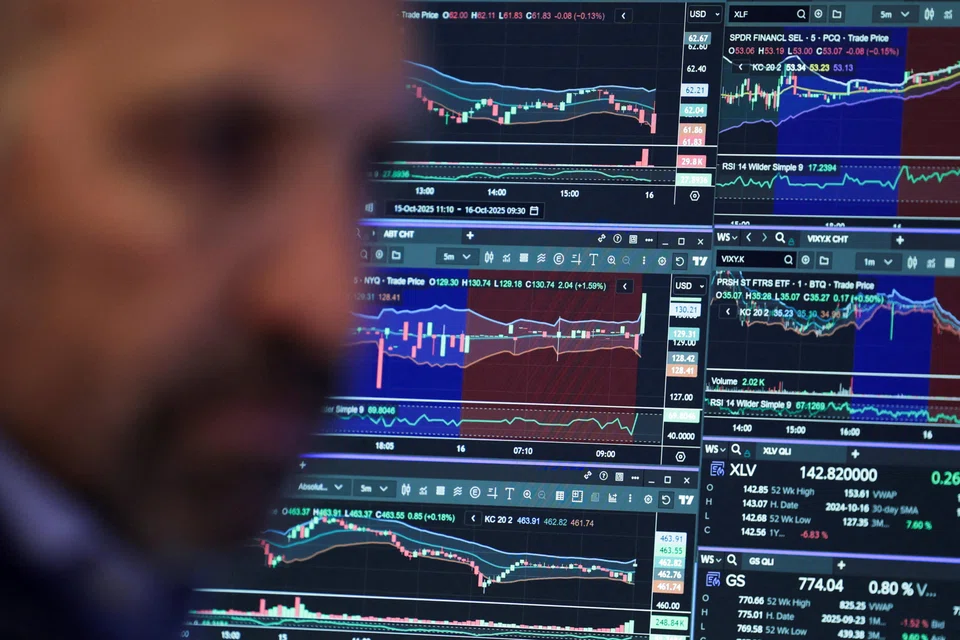
WALL Street’s biggest technology stocks have carried the S&P 500 to record highs even as the war in Iran continues. Now, earnings from a handful of them this week will give investors a read on whether this rally is sustainable.
Alphabet, Microsoft, Amazon.com and Meta Platforms are set to report their results on Wednesday (Apr 29), followed by Apple a day later. The companies are worth nearly US$16 trillion combined, representing a quarter of the S&P 500 Index’s market capitalisation.
“It’s going to be a critical week,” said Keith Lerner, chief investment officer and chief market strategist at Truist Advisory Services. Results need “to validate this recent move”, he added.
The so-called Magnificent Seven, which also includes Nvidia and Tesla, has powered a four-week rally in the US equity benchmark that has added 13 per cent. Shares of Alphabet, Amazon, Nvidia and Meta are all up more than 25 per cent since the S&P 500 bottomed on Mar 30.
The rally comes after Big Tech spent the first three months of the year dragging down the S&P 500 amid concerns the companies are overspending on artificial intelligence. The sell-off washed out investor positioning in the stocks and compressed valuations, making the group ripe for a comeback.
Economic risks posed by the war in Iran, which has driven oil prices higher and threatened to keep inflation sticky, has made tech giants’ strong earnings growth look more attractive, said Allen Bond, portfolio manager at Jensen Investment Management.
The Magnificent Seven’s earnings are projected to expand 19 per cent in the first quarter, compared with 12 per cent for the rest of the S&P 500, based on data compiled by Bloomberg Intelligence.
So far, the cohort is off to a good start. Last week, Tesla beat Wall Street estimates for first-quarter adjusted earnings, though that was overshadowed by concerns about a jump in capital spending. Nvidia, the world’s most valuable company, will be the last to report on May 20.
“Big Tech is living in a different world,” said Bond, whose firm manages about US$5 billion in assets. “Tech offers you a way to buy into a secular growth narrative, where there’s not much concern about disruption from geopolitical issues, and recently you’ve been able to do it at a pretty attractive discount.”




Expanding profits have helped keep a lid on valuations. Excluding Tesla, which trades at a nosebleed multiple, the group is priced at 25 times profits anticipated over the next 12 months, indicated data compiled by Bloomberg. That is down from 29 times in October, but still above the S&P 500 at 21 times.
Spooked by AI
There are risks, of course. Tech giants may have dominant market positions, but they’re not completely immune from macroeconomic problems. Plus, disappointments related to AI costs could derail the rally.
Earlier this year, higher-than-expected capital spending spooked investors and helped send Magnificent Seven stocks into a tailspin, falling 16 per cent in the first three months of 2026 – more than twice the decline in the S&P 500.
Combined capital expenditures from Microsoft, Alphabet, Amazon and Meta are projected to be US$649 billion in 2026, up from US$411 billion in 2025, Bloomberg-compiled data showed.
These firms need to prove that the spending will deliver strong returns, said Brian Barbetta, co-leader of Wellington Management’s technology team and co-portfolio manager on the global innovation strategy, which manages about US$50 billion in assets.
“We’re of the view that the capital being deployed has a strong (return on equity) that will result in faster growth and margin expansion over time,” he said.
The scale of investments, however, is taking a toll on cash flows. Amazon’s free cash flow is expected to be negative US$13.3 billion in the first quarter, which would be the widest since 2022, when investments in things such as warehouses soared to meet pandemic-fuelled demand. And Meta’s first-quarter free cash flow is projected to be US$4 billion, the smallest in nearly four years.
In response, some of the companies are tightening their belts. Meta and Microsoft are planning workforce reductions to help offset the impact of bigger AI spending. News of those moves on Thursday sent both stocks lower.
Investors will likely be looking closely at the companies’ cloud-computing businesses, where demand from AI startups such as Anthropic and OpenAI is driving rapid sales growth and outstripping supply.
Revenues at Amazon Web Services, the biggest cloud services provider, are projected to rise 26 per cent in the first quarter, while sales at Microsoft’s Azure and Google Cloud are expected to expand by 38 per cent and 50 per cent, respectively.
Last quarter, Azure’s 38 per cent revenue growth was not enough to satisfy investors, sending Microsoft shares down 10 per cent the day after earnings.
Excitement about new AI services from Anthropic has quelled a lot of concerns about whether such investments will ultimately pay off, noted Jensen’s Bond.
While those advancements have fanned anxieties about software makers seen as at risk of disruption, it is a positive for Big Tech companies that are aggressively investing for the future, he added.
“These are extremely strong businesses with high margins and a lot of consistency, and multiples don’t seem stretched,” he said. “The megacaps exist in a different universe in terms of their attractiveness.” BLOOMBERG
Decoding Asia newsletter: your guide to navigating Asia in a new global order. Sign up here to get Decoding Asia newsletter. Delivered to your inbox. Free.
Share with us your feedback on BT's products and services
TRENDING NOW

DBS, OCBC, UOB rout lops billions off STI as inflation, rate concerns spook investors

Grab CEO’s wife Chloe Tong on life with Anthony Tan and finding her purpose

OCBC sheds S$8 billion in value as shares close nearly 6% down; analysts cautious on banks

Deal between tycoon friends sparks scrutiny of Philippine power sector

