

AI retreat fuels India stock comeback in great rotation trade
Bounce-back illustrates broader rotation by global funds away from crowded tech bets toward markets backed by strong earnings
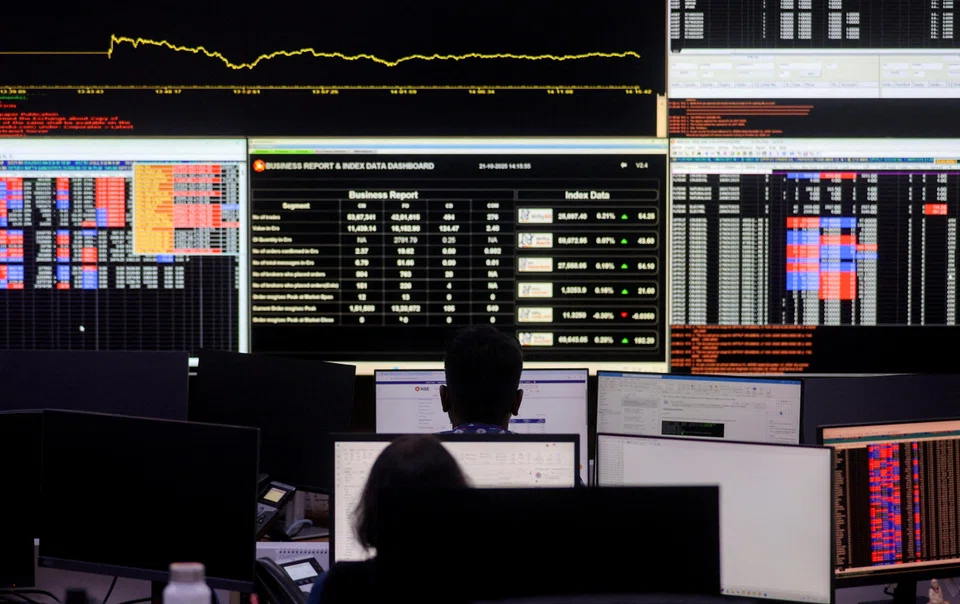
INDIAN stocks suffered bruising losses in the first nine months of 2026 as the artificial intelligence trade hoovered up global investor capital. The unwinding of that strategy has turned the Asian nation’s equities into world beaters.
The MSCI India gauge has rebounded 11 per cent from a six-month low set in October, adding more than US$400 billion in value and almost erasing this year’s losses, as the country’s relative lack of AI exposure has become a prime advantage. Global funds are also turning more positive on India’s US$5.4 trillion equity market as oil prices retreat and earnings growth accelerates.
“We’ve become more positive on India and have added back to our exposure in recent weeks,” said Tan Altundag, an investment manager for emerging equities at Pictet Asset Management in Hong Kong. “We see an improving balance between macro headwinds, portfolio flows and valuations,” while “diversification away from the increasingly volatile AI trade also appears likely to benefit India,” he said.
The bounce-back in Indian shares over the past month illustrates a broader rotation by global funds away from crowded tech bets toward markets backed by strong earnings. The shift signals a potential turning point for emerging markets as a whole, testing whether the world’s fastest-growing major economy can reclaim its status as a premier alternative to US tech giants after months of trailing its global peers.
A return of overseas investors has underpinned the rebound in Indian stocks, and the process may still have room to run as global funds remain largely underweight.
Overseas buyers have snapped up a net US$8.5 billion of Indian shares in November, heading for the biggest monthly inflow in six years, according to data compiled by Bloomberg. That has reduced this year’s total outflow to about US$22 billion.

Active long-only funds globally remain US$74 billion underweight on Indian shares relative to the benchmark, Bank of America data show, close to their lightest positioning since the bank began compiling the figures in 2015.
Earnings for Nifty 50 Index companies may rise around 18 per cent year on year in the September quarter, accelerating from 13 per cent growth in the prior three months, Bank of America data also show.
US-based Calamos Investments is among those boosting its holdings.



The money manager’s emerging-market strategy has lifted its India allocation to more than 10 per cent over the past three to four months from as little as 1 to 2 per cent about a year ago, co-chief investment officer Nick Niziolek said.
“We’re adding to India because we’re seeing an inflection in earnings,” he said. “We’re seeing an improvement in fundamentals, and we see really attractive valuations.”
Kabouter Management is another overseas investor that is growing more positive.
“As long-term investors, we remain constructive on the outlook for India,” said Nikhil Rastogi, portfolio manager at the Chicago-based money manager.
Indian shares have faced many challenges in the past two years, “but these headwinds do not change the long-term picture, and some of the global shifts behind them are working in India’s favour,” he said. “Valuations that looked stretched two years ago have become more attractive, particularly in pockets of the market.”
The MSCI India gauge trades at a price-to-earnings ratio of about 20 times one-year-ahead profits, a discount to its five-year average, data compiled by Bloomberg show.
The recent decline in oil prices is also helping shares in India, which imports nearly 90 per cent of its energy needs.
Global benchmark Brent crude has dropped over 18 per cent from a high set on Oct 30 as investors wager that the Democratic Party’s sweep of the US Congress in November’s midterm elections has increased the likelihood of an end to the Middle East conflict.
“I’m comfortable on India while Brent sits around US$100 a barrel or below,” said Lauren Hyslop, an investment manager at UK-based Mattioli Woods.
Despite the recent rally in Indian stocks, the market remains a relative laggard for 2026. MSCI’s India gauge has still dropped 2.2 per cent in 2026, whereas the index provider’s regional benchmark has jumped about 12 per cent. The Indian measure is on track for back-to-back years of underperformance against its regional peer for the first time since 2020, according to data compiled by Bloomberg.
Fidelity Investment Management is broadly positive on India, but it is not rushing back in.
“We have reduced some underweight on India over the past few weeks by trimming some AI-related stocks,” said Nick Price, an emerging-market portfolio manager at Fidelity in Hong Kong. “There’s no rush and it remains underweight, but India exposure may rise in a slow and deliberate manner from my side,” especially through financial stocks, he said.
Others are content to hold on to stocks that they see as offering value for the long term.
“With the unwinding of AI trades, we’ve seen buying interest coming back for India,” said Simon Sidmalm, a fund manager at Tundra Fonder in Stockholm. “We’re holding on to the value names we see upside in from a fundamental perspective longer term.” BLOOMBERG
Decoding Asia newsletter: your guide to navigating Asia in a new global order. Sign up here to get Decoding Asia newsletter. Delivered to your inbox. Free.
Share with us your feedback on BT's products and services
TRENDING NOW

Malaysia’s BN and ally PN declare victory in Melaka state polls in a blow to PM Anwar

Higher rates, weaker spending: Is the Philippines entering stagflation?

Demand, tech capabilities position Apac and AI as Skyscanner’s next growth frontiers: CEO Bryan Batista

Singapore’s S$2.32 billion ‘haze bill’: Can prevention cost less?

