

South Korea’s Kospi drops as Asian stocks dip after US tech rally; yen steadies
MSCI’s gauge of Asia Pacific stocks slides 0.7%, as eight of its 11 industry groups post losses
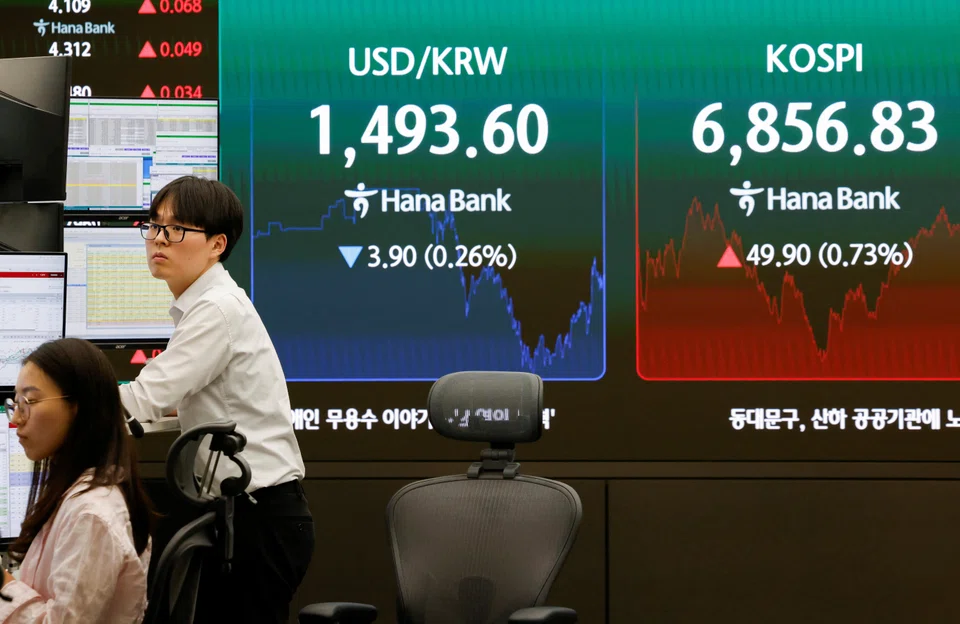
[SINGAPORE] Asian stocks diverged from Wall Street’s tech-led rally as persistent volatility in South Korean equities underscored lingering concerns over the artificial intelligence trade. The yen slipped after its intervention-led gains.
MSCI’s gauge of Asia Pacific stocks dropped 0.7 per cent, with eight of its 11 industry groups posting losses.
The benchmark was heading for a second day of declines after surging 5 per cent on Friday (Jul 31). A regional semiconductor gauge fell 1 per cent, while Korea’s Kospi dropped 1.1 per cent after earlier gaining 2.1 per cent.
Among the main market moves, the S&P futures rose 0.2 per cent as at 12.59 pm Tokyo time.
Japan’s Topix fell 0.3 per cent, Australia’s S&P/ASX 200 rose 1.3 per cent, Hong Kong’s Hang Seng fell 0.5 per cent and the Shanghai Composite rose 0.2 per cent.
Sentiment on Wall Street remained more positive with Nasdaq 100 futures rising 0.4 per cent.
Palantir Technologies surged 14 per cent in extended trading after raising its forecasts, while Amazon dropped 1.6 per cent post-market after chair Jeff Bezos disclosed plans to sell shares.
A three-day rally helped the company reach a US$3 trillion market value on Monday.
Elsewhere, the yen slipped 0.3 per cent to 157.64 per US dollar following four days of gains.

The currency’s sudden advance early on Monday had fuelled speculation that authorities may have intervened to support the yen again, building on last week’s coordinated action by the US and Japan.
Technology stocks remain volatile as investors increasingly question whether billions of dollars of spending on AI will translate into stronger growth and profits.
Geopolitical developments and US jobs data later this week also remain in focus as traders assess whether lower oil prices will ease inflation pressures and influence interest rate expectations.
“Investors are essentially waiting for data to force a clearer read on rate direction rather than trading on rhetoric,” said Billy Leung, an investment strategist at Global X Management. “Friday’s US payrolls print – that’s the next real test.”
Another potential challenge for markets comes on Tuesday, when SpaceX reports its first earnings as a public company.
It also sets the stage for one of the largest share unlocks in capital markets history, with as much as US$116 billion of stock becoming eligible for sale for the first time in September.
“Investors are cautious ahead of SpaceX earnings and job reports while they digest a mixed picture on the Middle East,” said Fabien Yip, a market analyst at IG International in Sydney.
On Monday, a Wall Street rally saw a gauge of megacaps post its best day since March and the S&P 500 Index close within touching distance of a record high. A gauge of semiconductor stocks rose about 1 per cent.
But the volatility in the sector is rippling across the industry, with Coatue Management’s hedge fund plunging 8.3 per cent in July as the sell-off in AI stocks whipsawed another tech-focused money manager.
In other corners of the market, oil retraced some of Monday’s losses.
US President Donald Trump said his latest offer of talks is Teheran’s “last chance” and that he expects a full reopening of the Strait of Hormuz. West Texas Intermediate rose 0.8 per cent to about US$81 a barrel, after sliding over 5 per cent on Monday.
Treasuries pared some of their gains from the previous session, when declining oil eased inflation concerns. The yield on the 10-year bond climbed two basis points to 4.69 per cent.
In Japan, bond futures sank and government bond yields surged after a 10-year bond sale had its weakest demand since May 2025.
Still, the on-again, off-again nature of US-Iran diplomacy may mean earnings and jobs data will have to do the heavy lifting for the bulls this week, according to Chris Larkin at E*Trade from Morgan Stanley.
In the countdown to a slew of jobs figures, data on Monday showed US manufacturing activity expanded in July at the fastest pace in more than four years, production surged and firms added workers.
Forces that propelled US stocks to record highs this year remain “firmly intact” after a reset in retail investors’ speculative trading, according to Citadel Securities’s Scott Rubner.
“Markets are transitioning from a flow-driven environment back to one increasingly dictated by earnings, corporate demand, and the macroeconomic backdrop,” he wrote. BLOOMBERG
Decoding Asia newsletter: your guide to navigating Asia in a new global order. Sign up here to get Decoding Asia newsletter. Delivered to your inbox. Free.
Share with us your feedback on BT's products and services






