

Asian shares drop on chips, US dollar edges higher
MSCI’s Asia Pacific equities gauge slips 0.4%, with a regional semiconductor benchmark down 1.6%
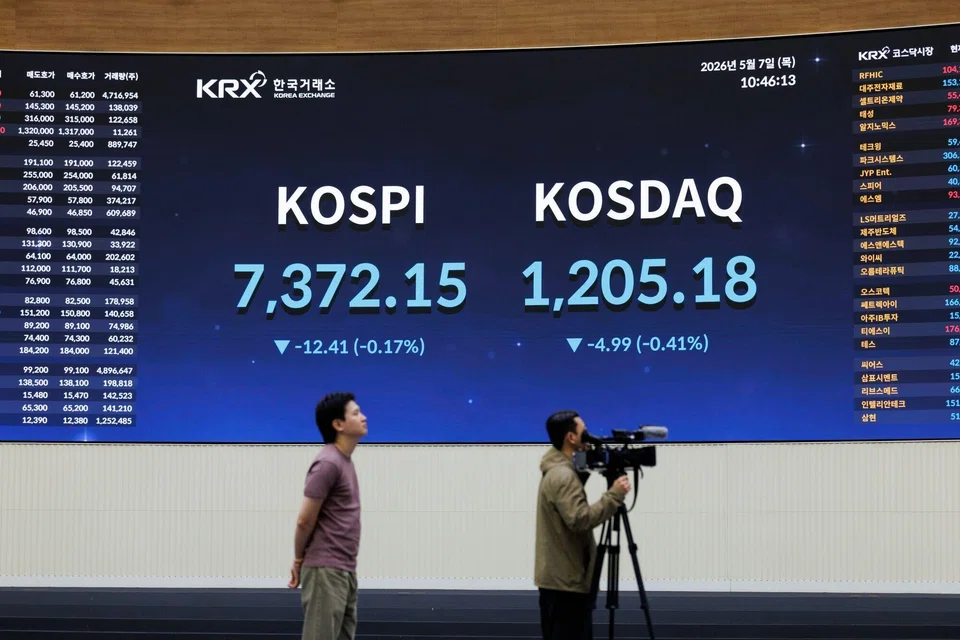
ASIAN equities swung to a loss and US stock futures pared gains as a rebound in regional semiconductor and technology stocks lost momentum and the dollar strengthened.
MSCI’s Asia Pacific equities gauge slipped 0.4 per cent, with the Kospi Index in South Korea leading losses with a 2.4 per cent drop. A regional semiconductor benchmark slipped 1.6 per cent.
As at 11.55 am Tokyo Time, S&P 500 futures rose 0.2 per cent while the Nikkei 225 futures (OSE) fell 1.4 per cent and Japan’s Topix rose 0.2 per cent.
Elsewhere, Australia’s S&P/ASX 200 fell 0.1 per cent, Hong Kong’s Hang Seng rose 1 per cent and the Shanghai Composite fell 0.8 per cent.
Attention was firmly on chipmakers with Nvidia’s server assembly partner Hon Hai Precision Industry reporting stronger-than-expected sales.
SK Hynix shares dropped more than 3 per cent, ahead of this week’s listing of US$29 billion American depositary receipts.
Samsung Electronics slipped 0.1 per cent after a report that the company is considering increasing some chip prices.
Bloomberg’s gauge of the dollar headed for its first gain in three days as the US currency strengthened against most of its Group of 10 peers.
Treasuries rose with the the benchmark 10-year yield falling two basis points to 4.46 per cent.



Markets entered the second half of the year on a cautious footing as investors weigh the fallout from the Iran war’s energy shock and whether the stock rally driven by artificial intelligence stocks can be sustained.
Attention is shifting to earnings season for signs that technology companies can turn their investments on AI sector into profits.
“The market has been volatile lately, especially around tech,” said Kazuhiro Sasaki, head of research at Phillip Securities Japan.
“Fund managers looking to secure profits are likely to keep selling AI stocks, which have broadly outperformed, and to turn to underperformers and value stocks.”
Sectors such as autos, machinery and healthcare stand to gain as investors rotate out of the AI sphere, he said.
Investors are likely to maintain a cautious stance on tech stocks ahead of earnings releases of major chipmakers, Sasaki said.
Better-than-expected results could trigger a substantial rebound as many shares have corrected to more reasonable levels, he said.
Elsewhere, Brent swung between gains and losses before trading 0.1 per cent lower at US$72.05 a barrel. Shipping through the US-protected corridor in the waterway showed signs of recovering.
Opec+ members also backed another modest rise in collective quotas for next month.
Gold was little changed following a three-day gain amid speculation that the Federal Reserve will not be raising interest rates anytime soon. The yellow metal traded at around US$4,175 an ounce.
Goldman Sachs Group revised its yen forecast to 165 per dollar in a year’s time from 155 previously. The Japanese currency traded at 161.54 per dollar in early Asian trading.
Overall though, markets remain focused on chips and technology stocks after a recent sell-off.
Semiconductor stocks in the US started the third quarter with their biggest two-day decline in nearly a month.
The Philadelphia Semiconductor Index, which gained a record 88 per cent last quarter, fell 5 per cent on Jul 2. That brought its two-session decline to 12 per cent, the most since Jun 5.
“Rotation from richly-valued tech stocks into cyclical and defensive sectors continues to resonate with investors in US and Asia,” said Fabien Yip, a market analyst at IG International.
“Sector rotation is a healthy development allowing market breadth to improve after the narrow rally between April and June.” BLOOMBERG
Decoding Asia newsletter: your guide to navigating Asia in a new global order. Sign up here to get Decoding Asia newsletter. Delivered to your inbox. Free.
Share with us your feedback on BT's products and services
TRENDING NOW

Britain’s mansion tax shows the difficulty of targeting wealth

Once staunchly pro-China, Malaysian Chinese businesses are now distancing themselves from Beijing

The only common thing in S-E Asia is that we all eat rice: Cisco’s Asean president

Singapore data centre operator DayOne opts for US IPO at likely US$20 billion valuation

