

AI-linked Asian stocks slump on calls to slow development; Fed, BOJ hikes loom
Strong corporate earnings should provide support for Wall Street if borrowing costs rise, says analyst
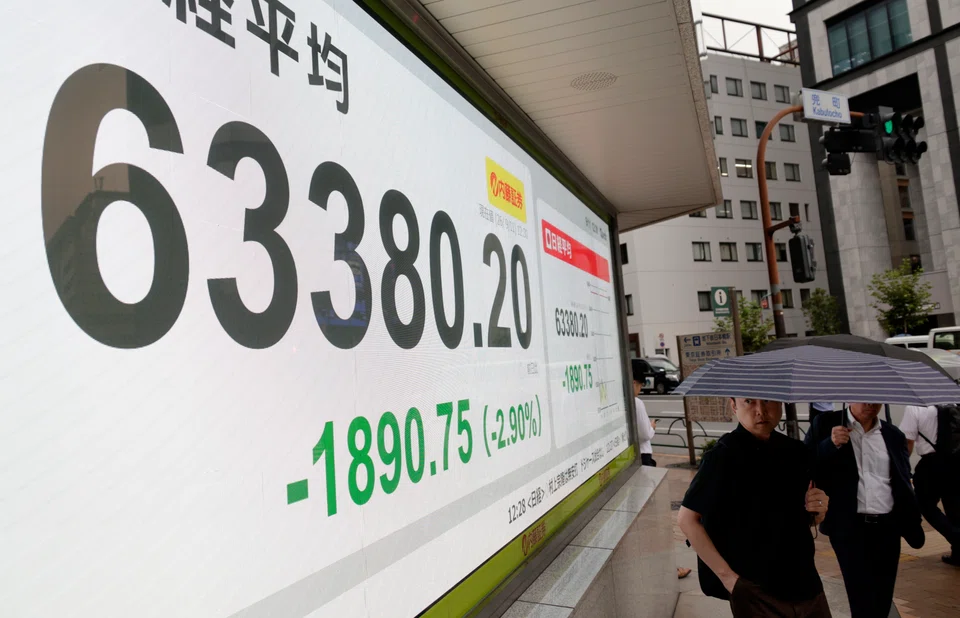
[SYDNEY] Share markets slid in Asia on Monday (Sep 14), dragged down by AI stocks, while supply concerns in the Middle East caused oil prices to spike anew, and investors braced for likely interest rate hikes in both the United States and Japan this week.
AI-linked shares took an added hit after the leaders of OpenAI and Anthropic called for a slowdown in development to manage risks and protect humanity.
On the oil front, Brent climbed almost 3 per cent as new strikes on Saudi Arabia and on ships in the Gulf strained nerves, after an attack on a Saudi oil pipeline and an advance by Yemen’s Houthis threatened to worsen the wartime disruption to global energy supplies.
A meeting in Oman between Iran and Gulf Arab states, scheduled for Monday to discuss a deal on opening the Strait of Hormuz, was postponed.
With shipping through the strait and the Bab el-Mandeb under threat, analysts fear oil prices could stay elevated for a lengthy period, stoking inflation globally.
An uncomfortably hot US consumer price report on Sep 11 led markets to price in an 86 per cent chance the US Federal Reserve will lift rates by 25 basis points on Wednesday, and move again by December. It would be the first hike since mid-2023.
“We now expect the Fed to hike twice this year, in September and December,” said Michael Feroli, chief US economist at JPMorgan. “At this stage, failing to back up words with action could put the credibility of the institution at risk.”
“Whether these actions represent a limited recalibration or mark the start of a more sustained hiking cycle will depend on incoming data,” he added. “We anticipate the former scenario but see risks for the latter.”
Brent futures were last up 2.5 per cent at US$107.18 a barrel, having gained almost 9 per cent last week, while US crude rose 2.6 per cent to US$102.62 a barrel.



Japan’s Nikkei fell 1 per cent, while South Korea dropped 3.2 per cent amid the talk of a slowdown for AI development.
MSCI’s broadest index of Asia-Pacific shares outside Japan slipped 1.1 per cent, while Chinese blue chips eased 0.5 per cent.
In Europe, Eurostoxx 50 futures lost 0.4 per cent, while Dax futures fell 0.2 per cent and FTSE futures firmed 0.2 per cent. On Wall Street, S&P 500 futures lost 0.5 per cent, while Nasdaq futures fell 1.3 per cent.
High yields test equity valuations
Yields on 10-year Treasury notes were a fraction lower at 4.967 per cent, having been sold heavily in recent weeks. Just last week alone, 2-year yields rose a steep 26 basis points, while 10-year yields added 19 basis points as the curve flattened.
Ben Snider, chief US equity strategist at Goldman Sachs, said strong corporate earnings should provide support for Wall Street if borrowing costs rise.
“Equities typically struggle when the Fed starts to hike rates, but we expect the bull market to continue,” he added. “The S&P 500 has generated an average three-month return of -2 per cent at the start of seven hiking cycles during the last few decades.”
“Yet the S&P 500 has generated an average return of +9 per cent during the 12 months following the first hike.”
Markets also imply around a 76 per cent chance the Bank of Japan will lift its cash rate by a quarter point, to 1.25 per cent, when it meets on Friday. The BOJ is also expected to sound hawkish on further tightening as it struggles to prevent a relapse in the yen after market intervention helped to pull it from a 40-year low.
The US dollar edged up to 153.98 yen, having fallen around 4 per cent over the last two weeks and away from a July peak of 163.99. The euro was 0.2 per cent lower at US$1.1565, and testing support around US$1.156.
Sterling also eased to US$1.3505 with the Bank of England expected to hold its rates at 3.75 per cent on Thursday, though the decision could again be split.
In commodity markets, gold lost 0.4 per cent to US$4,329 an ounce, as higher bond yields diminished the lure of the non-interest-paying metal. REUTERS
Decoding Asia newsletter: your guide to navigating Asia in a new global order. Sign up here to get Decoding Asia newsletter. Delivered to your inbox. Free.
Share with us your feedback on BT's products and services
TRENDING NOW

Beyond Nvidia: How Singapore is earning its place in the semiconductor value chain
S-Reits an ‘oasis of calm’ amid global bond yield surge: UOBKH

Deutsche Bank’s private bank seeks experienced wealth teams for deeper push into Asia

Can Bali swop beach capital for global capital without the skyscrapers?

