Tech sell-off drags Asian stocks lower from record
MSCI’s gauge of regional equities declined more than 2% after closing at a record high on Monday
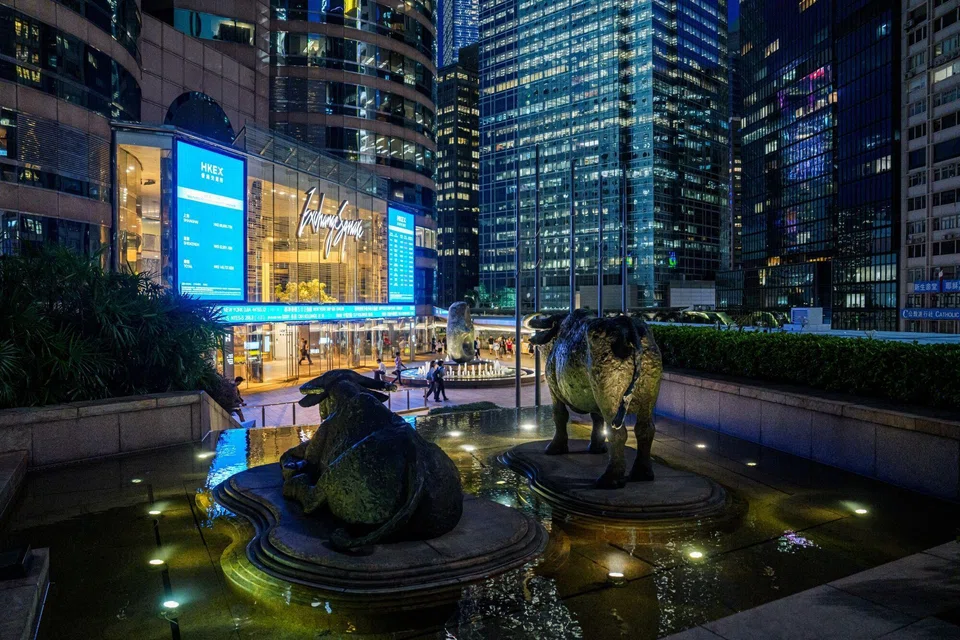
ASIAN stocks slumped on Tuesday (Jun 23) as investors rotated out of some of this year’s best-performing technology shares while awaiting further developments in US-Iran peace talks.
MSCI’s gauge of regional equities declined more than 2 per cent after closing at a record high, and South Korea’s Kospi plunged over 6 per cent on renewed concern that a rally in heavy-weight chip stocks has become overstretched.
A sub-gauge of Asian tech names snapped an eight-day winning run. S&P 500 futures retreated 0.6 per cent while Nasdaq 100 contracts slid 1.1 per cent. Oil prices edged lower.
The moves in Asia came after a slide in megacap tech stocks and rising bond yields dragged the S&P 500 down 0.4 per cent on Monday (Jun 22).
SpaceX shares tumbled 16 per cent in a third straight day of losses, shedding hundreds of billions of dollars in value, after the company said it is selling investment-grade bonds in what is expected to be a massive borrowing spree.
“The weakness in (megacap) tech overnight is putting pressure on market sentiment,” said Fabien Yip, a market analyst at online brokerage IG International.
“While the US-Iran peace deal continues to make progress, there are still fundamental differences on how both countries interpret the terms.”
Attention is shifting to memory chipmaker Micron Technology’s quarterly results on Wednesday, which will be a critical test of whether artificial intelligence spending can sustain its own rally – the shares are up more than 300 per cent this year – as well as the run-up across tech.
Bloomberg strategists weigh in
“Near-term risks for regional chip stocks include an increasingly unstable market structure and Micron’s earnings after the US close on Wednesday. Concerns are mounting about the prudence of unprecedented AI infrastructure investment from US hyper-scalers,” David Savage from Macro Squawk said.


This comes as the AI trade has been a key pillar for global equity markets this year, helping world stocks overcome challenges posed by the Middle East conflict and notch successive record highs.
Expectations that a peace deal will be reached, as well as solid corporate earnings, have fuelled a 14 per cent advance in the S&P 500 Index this quarter through Monday.
However, that trails a 26 per cent surge in the MSCI Asia Pacific Index. Benchmarks in Taiwan, South Korea and Japan’s Nikkei 225 have each soared at least 40 per cent.
“Asian markets are tracking a rotation already underway in the US rather than a fresh risk-off move,” said Billy Leung, an investment strategist at Global X Management in Sydney.
“Hyper-scalers have been leading the pullback on AI capex concerns and negative cash flow concerns,” Leung said.
Brent crude edged lower to trade below US$78 a barrel after falling more than 3 per cent on Monday, when both Washington and Teheran cited progress in the first round of discussions toward a lasting peace agreement.
The US issued a 60-day license allowing Iran to sell oil on the international market, giving it an economic lifeline, but some discrepancies have emerged – Vice-President JD Vance said Iran agreed to allow nuclear inspectors into the country, a claim disputed by Teheran.
In currencies, the Japanese yen lingered near its lowest level since 1986. Currency traders remained on high alert for intervention after a call between Finance Minister Satsuki Katayama and US Treasury Secretary Scott Bessent. The Bloomberg Dollar Spot Index was little changed after rising 0.2 per cent on Monday.
Treasuries were steady after falling on Monday even as oil prices turned lower.
Strategists cited Federal Reserve Chairman Kevin Warsh’s hawkish messaging last week as one of the reasons for the selling pressure. On Jun 17, Warsh kicked off his tenure with an ambitious reform plan to reshape how the US central bank conducts and communicates monetary policy, while leaving interest rates unchanged.
Bond traders are now looking to this week’s personal spending data in the US for an early read on whether the market’s newly hawkish stance is warranted.
Elsewhere in markets, gold declined more than 1 per cent as inflationary concerns overshadowed early optimism around negotiations to resolve the Iran war. Silver lost more than 2 per cent and Bitcoin edged lower.
“Iran talks shifting to lower-level technical discussions is keeping some uncertainty alive, but the real swing factor this week remains core PCE on Thursday,” said Leung of Global X.
Among the main market moves, Japan’s Topix was down 2.6 per cent as at 2.30 pm Singapore time. Australia’s S&P500/ASX 200 was 0.3 per cent down as at 2.25 pm, Hong Kong’s Hang Seng Index dropped 1.8 per cent as at 3.26 pm and the Shanghai Composite Index retreated 1.4 per cent as at 3 pm.
Decoding Asia newsletter: your guide to navigating Asia in a new global order. Sign up here to get Decoding Asia newsletter. Delivered to your inbox. Free.
Share with us your feedback on BT's products and services